CM Sai Frames Sushasan Tihar as Accountability Drive
Synopsis
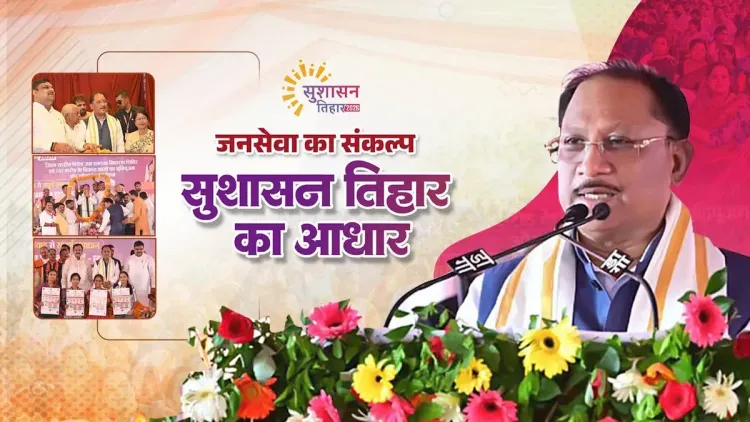
Chhattisgarh Chief Minister Vishnu Deo Sai on 31 May 2026 described Sushasan Tihar 2026 as an accountability campaign where the state government directly engages citizens, reviews scheme delivery on the ground, and presents a public report card of its performance — calling last-mile benefit delivery the true hallmark of good governance.
Key Takeaways
Chief Minister Vishnu Deo Sai posted on 31 May 2026 framing Sushasan Tihar 2026 as a public accountability exercise, not merely a scheme review.
The campaign involves the government reaching citizens directly to assess the ground-level status of state welfare and development schemes.
A formal report card of government works and achievements is being presented to the public as part of the initiative.
Sai stated that public trust is strengthened when scheme benefits reach the last person — describing this as the 'true hallmark of good governance.' The BJP -led Chhattisgarh government has prioritised transparent scheme delivery since assuming office in December 2023 .
District administrations and scheme beneficiaries are the primary stakeholders; subsequent phases may yield mid-course policy corrections.
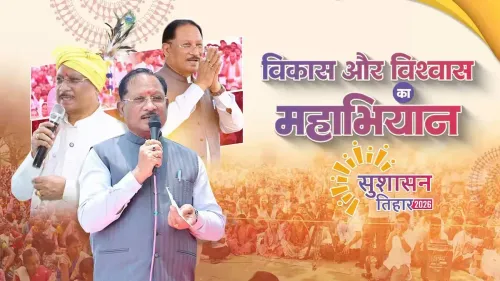
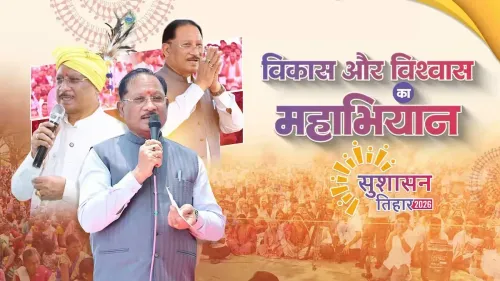
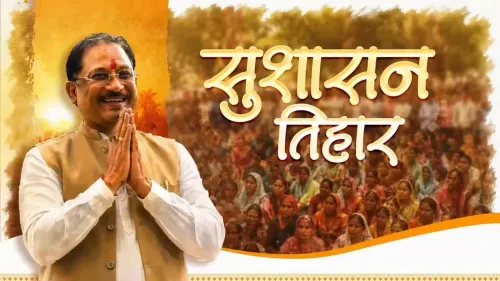
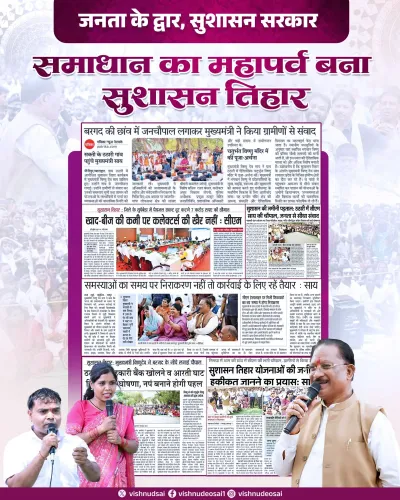
Chhattisgarh Chief Minister Vishnu Deo Sai on Sunday, 31 May 2026, described the ongoing Sushasan Tihar campaign as a direct accountability exercise, stating that the initiative goes beyond scheme reviews to place a formal report card of government performance before the public.
In a post on X, Chief Minister Sai wrote in Hindi: 'सुशासन तिहार योजनाओं की समीक्षा और समस्यायों के समाधान के साथ जनता के प्रति अपनी जवाबदेही निभाने का भी अभियान है' — ('Sushasan Tihar is not only a campaign to review schemes and resolve problems, but also to fulfil our accountability towards the public.')
He added that the government is reaching people directly to understand the ground-level status of state schemes and is presenting a report card of its works and achievements before citizens. His post carried the hashtags #सुशासन_तिहार_2026 and #SushasanTihar2026.
Context
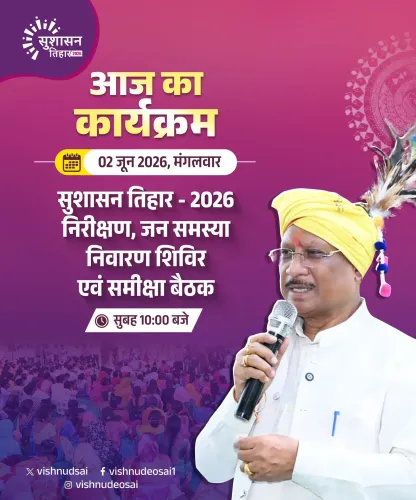
Sushasan Tihar is a periodic public-outreach initiative by the Chhattisgarh state government designed to assess the on-ground delivery of welfare and development schemes. The campaign involves senior officials and elected representatives visiting communities to gather citizen feedback and document scheme implementation gaps.
Chief Minister Sai, who assumed office in December 2023 after the BJP won the state assembly elections, has consistently positioned transparent scheme delivery as a cornerstone of his administration. The 2026 edition of the campaign, tagged Sushasan Tihar 2026, appears to extend this model into a more structured public-reporting exercise.
Policy Backdrop
The Sai government announced a focus on grassroots assessment and transparent delivery of welfare programmes following its formation in late 2023. The Sushasan Tihar framework builds on a broader governance model promoted by BJP-led state governments that emphasises direct benefit transfers, grievance resolution, and administrative feedback loops.
This approach mirrors national-level initiatives for direct beneficiary outreach expanded since 2014, adapted at the state level to include public-facing performance reporting. Chhattisgarh's exercise is among several similar campaigns running across BJP-governed states that seek to strengthen public trust through visible accountability mechanisms.
Chief Minister Sai underscored the philosophical basis of the campaign in his post: 'शासकीय योजनाओं का लाभ जब अंतिम व्यक्ति तक पहुँचता है, तब जनविश्वास और अधिक सशक्त होता है। यही सुशासन की वास्तविक पहचान है।' — ('When the benefits of government schemes reach the last person, public trust becomes stronger. That is the true hallmark of good governance.')
Stakeholders and Impact
The primary beneficiaries of the campaign are Chhattisgarh's scheme recipients, particularly those in rural and tribal areas who may face the steepest barriers to accessing state welfare programmes. District administrations are tasked with facilitating the outreach and documenting the findings.
For the state government, the exercise serves a dual function: identifying implementation gaps that can be corrected mid-cycle, and publicly demonstrating responsiveness ahead of future electoral cycles. Civil society observers note that the credibility of such campaigns rests on whether reported grievances translate into measurable corrections.
What's Next
Subsequent phases of the Sushasan Tihar 2026 campaign are expected to generate district-level feedback that the state government may use to announce mid-course corrections to flagship schemes. The degree to which public inputs lead to verifiable policy adjustments will determine the campaign's lasting impact on governance outcomes in Chhattisgarh.
Analysts will watch whether the report-card format introduced this year becomes a recurring feature of state governance, potentially setting a template for accountability mechanisms in other BJP-ruled states.
Point of View
The BJP administration in Chhattisgarh is attempting to institutionalise visible accountability as a governance brand, building on a pattern seen across BJP-ruled states since 2014. The emphasis on reaching the 'last person' echoes the Antyodaya philosophy central to BJP's welfare messaging, reinforcing ideological continuity between the state and national governments. Whether the campaign produces measurable corrections to scheme delivery, or remains primarily a communication exercise, will define its long-term credibility with voters.
NationPress
16 Oct 2026
Frequently Asked Questions
What is Sushasan Tihar in Chhattisgarh?
Sushasan Tihar is a periodic public-outreach and scheme-review campaign run by the Chhattisgarh state government, in which officials and representatives visit communities to assess on-ground delivery of welfare schemes, resolve grievances, and report government performance to citizens.
What did CM Vishnu Deo Sai say about Sushasan Tihar 2026?
Chief Minister Vishnu Deo Sai said Sushasan Tihar 2026 is a campaign to review schemes, resolve problems, and fulfil the government's accountability towards the public, including presenting a report card of government works and achievements directly to citizens.
When did Vishnu Deo Sai become Chief Minister of Chhattisgarh?
Vishnu Deo Sai became Chief Minister of Chhattisgarh in December 2023 after the BJP won the state assembly elections.
What is the goal of Sushasan Tihar 2026?
The stated goal is to understand the ground-level status of government schemes by reaching citizens directly, identify implementation gaps, resolve public grievances, and strengthen public trust by ensuring scheme benefits reach the last person.
How does Sushasan Tihar relate to BJP's broader governance model?
Sushasan Tihar reflects a wider BJP state-governance model that emphasises direct beneficiary outreach, administrative feedback loops, and public accountability — an approach aligned with national-level direct benefit transfer and grievance mechanisms expanded since 2014.