CM Sai: PM SVANidhi aids 1.12 lakh Chhattisgarh vendors
Synopsis
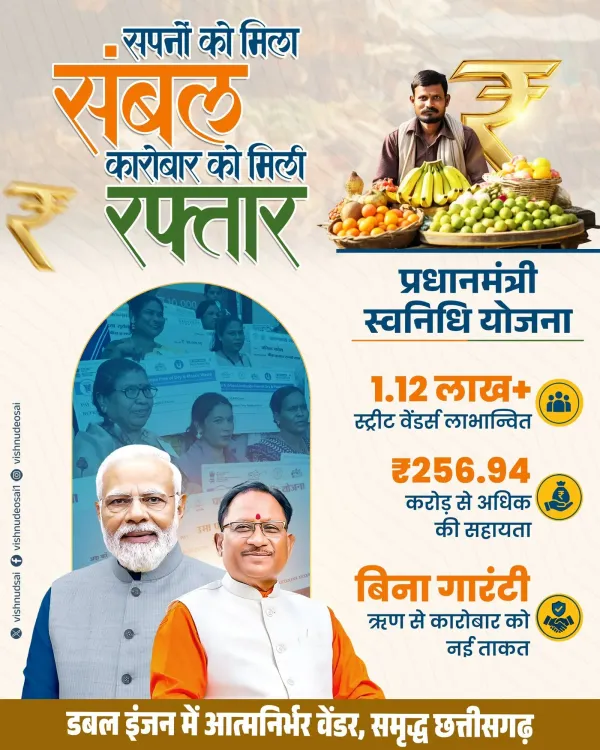
Chhattisgarh Chief Minister Vishnu Deo Sai announced on June 16, 2026, that the PM SVANidhi scheme has extended collateral-free loans worth over ₹256.94 crore to more than 1.12 lakh street vendors in the state, crediting double-engine governance for the outreach.
Key Takeaways
Chhattisgarh CM Vishnu Deo Sai highlighted PM SVANidhi's reach in the state on June 16, 2026 .
More than 1.12 lakh street vendors in Chhattisgarh have received assistance under the scheme.
Total disbursement under PM SVANidhi in Chhattisgarh exceeds ₹256.94 crore .
Loans are collateral-free, targeting vendors excluded from formal credit channels.
The PM SVANidhi scheme was launched in June 2020 as part of the Atmanirbhar Bharat package.
CM Sai attributed the progress to 'double-engine' alignment between the state and central governments.
Chhattisgarh Chief Minister Vishnu Deo Sai on Tuesday, June 16, 2026, highlighted the reach of the Pradhan Mantri SVANidhi scheme in the state, stating that more than 1.12 lakh street vendors have received financial assistance exceeding ₹256.94 crore through the central programme.
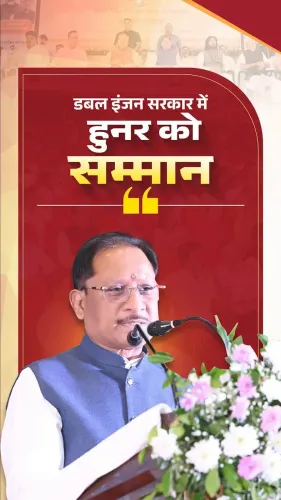
In his post, the Chief Minister wrote: 'छोटे कारोबारियों के बड़े सपनों को मिला नया संबल' ['The big dreams of small traders have found new support'], crediting the scheme's collateral-free loan facility for enabling vendor families to become self-reliant and expand their businesses. He attributed the progress to the 'double-engine government' — a phrase the BJP uses to describe aligned governance at the state and central levels.
Context
The Pradhan Mantri Street Vendor's AtmaNirbhar Nidhi (PM SVANidhi) was launched by the Government of India in June 2020 as part of the Atmanirbhar Bharat package to extend working capital credit to street vendors whose livelihoods were disrupted by COVID-19 restrictions. The scheme offers collateral-free loans, initially of ₹10,000, with higher tranches available upon timely repayment, bringing vendors into the formal credit ecosystem for the first time.
Prime Minister Narendra Modi designed the scheme to address the urban informal sector, which had largely been excluded from institutional lending. Street vendors — selling vegetables, snacks, clothing, and daily goods — represent one of the most economically vulnerable segments of India's urban workforce.
Policy Backdrop
The BJP won the Chhattisgarh assembly elections in late 2023, and Vishnu Deo Sai was sworn in as Chief Minister in December 2023. Since taking office, his government has consistently highlighted the rollout of centrally sponsored welfare schemes in the state, framing them as evidence of effective 'double-engine' coordination between Raipur and New Delhi.
Similar progress reports on PM SVANidhi disbursements have been issued by other BJP-governed states, making such announcements part of a broader pattern of showcasing the scheme's ground-level impact ahead of periodic policy reviews by the Ministry of Housing and Urban Affairs.
Stakeholders and Impact
The primary beneficiaries are street vendors and small traders across Chhattisgarh's urban and semi-urban areas. Access to collateral-free credit allows them to replenish stock, upgrade equipment, and avoid high-interest borrowing from informal moneylenders — a structural vulnerability that has historically trapped vendor families in debt cycles.
Families dependent on street vending as their sole income source stand to gain the most, as formal credit access also builds a credit history that can unlock larger loans in future cycles. The scheme's digital repayment incentives further encourage adoption of cashless transactions among this segment.
What's Next
Attention will now turn to updated state-wise disbursement data expected from the Ministry of Housing and Urban Affairs, which periodically reviews scheme performance. Any revision to loan limits or eligibility criteria in the next central budget could further expand the programme's reach in states like Chhattisgarh. The state government's ability to sustain outreach to the remaining unbanked vendor population will be a key metric of the scheme's long-term success.
Point of View
Now six years old, has become a recurring proof-point for BJP state governments seeking to demonstrate inclusive growth credentials to urban informal workers. By foregrounding collateral-free credit and self-reliance, the messaging also dovetails with the broader Atmanirbhar Bharat ideological frame. As the next central budget approaches, such state-level performance claims are likely to intensify, serving both as political signalling and as inputs for potential scheme expansion.
NationPress
15 Sept 2026
Frequently Asked Questions
What is the PM SVANidhi scheme?
PM SVANidhi, or Pradhan Mantri Street Vendor's AtmaNirbhar Nidhi, is a central government scheme launched in June 2020 that provides collateral-free working capital loans to street vendors, initially up to ₹10,000, with higher loan tranches available on timely repayment.
How many street vendors in Chhattisgarh have benefited from PM SVANidhi?
According to Chief Minister Vishnu Deo Sai's post on June 16, 2026, more than 1.12 lakh street vendors in Chhattisgarh have received assistance under the PM SVANidhi scheme.
How much money has been disbursed under PM SVANidhi in Chhattisgarh?
CM Sai stated that financial assistance exceeding ₹256.94 crore has been provided to street vendors in Chhattisgarh through the PM SVANidhi scheme.
Who launched the PM SVANidhi scheme and why?
Prime Minister Narendra Modi launched PM SVANidhi in June 2020 as part of the Atmanirbhar Bharat package to support street vendors whose livelihoods were severely impacted by COVID-19 restrictions and who lacked access to formal credit.
What does 'double-engine government' mean in the context of Chhattisgarh?
'Double-engine government' is a phrase used by the BJP to describe states where both the state government and the central government are led by the BJP, arguing that this alignment leads to faster and more effective implementation of central welfare schemes.