CM Sai to Review Panchayat Development Schemes at SIRD Nava Raipur
Synopsis
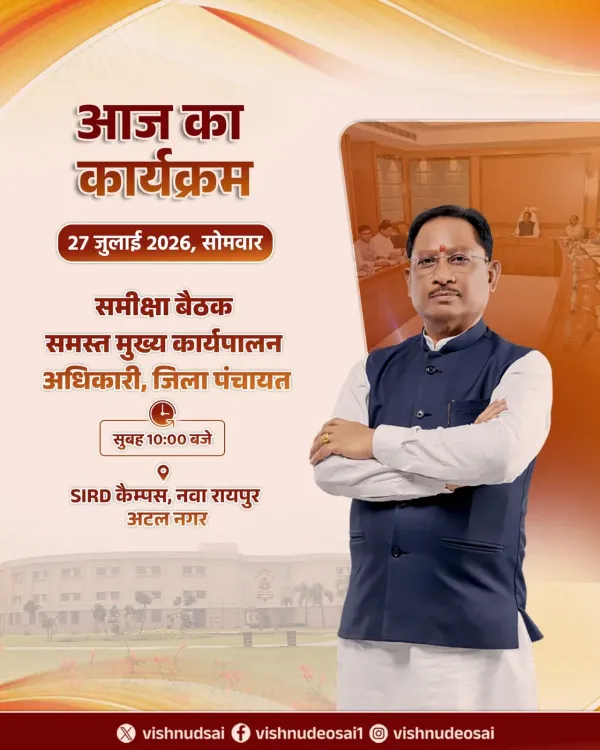
Chhattisgarh Chief Minister Vishnu Deo Sai announced a review meeting with district panchayat CEOs at SIRD, Nava Raipur, on 27 July 2026, to assess progress of panchayat functions and rural development schemes across the state.
Key Takeaways
CM Vishnu Deo Sai called a review meeting with Chief Executive Officers of district panchayats on 27 July 2026 .
The meeting is scheduled at the SIRD campus in Nava Raipur , Chhattisgarh's planned administrative capital.
The agenda covers the progress of panchayat functions and development schemes across the state's districts.
District panchayat CEOs are senior civil servants responsible for implementing central and state rural development programmes .
The review reflects the constitutional mandate of the 73rd Amendment of 1992 , which established India's three-tier Panchayati Raj system.
Outcomes are expected to include fresh directives on fund utilisation and scheme completion timelines.
Chhattisgarh Chief Minister Vishnu Deo Sai announced on Monday, 27 July 2026, that he would chair a review meeting with Chief Executive Officers of district panchayats at the State Institute of Rural Development (SIRD) campus in Nava Raipur, focusing on the progress of panchayat functions and development schemes.
In a post on X, CM Sai stated — 'aaj Nava Raipur sthit SIRD parisar mein jila panchayaton ke mukhya karyapalana adhikariyon ke saath baithak kar panchayaton ke karyon evam vikas yojanaon ki pragati ki samiksha karunga' — meaning: 'Today, at the SIRD campus in Nava Raipur, I will hold a meeting with the Chief Executive Officers of district panchayats to review the progress of panchayat functions and development schemes.'
Context
Nava Raipur, the planned administrative capital of Chhattisgarh, houses several key state government institutions, including the SIRD. The State Institute of Rural Development functions as the nodal training and capacity-building body for rural local governance functionaries across the state. Holding such a high-level review at the SIRD campus underscores the government's intent to use the institution as a hub for administrative coordination beyond its training mandate.
Policy Backdrop
District panchayats in India operate under the framework established by the 73rd Constitutional Amendment of 1992, which institutionalised a three-tier Panchayati Raj system to decentralise rural governance and development planning. When Chhattisgarh was carved out as a separate state in 2000, it adopted this framework with state-specific rules governing district and village bodies. The Chief Executive Officers of district panchayats are senior IAS or state civil service officers responsible for translating central and state scheme allocations into on-ground delivery.
State governments across India routinely convene such review meetings with district-level panchayat officials to monitor fund utilisation, identify implementation bottlenecks, and strengthen accountability at the grassroots level. CM Sai, who assumed office in December 2023 following the BJP's victory in the Chhattisgarh assembly elections, has positioned rural development oversight as a governance priority.
Stakeholders and Impact
The primary participants in the review are Chief Executive Officers of district panchayats drawn from across Chhattisgarh's districts. These officials oversee the execution of multiple centrally sponsored and state-funded rural development schemes — ranging from rural infrastructure and sanitation to livelihood programmes — and their performance directly affects rural communities at the village level. A direct review by the Chief Minister signals heightened accountability expectations for scheme delivery timelines and expenditure targets.
For district panchayat administrations, such a top-level meeting typically results in fresh directives on pending works, reallocation of resources where utilisation is lagging, and identification of districts requiring additional administrative support.
What's Next
The outcome of this review meeting is likely to yield state-level directives on panchayat scheme implementation, with follow-up performance reports expected in the coming months. Observers of Chhattisgarh's rural governance landscape will watch for any fresh targets set for district panchayats, particularly on fund utilisation rates and scheme completion milestones, as the state moves through the second half of the financial year.
Point of View
This move reinforces an emphasis on visible administrative action on rural development. It also places pressure on the district panchayat machinery to demonstrate measurable progress before the next budget cycle.
NationPress
27 Jul 2026
Frequently Asked Questions
What is the SIRD in Chhattisgarh?
The State Institute of Rural Development (SIRD) in Nava Raipur is a Chhattisgarh government body responsible for training and capacity building of rural local governance functionaries, including panchayat officials across the state.
Why did CM Vishnu Deo Sai call a meeting with district panchayat CEOs?
CM Sai called the meeting on 27 July 2026 to review the progress of panchayat functions and development schemes, a routine but important exercise to monitor fund utilisation and scheme delivery at the district level.
What is the role of a district panchayat CEO in Chhattisgarh?
The Chief Executive Officer of a district panchayat is a senior civil service officer who oversees the implementation of central and state rural development schemes and manages the administrative functions of the elected district panchayat body.
What is the 73rd Constitutional Amendment and why does it matter for panchayats?
The 73rd Constitutional Amendment of 1992 established India's three-tier Panchayati Raj system, giving constitutional status to gram panchayats, block panchayats, and district panchayats, and mandating devolution of powers and funds for rural governance.
Where is Nava Raipur located?
Nava Raipur is the planned new administrative capital of Chhattisgarh, located adjacent to the existing city of Raipur, and houses key state government offices and institutions including the SIRD campus.