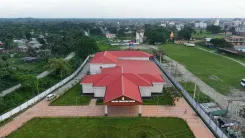
CM Sai: Tribal Youth Hostel seats in Delhi raised to 200
Synopsis
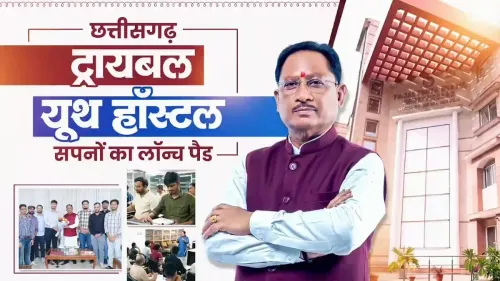
Chhattisgarh CM Vishnu Deo Sai announced in the state assembly that the Delhi Tribal Youth Hostel's capacity was quadrupled from 50 to 200 seats in two and a half years, with 13 hostel residents clearing the UPSC preliminary exam this year.
Key Takeaways
CM Vishnu Deo Sai made the announcement while addressing the opposition's no-confidence motion in the Chhattisgarh Legislative Assembly on 18 July 2026 .
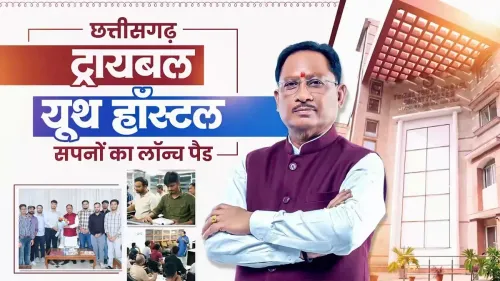
The Delhi Tribal Youth Hostel was expanded from 50 seats to 200 seats — a four-fold increase — within two and a half years of the BJP government taking office.
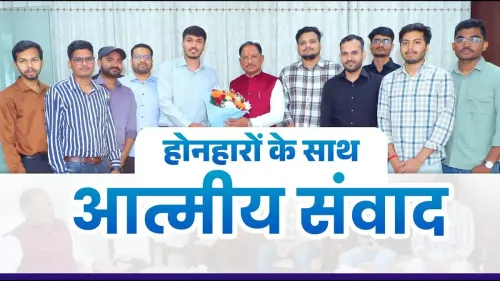
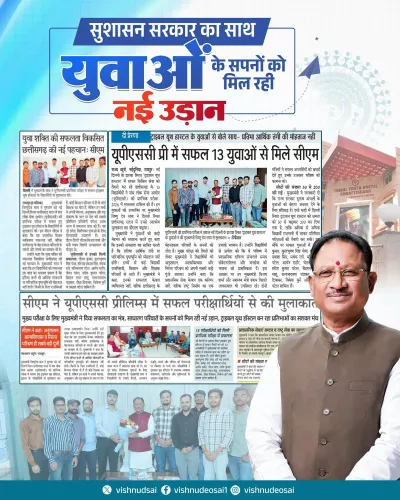
13 tribal youth residing at the hostel cleared the UPSC preliminary examination in the current cycle.
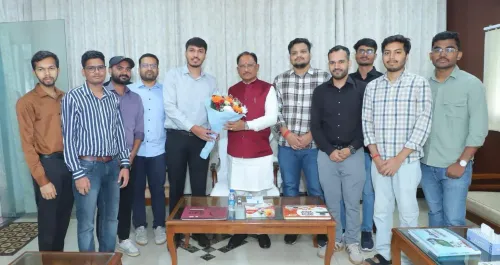
The hostel supports Scheduled Tribe students from Chhattisgarh preparing for national civil services examinations in New Delhi .
The announcement is part of the BJP government's broader emphasis on tribal welfare and educational infrastructure since December 2023 .
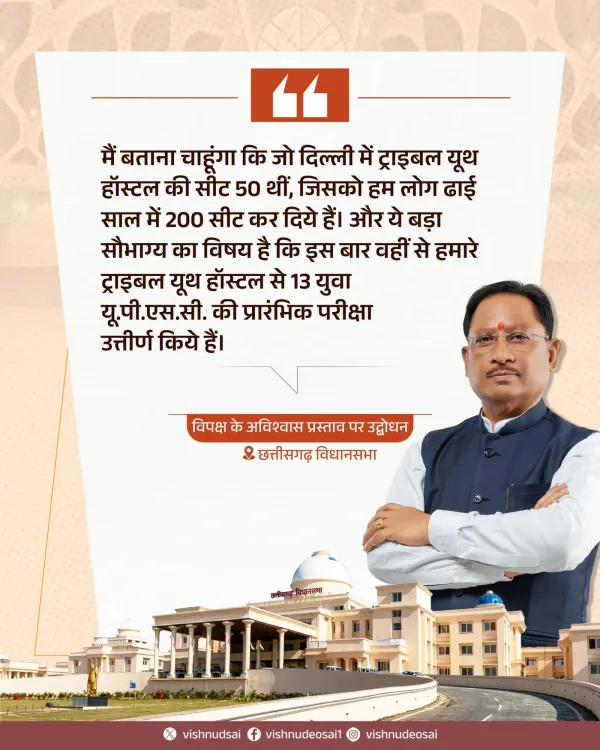
Chhattisgarh Chief Minister Vishnu Deo Sai on Saturday, 18 July 2026, told the Chhattisgarh Legislative Assembly that his government had expanded the Tribal Youth Hostel in Delhi from 50 seats to 200 seats in two and a half years, and that 13 tribal youth from the hostel had cleared the UPSC preliminary examination this year. The Chief Minister made these remarks while addressing the opposition's no-confidence motion on the floor of the House.
Context
Speaking during the debate on the no-confidence motion, CM Sai highlighted the hostel expansion as a concrete achievement of his administration. In his words, 'जो दिल्ली में ट्राइबल यूथ हॉस्टल की सीट 50 थीं, जिसको हम लोग ढाई साल में 200 सीट कर दिये हैं' — 'the Tribal Youth Hostel in Delhi, which had 50 seats, we have raised to 200 seats in two and a half years.' He further described it as a matter of great fortune that 13 young people from that very hostel had cleared the UPSC preliminary examination this year.
Policy Backdrop
The Tribal Youth Hostel in Delhi is a state-supported residential facility providing accommodation to Scheduled Tribe students from Chhattisgarh who travel to the capital to prepare for national-level competitive examinations, particularly the civil services. CM Sai, who took charge in December 2023 following the BJP's victory in the Chhattisgarh assembly elections, has placed tribal welfare and educational uplift at the centre of his government's agenda. Expanding hostel capacity in Delhi directly addresses the financial and logistical barriers that ST aspirants face when attempting the Union Public Service Commission (UPSC) examination cycle.
Chhattisgarh, where Scheduled Tribes account for a significant share of the population, has seen successive state governments invest in hostel and coaching infrastructure to improve ST representation in central services. The current administration's claimed four-fold expansion of the Delhi hostel — from 50 to 200 seats — is framed as an acceleration of this longer-standing effort.
Stakeholders and Impact
The primary beneficiaries are tribal civil services aspirants from Chhattisgarh who lack the means to independently sustain themselves in New Delhi during the lengthy UPSC preparation cycle. A larger hostel capacity means more students can access subsidised accommodation simultaneously, reducing attrition caused by financial pressure. The reported success of 13 students clearing the UPSC preliminary stage from this hostel is being presented by the government as early evidence that the expanded facility is yielding results.
For the BJP government, the data point also serves a political purpose: it offers a measurable welfare outcome to counter the opposition's no-confidence motion and demonstrate administrative delivery within two and a half years of taking office.
What's Next
Attention will now turn to how many of the 13 UPSC preliminary qualifiers proceed to clear the mains examination and, ultimately, the final selection — the stages that translate into actual civil service appointments. Any further state budget allocations for the Delhi Tribal Youth Hostel or similar facilities in other cities will also be watched as indicators of whether the government intends to sustain and deepen this programme beyond the current political moment.
Point of View
CM Sai is deploying welfare delivery as a political shield — a well-worn but effective tactic in Indian legislative politics. The move fits a broader BJP pattern of using measurable tribal welfare outcomes in Chhattisgarh, a state where ST voters are decisive, to counter opposition narratives about governance failure. If the UPSC pipeline from the hostel continues to yield final selections, it could become a durable political asset for the government heading into future electoral cycles. The opposition will likely scrutinise the precise numbers and the quality of support provided, making the mains and final results for these 13 candidates a closely watched metric.
NationPress
18 Jul 2026
Frequently Asked Questions
What is the Tribal Youth Hostel in Delhi for Chhattisgarh students?
The Tribal Youth Hostel in Delhi is a state-government-supported residential facility that provides affordable accommodation to Scheduled Tribe students from Chhattisgarh who travel to New Delhi to prepare for competitive examinations such as the UPSC civil services.
How many seats does the Delhi Tribal Youth Hostel have now?
According to CM Vishnu Deo Sai's statement in the Chhattisgarh Assembly on 18 July 2026, the hostel's capacity has been raised to 200 seats, up from 50 seats when the current government took office.
How many tribal students from Chhattisgarh cleared UPSC prelims 2026?
CM Sai stated that 13 tribal youth from the Delhi Tribal Youth Hostel cleared the UPSC preliminary examination this year, though final UPSC results for mains and the interview stage are yet to be declared.
What did CM Vishnu Deo Sai say in the no-confidence motion debate?
CM Sai used the no-confidence motion debate in the Chhattisgarh Legislative Assembly to highlight welfare achievements, including the expansion of the Delhi Tribal Youth Hostel from 50 to 200 seats and the UPSC preliminary success of 13 tribal students from the hostel.
What is the BJP government's tribal welfare policy in Chhattisgarh?
Since taking office in December 2023, the BJP government under CM Vishnu Deo Sai has focused on expanding educational infrastructure for Scheduled Tribe youth, including increasing hostel capacity in Delhi to improve access to UPSC and other central government examinations.