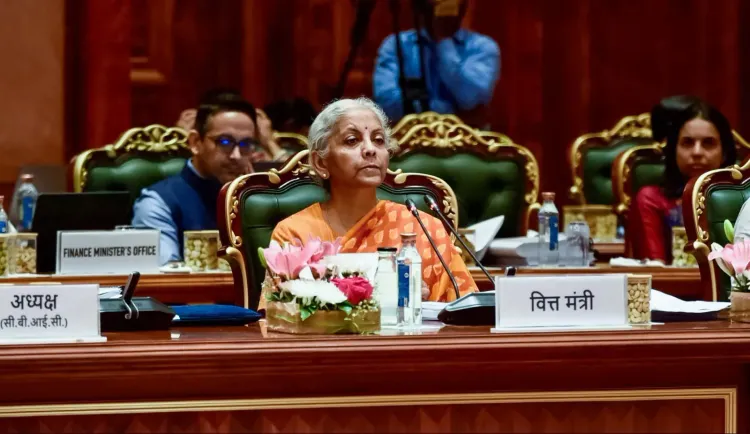
CM Saini at 57th GST Council Meet in New Delhi
Synopsis
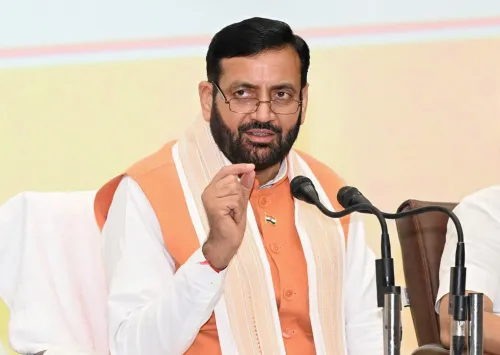
Haryana Chief Minister Nayab Singh Saini participated in the 57th GST Council meeting at Bharat Mandapam, New Delhi, chaired by Finance Minister Nirmala Sitharaman, advocating for GST simplification and Ease of Doing Business improvements for Haryana's trade and industry.
Key Takeaways
Haryana CM Nayab Singh Saini attended the 57th GST Council meeting on 8 October 2026 at Bharat Mandapam, New Delhi .
The meeting was chaired by Union Finance Minister Nirmala Sitharaman .
Key agenda items included simplifying the GST framework and strengthening Ease of Doing Business .
CM Saini presented Haryana-specific recommendations focused on easing trade and industrial operations in the state.
The GST Council is a constitutional body under Article 279A that governs tax policy across all Indian states.
At Bharat Mandapam, New Delhi, on Thursday, 8 October 2026, Haryana Chief Minister Nayab Singh Saini joined the 57th GST Council meeting chaired by Union Finance Minister Nirmala Sitharaman — and walked in with a clear agenda: push for reforms that ease the burden on Haryana's trade and industry.
What went on inside the Council chamber
The meeting, held at the iconic Bharat Mandapam convention centre, brought together finance ministers from across India under the Finance Minister's chairmanship — the standard composition of the GST Council, which is a constitutional body under Article 279A. CM Saini confirmed that deliberations covered GST vyavastha ko aur saral evam prabhavi banana (making the GST framework simpler and more effective) and strengthening Ease of Doing Business across the country.
Saini also shared Haryana-specific recommendations on the floor — pitching for measures that would make commerce and industry more accessible within the state. The post does not detail the exact proposals, but the thrust was clearly on reducing compliance friction for businesses operating in Haryana.
Why the 57th Council meeting matters for businesses
The GST Council is the apex decision-making body on goods and services tax policy in India, and its meetings routinely yield rate revisions, compliance simplifications, and sector-specific relief. The emphasis on Ease of Doing Business in this session signals that state governments are pushing the Centre to continue the rationalization agenda that has been a recurring theme since GST's July 2017 rollout.
For Haryana — a state with a large manufacturing base, a booming logistics corridor along the Delhi-Mumbai Industrial Corridor, and a dense cluster of small and medium enterprises in districts like Gurugram, Faridabad, and Sonipat — any reduction in GST compliance complexity translates directly into business confidence and investment flows.
Saini's seat at the table
By attending in person and formally registering Haryana's positions, CM Saini is exercising the state's co-ownership of the GST architecture. The Council operates on a weighted-vote basis but almost always seeks consensus — meaning a state's voice in deliberations can shape the final communiqué even without a formal vote. Saini's participation signals that Haryana intends to be an active stakeholder in the next phase of GST reform, not merely a recipient of decisions made elsewhere.
The outcomes of the 57th Council — including any rate changes, exemption revisions, or compliance relaxations — are expected to be announced formally after the meeting concludes. The details, once notified, will determine how much of Haryana's stated agenda was actually carried forward.
Point of View
Now in its ninth year, where state-level pressure has historically accelerated compliance reforms. Haryana's industrial geography — anchored by Gurugram's services economy and Faridabad's manufacturing belt — gives its demands particular weight in Council deliberations. Whether Saini's recommendations are adopted will be a key test of how much influence state governments retain in a Council that is increasingly Centre-led.
NationPress
8 Oct 2026
Frequently Asked Questions
What is the 57th GST Council meeting?
The 57th GST Council meeting was held on 8 October 2026 at Bharat Mandapam, New Delhi , chaired by Finance Minister Nirmala Sitharaman , to discuss GST simplification, rate revisions, and Ease of Doing Business improvements.
Why did Haryana CM Nayab Singh Saini attend the GST Council meeting?
CM Saini attended to represent Haryana's interests, specifically advocating for measures to simplify GST compliance and ease trade and industrial operations within the state.
What is the GST Council and who chairs it?
The GST Council is a constitutional body under Article 279A of the Indian Constitution. It is chaired by the Union Finance Minister and includes finance ministers of all states and Union Territories.
What were the key topics discussed at the 57th GST Council?
The meeting focused on making the GST framework simpler and more effective, and on strengthening Ease of Doing Business — along with other significant policy subjects.
How does the GST Council affect businesses in Haryana?
Decisions made at the GST Council — including rate changes, exemptions, and compliance reforms — directly impact Haryana's large manufacturing, logistics, and SME sectors in cities like Gurugram, Faridabad, and Sonipat.