CM Saini Backs NSAP Extension, Wider Disability Pension Access
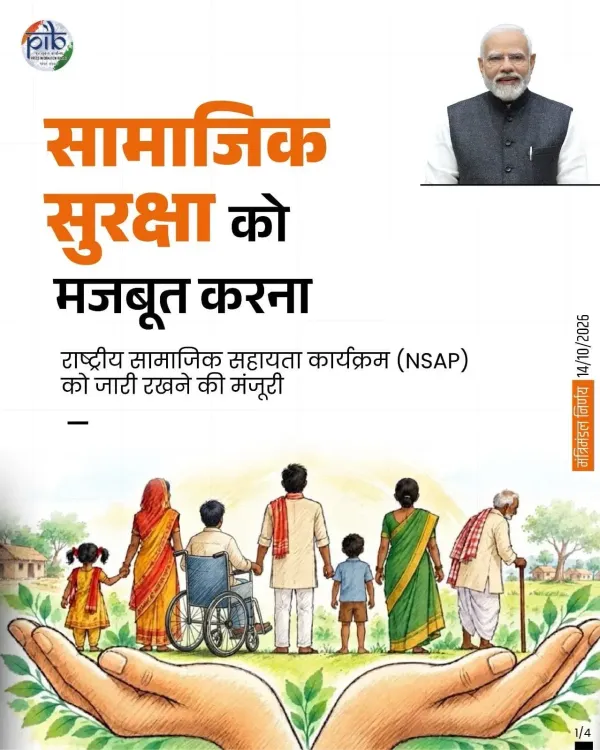
Synopsis
Haryana CM Nayab Singh Saini praised the central government's decision to extend NSAP for five years with a ₹53,428 crore allocation and slash the disability pension eligibility threshold from 80% to 40%, widening coverage for millions of persons with disabilities across India.
Key Takeaways
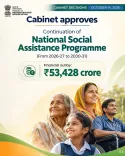
The central government has allocated ₹53,428 crore to continue the National Social Assistance Programme for the next five years .
The disability eligibility threshold for NSAP pensions has been reduced from 80% to 40% , significantly expanding the beneficiary base.
Persons with disabilities eligible from birth will now be enrolled in the pension scheme from the outset.
Haryana CM Nayab Singh Saini publicly endorsed the cabinet decisions, framing them as evidence of the Modi government's Antyodaya-driven governance model.
NSAP was originally launched in 1995 and remains one of India's primary direct cash-transfer mechanisms for the elderly, widows, and persons with disabilities.
A welfare decision targeting India's most vulnerable citizens drew strong support from Haryana Chief Minister Nayab Singh Saini on Wednesday, October 14, 2026, as he praised the central government's move to extend the National Social Assistance Programme (NSAP) for five more years and dramatically widen the disability pension net.
Posting in Hindi on X, CM Saini welcomed what he described as decisions that reflect the government's resolve to bring dignity and empowerment to the person standing in the last row of society — 'samaj ki antim pankti mein khade vyakti'. At the heart of his post: an allocation of ₹53,428 crore to keep NSAP running for the next five years, and a landmark shift in eligibility — the disability threshold cut from 80% to 40%, bringing persons with moderate disabilities into the pension fold for the first time.
What the disability threshold change actually means
Until now, only persons certified with 80% or more disability qualified for NSAP's disability pension component. That bar was, by any measure, high — excluding millions with significant but sub-80% impairments. Lowering it to 40% is not a minor administrative tweak. It opens the door to an entirely new category of beneficiaries, including many whose conditions make sustained employment difficult but who previously fell outside formal social protection.
Saini also highlighted that persons with disabilities eligible from birth will now be brought within the pension scheme's ambit from the outset — a change that addresses a long-standing gap where delayed registration meant years of lost entitlement for the most acutely affected families.
NSAP's long road since 1995
The National Social Assistance Programme was launched in 1995 as a centrally sponsored safety net delivering monthly pensions to elderly citizens, widows, and persons with disabilities — administered through state governments. Over three decades it has remained one of India's most direct cash-transfer mechanisms for the poorest households, though coverage gaps and modest pension amounts have drawn periodic scrutiny.
The fresh five-year commitment and the revised eligibility criteria mark the latest in a series of periodic expansions the central government has undertaken under what it frames as the Antyodaya philosophy — a term drawn from Gandhian political thought, meaning the uplift of the very last person. Prime Minister Narendra Modi's government has consistently invoked Antyodaya as the governing principle behind last-mile welfare delivery, from Jan Dhan bank accounts to Ayushman Bharat health cover.
Saini's endorsement and its political weight
For CM Saini, the endorsement is both ideological and electoral signalling. Haryana has a significant population of persons with disabilities and elderly pensioners dependent on central welfare flows. His post frames the cabinet decisions not merely as policy but as proof — 'praman' — of inclusive and empathetic governance, explicitly linking them to Prime Minister Modi's leadership.
The immediate watch-point is implementation: state-level beneficiary registration drives will determine how quickly the expanded eligibility translates into actual pension disbursements. The gap between a policy announcement and a pension reaching a first-generation beneficiary in a remote district has historically been where such schemes lose momentum.
If the registration machinery moves fast, millions of families could see their first NSAP pension cheque within months. That is the promise on the table — and the standard by which this decision will ultimately be judged.
Point of View
Moving the eligibility bar from severe to moderate disability for the first time in the programme's three-decade history. For the BJP, the political calculus is clear: welfare expansion ahead of state election cycles consolidates support among marginalised communities who vote in high numbers. CM Saini's vocal endorsement also signals Haryana's readiness to align state machinery with accelerated beneficiary registration, which will be the real test of whether this policy shift delivers on its promise. The Antyodaya framing, while well-worn, retains potency precisely because it sets a measurable benchmark — reach the last person — against which the government's own supporters will eventually hold it accountable.
NationPress
14 Oct 2026
Frequently Asked Questions
What is the National Social Assistance Programme (NSAP)?
NSAP is a centrally sponsored welfare scheme launched in 1995 that provides monthly pensions to elderly citizens, widows, and persons with disabilities, administered through state governments across India.
What is the new disability eligibility threshold for NSAP pensions?
The disability eligibility threshold has been reduced from 80% to 40%, meaning persons with moderate disabilities can now qualify for NSAP pensions — a significant expansion of coverage.
How much has the government allocated for NSAP in the latest cabinet decision?
The central government has announced a provision of ₹53,428 crore to continue the National Social Assistance Programme for the next five years.
What did Haryana CM Nayab Singh Saini say about the NSAP cabinet decision?
CM Saini praised the decisions as proof of inclusive and sensitive governance, saying they reflect PM Modi's commitment to empowering the last person in society and will bring economic security to millions of families.
Who benefits from persons with disabilities being enrolled from birth under NSAP?
Families of children and individuals born with qualifying disabilities benefit directly, as they can now access pension support from the point of eligibility rather than facing delays due to late registration under earlier rules.