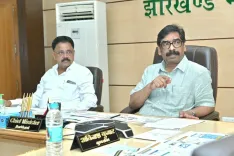
CM Saini Congratulates Indian Students on IPhO 2026 Gold
Synopsis
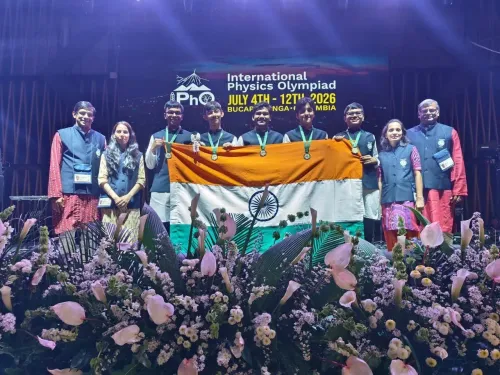
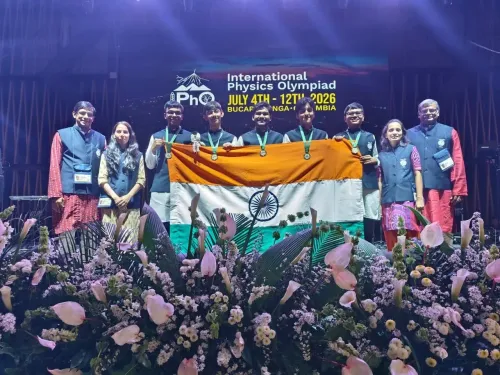
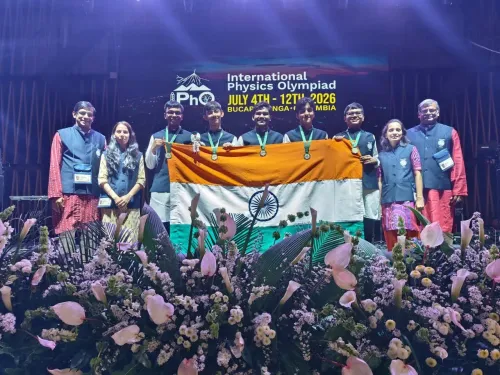
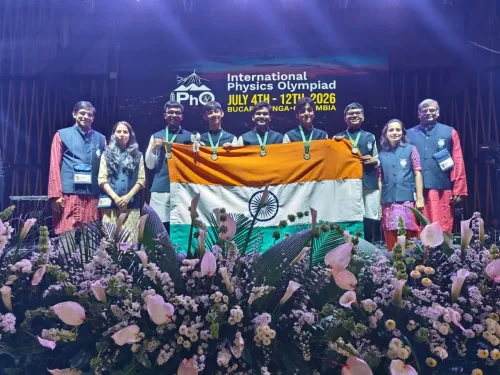
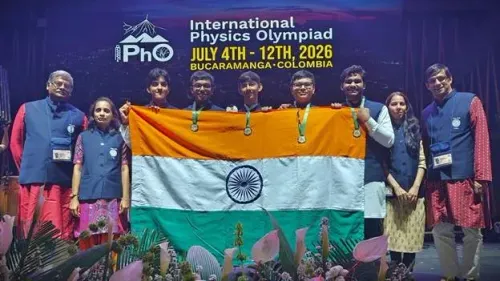
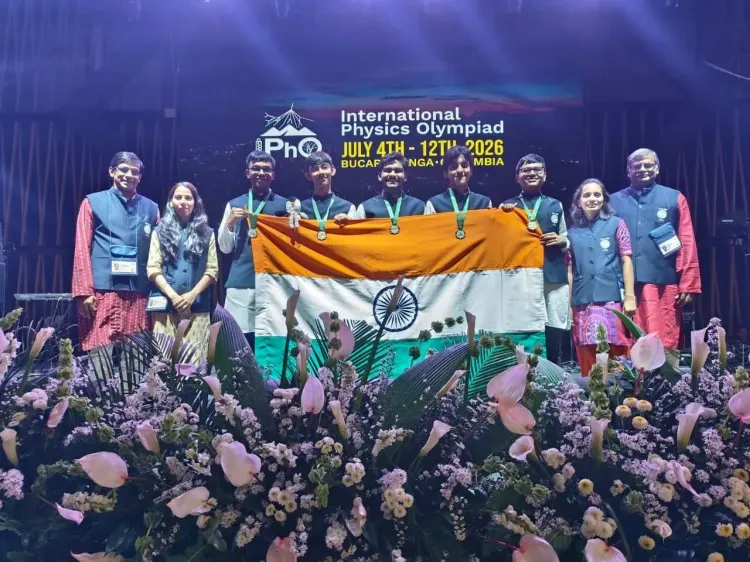
Haryana Chief Minister Nayab Singh Saini congratulated Rishit Garg, Kanishk Jain, Riddhesh Anant Bendale, Shreshth Suraiya, and Swarit Joshi on winning gold medals at the 56th International Physics Olympiad 2026 in Colombia, calling the feat proof of India's youth scientific potential.
Key Takeaways
All five members of Team India won gold medals at the 56th International Physics Olympiad (IPhO) 2026 held in Colombia .
The gold medallists named are Rishit Garg , Kanishk Jain , Riddhesh Anant Bendale , Shreshth Suraiya , and Swarit Joshi .
Haryana CM Nayab Singh Saini extended congratulations via X on 13 July 2026 .
India's IPhO team is selected and trained by the Homi Bhabha Centre for Science Education (HBCSE) , a TIFR institute.
The National Education Policy 2020 emphasises scientific temper and innovation, goals aligned with olympiad participation.
CM Saini said the achievement would inspire crores of young Indians toward science, innovation, and research.
Haryana Chief Minister Nayab Singh Saini on Monday, 13 July 2026, extended congratulations to five Indian students who won gold medals at the 56th International Physics Olympiad (IPhO) 2026, held in Colombia, calling their achievement a powerful testament to the scientific talent and hard work of India's youth.
Context
In his post on X, CM Saini named the five gold medallists: Rishit Garg, Kanishk Jain, Riddhesh Anant Bendale, Shreshth Suraiya, and Swarit Joshi. Writing in Hindi, he described the feat as 'bharat ki yuva shakti ki pratibha, parishram aur vaigyanik soch ka sashakt praman' — 'a strong proof of the talent, hard work, and scientific thinking of India's youth.' He added that the achievement would inspire crores of young Indians to pursue science, innovation, and research.
The International Physics Olympiad is an annual global competition for high-school students, first held in 1967, that tests deep conceptual and problem-solving ability in physics. India has participated consistently, with the national team selected and trained by the Homi Bhabha Centre for Science Education (HBCSE), a Tata Institute of Fundamental Research (TIFR) institute established in 1974.
Policy Backdrop
India's engagement with international science olympiads has grown alongside a broader policy push for STEM education. The National Education Policy (NEP) 2020 explicitly emphasises cultivating scientific temper, critical thinking, and innovation from the school level — goals that olympiad participation directly embodies.
The HBCSE runs rigorous multi-stage selection camps that identify and mentor students months before the international event. Political leaders across parties have increasingly spotlighted such achievements as evidence of returns on investment in science education infrastructure, positioning India as an emerging knowledge economy.
Stakeholders and Impact
The five gold medallists represent the pinnacle of school-level physics achievement in the country, and their success draws attention to the training ecosystem that supports them. For thousands of students preparing for competitive science examinations, such results serve as visible proof that deep conceptual study can yield global recognition.
Statements from prominent political figures like CM Saini amplify the visibility of these achievements beyond specialist circles, potentially encouraging state governments — including Haryana — to invest further in olympiad coaching, school science infrastructure, and scholarship programmes for high-performing students.
What's Next
India's performance at the IPhO 2026 is likely to be followed closely by the Ministry of Education, which may announce recognition or support measures for the winning students. Parallel olympiads in mathematics, chemistry, and biology also take place through the year, and India's results at those events will further indicate the health of the country's school-level STEM pipeline.
As national discourse around science education intensifies, achievements like this gold-medal sweep at IPhO 2026 are expected to feature in policy conversations around expanding olympiad training access to students from smaller towns and rural areas — a key frontier for India's human-capital ambitions.
Point of View
The message moves beyond routine ceremonial tribute toward personal recognition that resonates with aspirational middle-class families invested in competitive science education. The timing also connects to a broader BJP-led government narrative around NEP 2020's emphasis on scientific temper and India's ambition to be a knowledge economy. Whether such public endorsements translate into tangible policy support — expanded olympiad training, scholarships, or school science infrastructure — remains the key question that follows every such announcement.
NationPress
13 Jul 2026
Frequently Asked Questions
Who won gold medals for India at IPhO 2026?
Five Indian students — Rishit Garg , Kanishk Jain , Riddhesh Anant Bendale , Shreshth Suraiya , and Swarit Joshi — won gold medals at the 56th International Physics Olympiad 2026 in Colombia.
Where was the International Physics Olympiad 2026 held?
The 56th International Physics Olympiad (IPhO) 2026 was held in Colombia .
What is the International Physics Olympiad?
The International Physics Olympiad is an annual global competition for high-school students, first held in 1967 , that tests advanced conceptual and problem-solving ability in physics. India participates through a team selected and trained by the Homi Bhabha Centre for Science Education (HBCSE) .
Which organisation trains India's IPhO team?
The Homi Bhabha Centre for Science Education (HBCSE) , a Tata Institute of Fundamental Research (TIFR) institute established in 1974, selects and trains India's teams for the International Physics Olympiad and other science olympiads.
What did Haryana CM Nayab Singh Saini say about IPhO 2026?
CM Saini congratulated all five gold medallists on 13 July 2026 , calling the achievement 'a strong proof of the talent, hard work, and scientific thinking of India's youth' and saying it would inspire crores of young Indians to pursue science, innovation, and research.