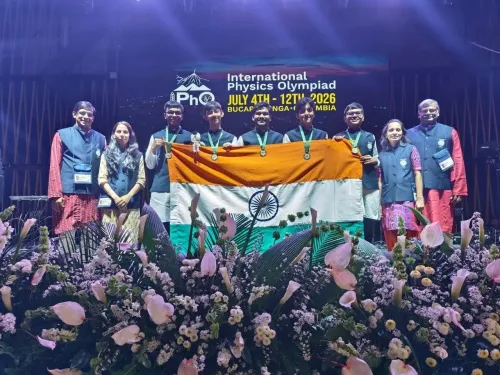
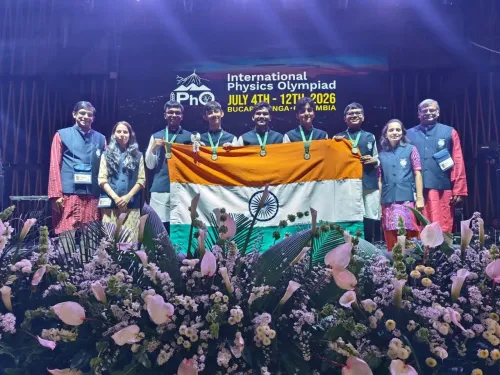
India wins 5 gold medals at IPhO 2026, claims joint World No. 1 rank
Synopsis
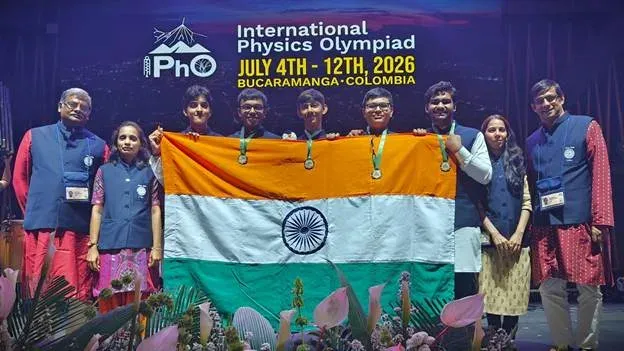
India sent five students to the 56th International Physics Olympiad in Colombia — and brought back five gold medals, sharing the world's top rank with China, Kazakhstan, Russia, South Korea, and Taiwan. It is a clean sweep in a competition of 381 students from 87 nations, and it extends a decade-long streak of every Indian participant winning a podium finish.
Key Takeaways
India won five gold medals at the 56th International Physics Olympiad (IPhO) 2026 in Colombia , achieving a clean sweep.
India shares the joint World No.
1 rank with China , Kazakhstan , Russia , South Korea , and Taiwan among 87 participating countries .
Gold medallists: Kanishk Jain (Pune), Riddhesh Anant Bendale (Indore), Rishit Garg (New Delhi), Shresth Suraiya (Mumbai), Svarit Joshi (Ahmedabad).
Every Indian IPhO participant over the past decade has won a podium finish.
The programme is run by HBCSE-TIFR under the Department of Atomic Energy , which oversees India's international science olympiad preparation.
DAE Secretary Ajit Kumar Mohanty called the achievement 'a matter of immense national pride.'
India's five-member team claimed a clean sweep of five gold medals at the 56th International Physics Olympiad (IPhO) 2026 held in Colombia, securing the country a joint World No. 1 ranking alongside China, Kazakhstan, Russia, South Korea, and Taiwan. The result, announced on 12 July 2026, places India at the pinnacle of one of the world's most competitive science olympiads, with 381 students from 87 countries competing.
The Gold Medallists
All five members of the Indian contingent returned with gold. The winners are Kanishk Jain from Pune, Maharashtra; Riddhesh Anant Bendale from Indore, Madhya Pradesh; Rishit Garg from Dwarka, New Delhi; Shresth Suraiya from Mumbai, Maharashtra; and Svarit Joshi from Ahmedabad, Gujarat. The clean sweep is a rare feat in a competition where even a single gold is considered exceptional.
A Decade of Podium Finishes
This victory extends an already remarkable run: every Indian participant at the International Physics Olympiad over the past decade has secured a podium finish. The consistency points not to a single exceptional cohort but to a structural strength in how India identifies and develops physics talent at the pre-university level.
The Role of HBCSE-TIFR
The success is widely attributed to the Olympiad programme run by the Homi Bhabha Centre for Science Education (HBCSE), a national centre of the Tata Institute of Fundamental Research (TIFR), operating under the Department of Atomic Energy (DAE). As India's nodal agency for international science olympiads, HBCSE runs a rigorous multi-stage selection process, followed by orientation camps and intensive residential training. The programme has long been credited with bridging raw talent and world-class competitive readiness.
Government Response and Recognition
Department of Atomic Energy Secretary and Atomic Energy Commission Chairman Ajit Kumar Mohanty described the achievement as 'a matter of immense national pride.' He said the clean sweep and the joint top ranking reflected both the students' dedication and the sustained efforts of the HBCSE-TIFR Olympiad programme. Mohanty also acknowledged the students' parents, teachers, and mentors, expressing confidence that the result would inspire more young Indians to pursue excellence in science.
The Department of Atomic Energy separately congratulated team leaders Prof. Anwesh Mazumdar of HBCSE-TIFR and Dr. Leena Joshi of St. Xavier's College, Mumbai, as well as scientific observers Prof. Ananda Dasgupta of IISER Kolkata and Nisha Kelkar of Gogate-Joglekar College, Ratnagiri, and the broader Physics Olympiad mentor pool at HBCSE.
What This Signals for Indian Science Education
India's joint top finish at IPhO 2026 arrives at a moment of growing national focus on STEM capacity-building. The result challenges the perception that India's science education system excels only at rote learning — five gold medals in theoretical and experimental physics demand deep conceptual mastery. Whether this pipeline of olympiad talent translates into breakthrough research careers domestically remains the longer-term question to watch.
Frequently Asked Questions
What is the International Physics Olympiad 2026?
The International Physics Olympiad (IPhO) 2026 is the 56th edition of the annual global physics competition for pre-university students, held in Colombia. A total of 381 students from 87 countries competed in theoretical and experimental physics challenges.
How did India perform at IPhO 2026?
India won five gold medals — a clean sweep — and secured the joint World No. 1 rank alongside China, Kazakhstan, Russia, South Korea, and Taiwan. All five members of the Indian team returned with gold medals.
Who are the five Indian gold medallists at IPhO 2026?
The five gold medallists are Kanishk Jain from Pune, Riddhesh Anant Bendale from Indore, Rishit Garg from New Delhi, Shresth Suraiya from Mumbai, and Svarit Joshi from Ahmedabad.
Which organisation trains India's Physics Olympiad team?
The Homi Bhabha Centre for Science Education (HBCSE), a national centre of the Tata Institute of Fundamental Research (TIFR) under the Department of Atomic Energy, is India's nodal agency for international science olympiads. It runs a multi-stage selection process and intensive training camps to prepare students.
How consistent has India been at the Physics Olympiad?
Every Indian participant at the International Physics Olympiad over the past decade has won a podium finish, according to the available record. The 2026 clean sweep is the latest in this unbroken run of top-level performance.