Rajnath Singh hails India's gold sweep at Physics Olympiad 2026
Synopsis
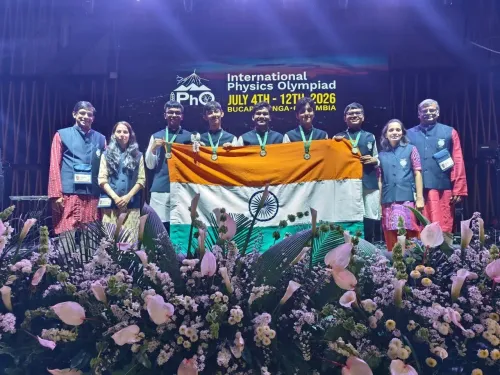
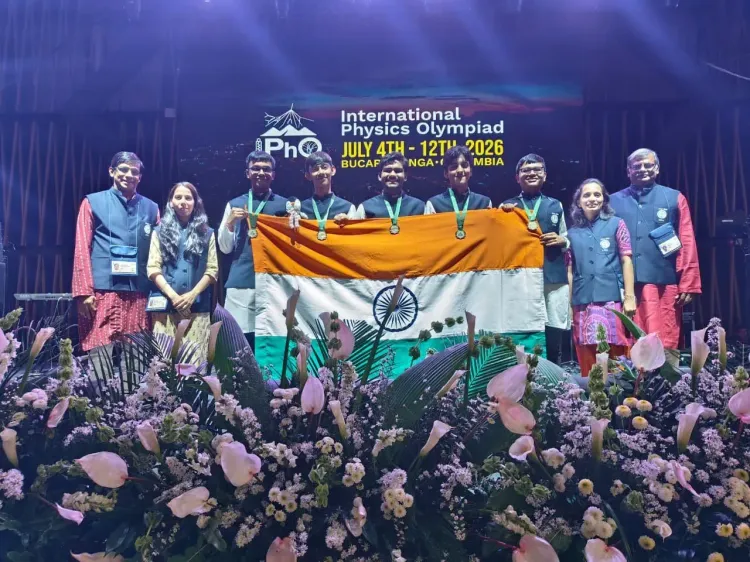
All five members of India's contingent at the 56th International Physics Olympiad in Bucaramanga, Colombia won gold medals, Union Defence Minister Rajnath Singh announced on 13 July 2026. Singh, a former physics teacher, called the result proof of India's unbroken decade-long medal streak at the competition and linked it to the legacy of C. V. Raman and Satyendra Nath Bose.
Key Takeaways
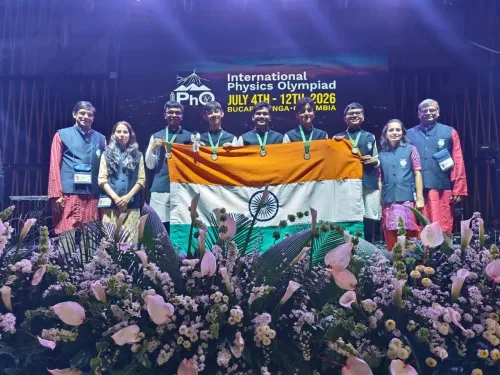
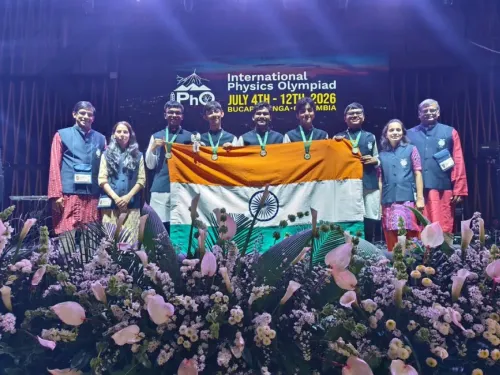
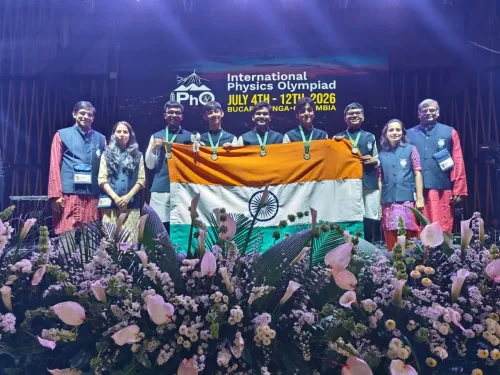
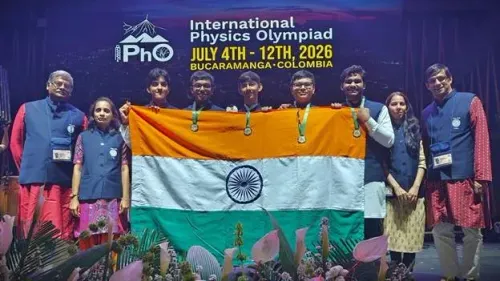
All five Indian students at the 56th International Physics Olympiad 2026 in Bucaramanga, Colombia won gold medals.
This is India's 27th participation at the International Physics Olympiad.
Every Indian contingent for the past decade has returned with at least one medal, according to Rajnath Singh .
Union Defence Minister Rajnath Singh , a former physics teacher, personally congratulated the students on 13 July 2026 .
India's olympiad training is anchored by the Homi Bhabha Centre for Science Education (HBCSE) , which has run the national programme since the late 1990s.
Singh invoked Sir C.
Raman and Satyendra Nath Bose as the scientific forebears whose legacy the young medallists carry forward.
Union Defence Minister Rajnath Singh on Monday, 13 July 2026 congratulated five Indian students who won gold medals at the 56th International Physics Olympiad (IPhO), held in Bucaramanga, Colombia, calling the achievement a reflection of India's sustained commitment to nurturing world-class scientific talent.
Context
In his post on X, Rajnath Singh noted that this marks India's 27th participation at the International Physics Olympiad and that 'for the past decade, every Indian contingent has returned home with a medal.' All five members of the 2026 Indian contingent secured gold — a clean sweep that places the team among the top-performing nations at the prestigious annual competition. Singh added a personal dimension, noting that 'as someone who had the privilege of teaching physics earlier in my career, this achievement gives me immense joy.'
The International Physics Olympiad is the premier global contest for high-school physics students, drawing teams from across the world each year. Bucaramanga, a major Colombian city, hosted the 56th edition of the competition in 2026.
Policy Backdrop
India's consistent performance at the IPhO is underpinned by a structured training ecosystem. The Homi Bhabha Centre for Science Education (HBCSE) in Mumbai has for decades run the national olympiad programme that identifies and trains school-level students in physics, chemistry, mathematics, and biology. India began regular participation in the IPhO in the late 1990s, and successive governments have invested in expanding the talent pipeline.
The broader policy context includes the National Education Policy 2020, which emphasises science enrichment and critical thinking at the school level. Olympiad performance is frequently cited by policymakers as a measurable indicator of progress toward a knowledge-based economy and greater self-reliance in science and technology — themes that align with the government's Aatmanirbhar Bharat (self-reliant India) framework.
Stakeholders and Impact
Singh situated the gold-medal performance within India's longer scientific legacy, invoking Sir C. V. Raman — whose discovery of the Raman effect earned him the Nobel Prize in Physics in 1930 — and Satyendra Nath Bose, whose foundational work on quantum statistics gave rise to Bose-Einstein condensate theory and lent his name to bosons. 'This remarkable accomplishment carries forward India's proud scientific legacy,' Singh wrote.
For the five gold medallists themselves, the win typically opens doors to premier undergraduate institutions and research fellowships in India and abroad. The scientific community has broadly welcomed the result as evidence that India's school-level talent identification and training mechanisms are producing results at the highest international level.
What's Next
Attention will now turn to how India builds on this momentum, particularly in the context of any updated guidelines under the National Education Policy 2020 for school-level science enrichment and the selection cycle for the 57th International Physics Olympiad in 2027. The HBCSE is expected to use this result to strengthen the case for continued public investment in olympiad training programmes. Singh's personal connection to physics teaching may also lend political weight to future proposals for expanding science education infrastructure at the secondary level.
Point of View
Not merely academic success. Rajnath Singh's disclosure of his own background as a physics teacher adds unusual personal credibility to the post and makes it harder to read as purely ceremonial. The invocation of Raman and Bose is a deliberate narrative move: it anchors a 2026 competition result in a century-long arc of indigenous scientific achievement, reinforcing the government's broader self-reliance messaging. Sustained gold-medal performance at the IPhO will likely be cited in future budget arguments for expanding school-level science enrichment under the National Education Policy 2020.
NationPress
12 Oct 2026
Frequently Asked Questions
Did India win gold at the International Physics Olympiad 2026?
Yes. All five members of India's contingent at the 56th International Physics Olympiad, held in Bucaramanga, Colombia, won gold medals, as confirmed by Union Defence Minister Rajnath Singh on 13 July 2026.
Where was the 56th International Physics Olympiad held?
The 56th International Physics Olympiad was held in Bucaramanga, Colombia in 2026.
How many times has India participated in the International Physics Olympiad?
According to Rajnath Singh's post, the 2026 edition marks India's 27th participation at the International Physics Olympiad.
Was Rajnath Singh a physics teacher before entering politics?
Yes. Rajnath Singh has publicly stated that he taught physics earlier in his career before entering full-time politics, a background he referenced in his congratulatory message for the IPhO 2026 winners.
Which institution trains India's International Physics Olympiad team?
The Homi Bhabha Centre for Science Education (HBCSE) in Mumbai runs India's national science olympiad programme, which identifies and trains school-level students for competitions including the International Physics Olympiad.