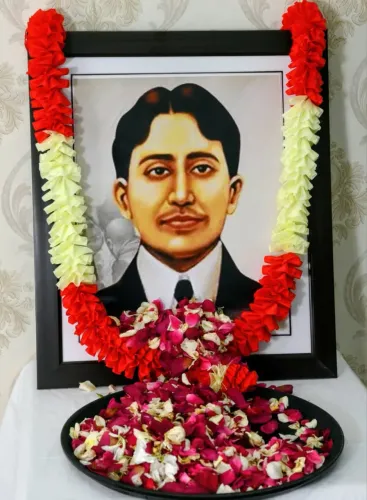
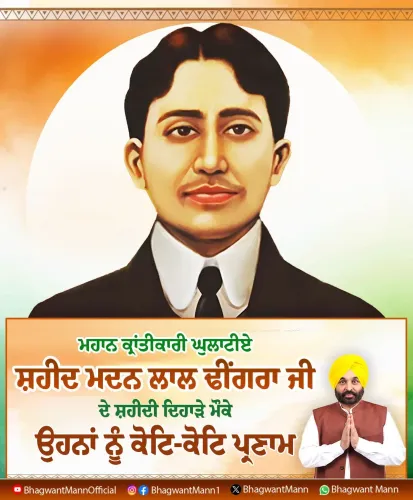
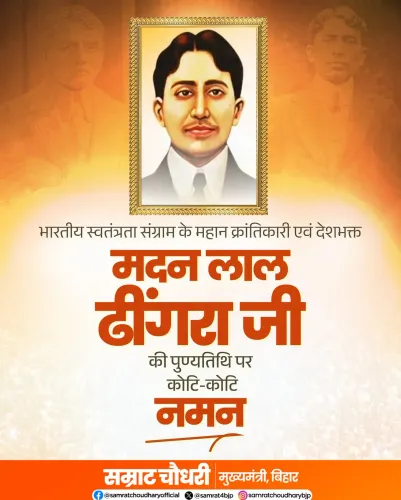
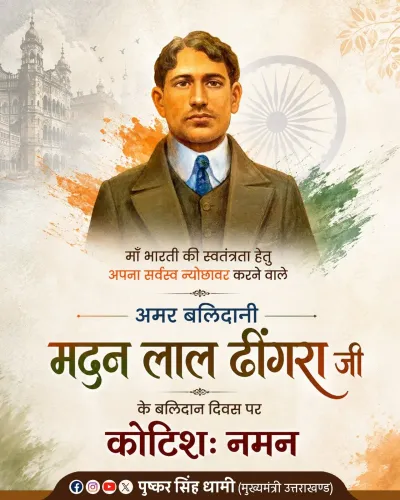
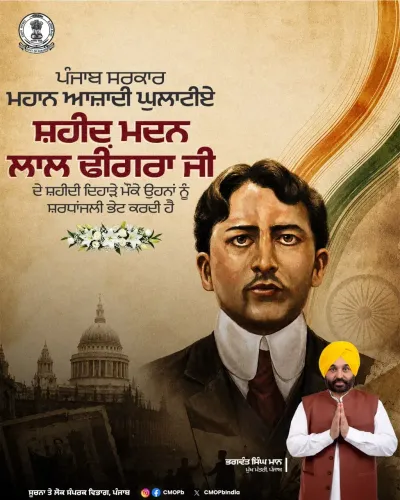
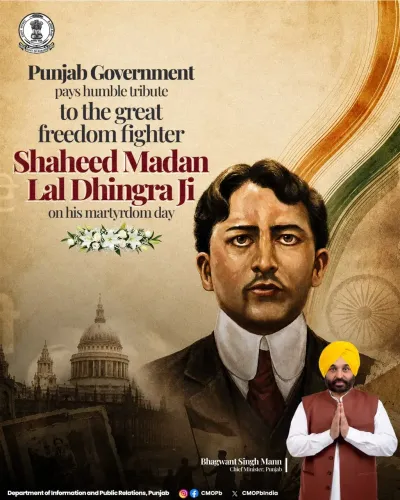
CM Nayab Saini Pays Tribute to Martyr Madan Lal Dhingra
Synopsis
Haryana Chief Minister Nayab Singh Saini on 17 August 2026 honoured revolutionary martyr Madan Lal Dhingra on his martyrdom anniversary, recalling the 1909 London act of defiance that made the Amritsar-born revolutionary an enduring symbol of India's armed independence struggle.
Key Takeaways
Haryana CM Nayab Singh Saini posted a tribute to Madan Lal Dhingra on 17 August 2026 , his martyrdom anniversary.
Dhingra was hanged on 17 August 1909 at Pentonville Prison, London , aged 25 , after assassinating British officer Sir William Hutt Curzon Wyllie .
Dhingra was born in Amritsar and was associated with Vinayak Damodar Savarkar's India House circle in London.
Saini described Dhingra's legacy as a continuing inspiration for youth in 'love for the nation and national service.' The tribute reflects a broader political tradition of honouring the armed-resistance strand of India's freedom movement alongside the Gandhian mainstream.
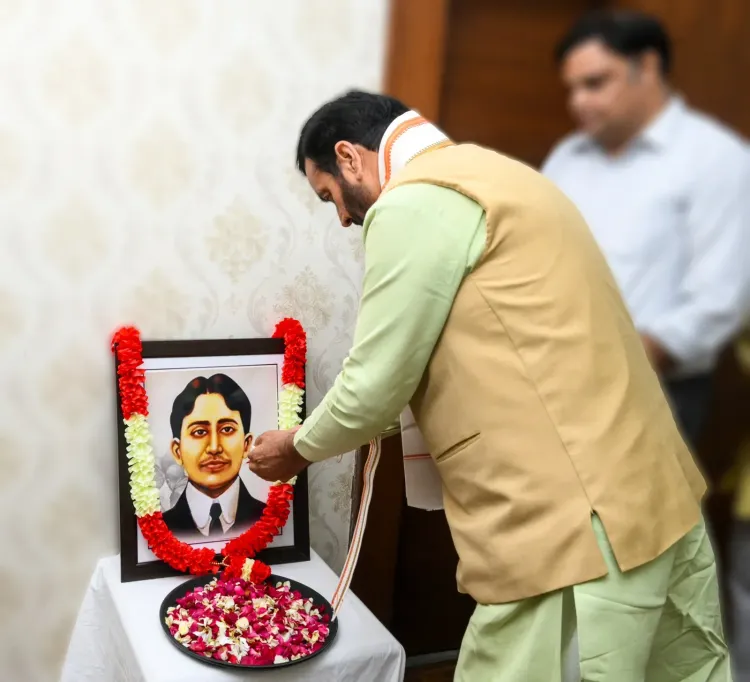
On the martyrdom anniversary of one of India's most fearless revolutionary sons, Haryana Chief Minister Nayab Singh Saini paused to honour a name that history has never fully forgotten — Madan Lal Dhingra.
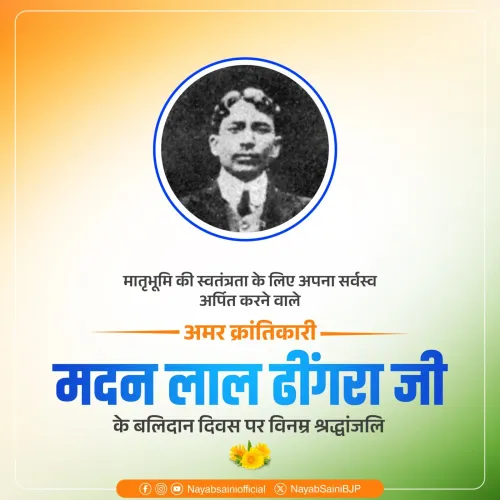
Posting on Monday, 17 August 2026, CM Saini offered his heartfelt tribute, writing: 'मातृभूमि की स्वतंत्रता के लिए अपना सर्वस्व न्योछावर करने वाले अमर क्रांतिकारी मदन लाल ढींगरा जी के बलिदान दिवस पर उन्हें भावपूर्ण श्रद्धांजलि अर्पित कर नमन किया।' ('On the martyrdom day of immortal revolutionary Madan Lal Dhingra, who sacrificed everything for the freedom of the motherland, I bow to him with heartfelt tribute.')
Madan Lal Dhingra was a young Punjab-born revolutionary who, in 1909, assassinated Sir William Hutt Curzon Wyllie, a British Indian Army officer, in London — an act of defiance that sent shockwaves through the colonial establishment. Arrested immediately, Dhingra was tried and hanged on 17 August 1909 at Pentonville Prison, London, aged just 25. His final statement in court — unequivocal, unafraid — became one of the most quoted declarations of Indian nationalist resolve from the era.
A Revolutionary from Amritsar Who Shook London
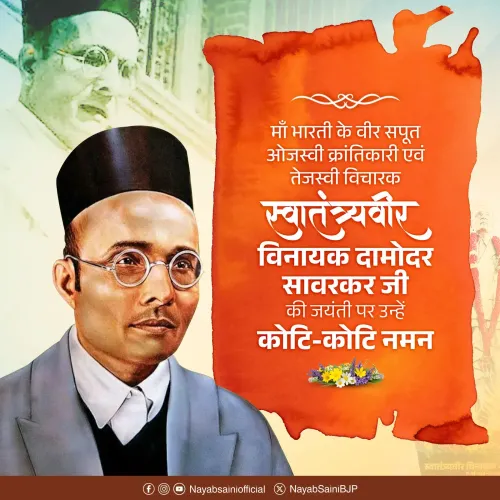
Born in Amritsar into a prosperous family, Dhingra travelled to England to study engineering and fell under the influence of Vinayak Damodar Savarkar and the India House circle in London — a hub of radical Indian nationalist thought in the early twentieth century. His act was not impulsive; it was a calculated political statement against British rule, carried out at the Imperial Institute's annual gathering. He refused to plead for mercy and walked to the gallows with the composure that would later inspire generations.Why Dhingra's Memory Endures in Political Discourse
CM Saini's tribute underlines a recurring thread in contemporary Indian political culture: the reclamation of early twentieth-century revolutionary figures — distinct from the mainstream Gandhian narrative — as foundational icons of national sacrifice. Dhingra is remembered alongside Bhagat Singh, Sukhdev, and Chandrashekhar Azad as part of the armed-resistance strand of India's freedom movement. Saini noted that Dhingra's 'courage, sacrifice, and patriotism continue to inspire the youth towards love for the nation and national service.' For Haryana, a state with deep ties to Punjab's revolutionary heritage, the tribute carries particular resonance — Dhingra's Punjabi roots connect directly to the region's own memory of the independence struggle.Point of View
Armed-resistance figures from India's freedom movement — a counterpoint to the Congress-dominated Gandhian narrative. Dhingra, a Punjabi revolutionary, holds special symbolic weight in Haryana, where the freedom-struggle memory is deeply intertwined with the broader Punjab heritage. By invoking Dhingra's courage and sacrifice on the exact date of his hanging, Saini signals both cultural continuity and a political identity rooted in assertive nationalism. The tribute is unlikely to be contentious, but it does reinforce which strand of the independence story the ruling dispensation in Haryana chooses to amplify.
NationPress
2 Oct 2026
Frequently Asked Questions
Who was Madan Lal Dhingra?
Madan Lal Dhingra was an Indian revolutionary born in Amritsar who, in 1909, assassinated British officer Sir William Hutt Curzon Wyllie in London as an act of protest against British colonial rule. He was hanged on 17 August 1909 at Pentonville Prison, London, aged 25.
Why is 17 August significant for Madan Lal Dhingra?
17 August marks the anniversary of Madan Lal Dhingra's execution in 1909. He was hanged at Pentonville Prison in London after being convicted for the assassination of Sir William Hutt Curzon Wyllie.
Why did Haryana CM Nayab Saini pay tribute to Madan Lal Dhingra?
CM Nayab Singh Saini posted a tribute on 17 August 2026, the martyrdom anniversary of Madan Lal Dhingra, honouring the revolutionary's sacrifice for India's independence and calling his patriotism an inspiration for today's youth.
What is the connection between Madan Lal Dhingra and Haryana?
Dhingra was born in Amritsar in undivided Punjab. Haryana, carved out of the former Punjab region, shares a deep cultural and historical connection to the Punjab freedom-struggle heritage, making Dhingra a figure of regional pride.
Who influenced Madan Lal Dhingra's revolutionary activities?
Dhingra came under the influence of Vinayak Damodar Savarkar and the India House circle in London, a centre of radical Indian nationalist activity in the early twentieth century.