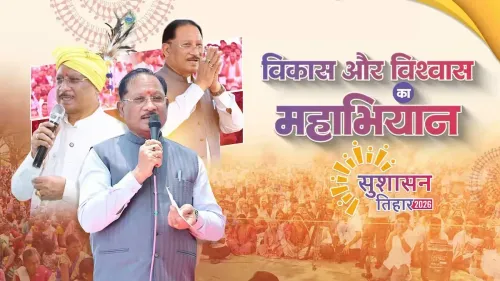
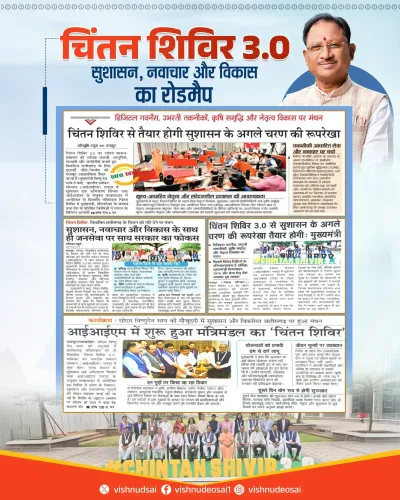
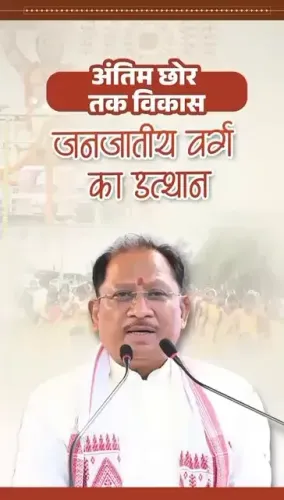
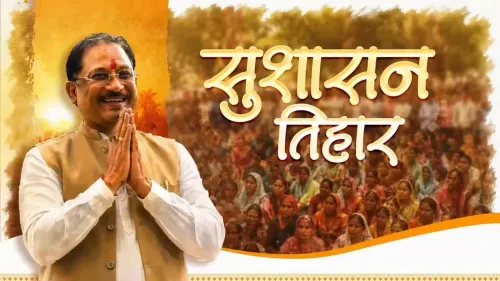
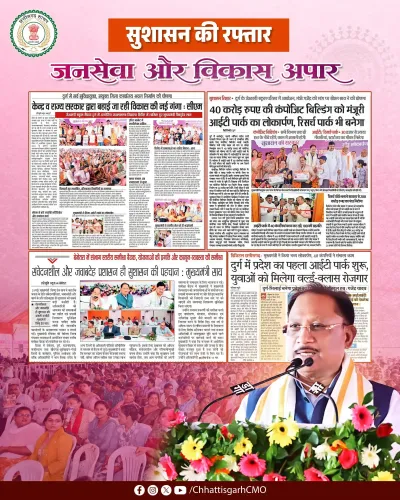
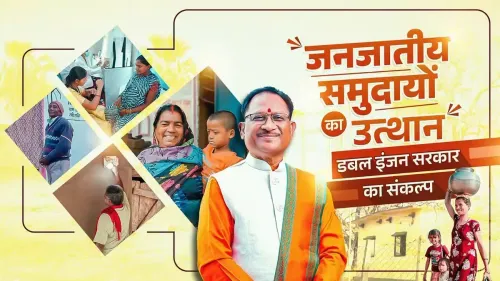
CM Sai's Office Flags Rail, Digital and Tribal Push in Chhattisgarh
Synopsis
The Chief Minister's Office of Chhattisgarh on 13 July 2026 reaffirmed a three-pillar development agenda — rail expansion, digital governance and tribal upliftment — under the 'Sushasan Sarkar' banner, signalling policy continuity and a bid to link infrastructure investment with employment and connectivity outcomes across the state.
Key Takeaways
The Chief Minister's Office of Chhattisgarh posted on 13 July 2026 reaffirming its 'Sushasan Sarkar' (Good Governance Government) development agenda.
The three stated pillars are rail development, digital governance and tribal upliftment , framed as mutually reinforcing instruments.
Chief Minister Vishnu Deo Sai has led the BJP government in Chhattisgarh since December 2023 .
Roughly one-third of Chhattisgarh's population is classified as Scheduled Tribe, making tribal welfare a central policy and political priority.
Key rail projects are focused on the Bastar and Surguja divisions , historically underserved mineral-rich regions.
Completion timelines for rail corridors and rollout metrics for digital portals will be the primary tests of the government's stated 'Vikas ki Raftar' (speed of development).
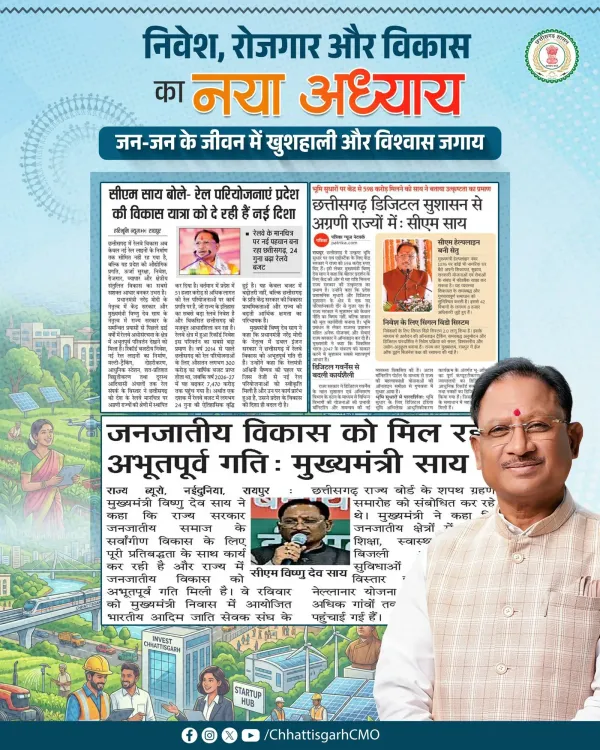
The Chief Minister's Office of Chhattisgarh on Monday, 13 July 2026, reaffirmed the state government's three-pillar development agenda — rail expansion, digital governance and tribal welfare — framing them as the core of what it calls the 'Sushasan Sarkar' (Good Governance Government) resolve.
Posting on X, the office declared: 'Reel vikas, digital sushasan aur janjatiya utthan — nivesh, rozgar aur connectivity ki raftar ke saath, har kshetra mein vikas ka vishwas mazboot ho raha hai' ('Rail development, digital good governance and tribal upliftment — with the pace of investment, employment and connectivity, confidence in development is strengthening across every sector'). The message was tagged with the hashtags #SushasanSarkar, #Chhattisgarh, #VikasKiRaftar, #DigitalGovernance, #RailDevelopment and #TribalDevelopment.
Context
The post comes nearly two and a half years into the BJP administration led by Chief Minister Vishnu Deo Sai, who took office in December 2023 following the state assembly elections. The government has consistently positioned itself around a governance model that combines physical infrastructure with digital service delivery and targeted welfare for the state's sizable Scheduled Tribe population, which accounts for roughly one-third of Chhattisgarh's total residents. The three themes — rail, digital and tribal — are not new to state messaging, but their bundling under the 'Sushasan Sarkar' brand signals an effort to consolidate these as a unified political and policy identity ahead of continued scrutiny on delivery.Policy Backdrop
Indian Railways has included dedicated outlays in successive central budgets for new lines, route-doubling and electrification works across Chhattisgarh, particularly in the Bastar and Surguja divisions — regions that are mineral-rich but historically underserved by rail connectivity. Improved rail links are seen as critical for both economic integration and access to markets for tribal and rural communities. On the digital front, the state government has pursued e-governance portals aimed at reducing friction in citizen-service delivery — from land records to welfare scheme disbursements. This mirrors a broader national pattern in which post-2023 state governments have treated digital infrastructure as a force-multiplier for physical development programmes. Tribal welfare schemes, both at the state and central level, target Scheduled Tribe communities in Chhattisgarh for education, health and livelihood support. The state's forest and mining economy makes tribal upliftment both a social imperative and a politically salient issue.Stakeholders and Impact
The communities most directly referenced by this agenda are Chhattisgarh's tribal households, particularly those in interior districts where rail connectivity remains limited and digital access is still being expanded. Rural investors and small enterprises also stand to benefit if infrastructure and connectivity commitments translate into on-ground project completions. For the state government, the messaging serves a dual purpose: signalling policy continuity to investors and development agencies while reinforcing the 'Sushasan Sarkar' brand with the electorate. The simultaneous invocation of employment (rozgar) and investment (nivesh) suggests the administration is conscious of linking infrastructure to livelihood outcomes.What's Next
The key metrics to watch will be completion timelines for ongoing rail corridors in the Bastar and Surguja divisions, uptake figures for state digital service portals, and the reach of tribal welfare disbursements. If the government's stated pace of 'Vikas ki Raftar' (speed of development) is to be substantiated, project-level progress reports in the coming months will be the primary test. The convergence of infrastructure, governance and welfare as a single political narrative positions Chhattisgarh as a template the ruling party may seek to project nationally.Point of View
Digital delivery and targeted welfare — collapsing distinct policy domains into a single, electorally resonant narrative. For a state where tribal communities form a third of the population and where Bastar's security and development challenges remain unresolved, the 'Sushasan Sarkar' framing carries both genuine policy weight and clear political calculation. The bundling of rail, digital and tribal themes also aligns Chhattisgarh's state messaging tightly with the national BJP's development vocabulary, suggesting a deliberate effort to project the state as a model of the party's governance philosophy. Whether the narrative holds will depend on verifiable project completions and welfare delivery metrics in the months ahead.
NationPress
13 Jul 2026
Frequently Asked Questions
What is the 'Sushasan Sarkar' initiative in Chhattisgarh?
'Sushasan Sarkar' translates as 'Good Governance Government' and is the branding used by the Chhattisgarh BJP administration under Chief Minister Vishnu Deo Sai to describe its approach of combining infrastructure, digital services and tribal welfare as a unified development agenda.
Who is the Chief Minister of Chhattisgarh in 2026?
Vishnu Deo Sai is the Chief Minister of Chhattisgarh, having taken office in December 2023 following the BJP's victory in the state assembly elections.
What rail projects are planned for Chhattisgarh?
Central government rail budgets have included dedicated outlays for new lines, route-doubling and electrification works in Chhattisgarh, with particular focus on the Bastar and Surguja divisions, which are mineral-rich but historically underserved by rail connectivity.
What share of Chhattisgarh's population is tribal?
Roughly one-third of Chhattisgarh's total population is classified as Scheduled Tribe, making the state one of India's most significant in terms of tribal demography and welfare policy.
What does 'Vikas ki Raftar' mean in the context of Chhattisgarh governance?
'Vikas ki Raftar' translates as 'speed of development' and is used by the Chhattisgarh government to describe the pace at which it aims to deliver investment, employment and connectivity improvements across the state.