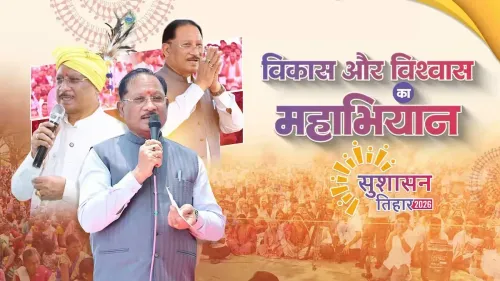
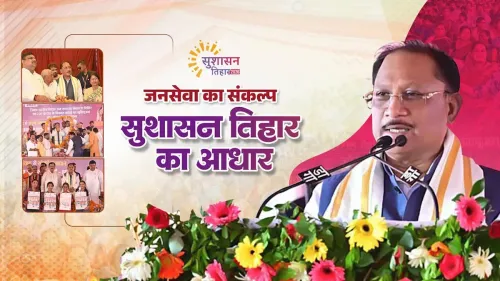
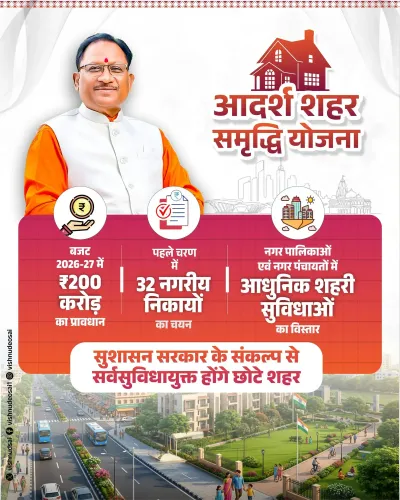
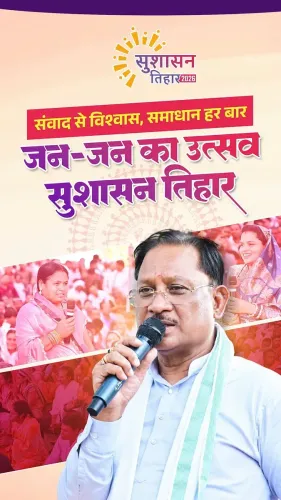
CM Sai's Sushasan Express Reaches Abujhmad's Tribal Heartland
Synopsis
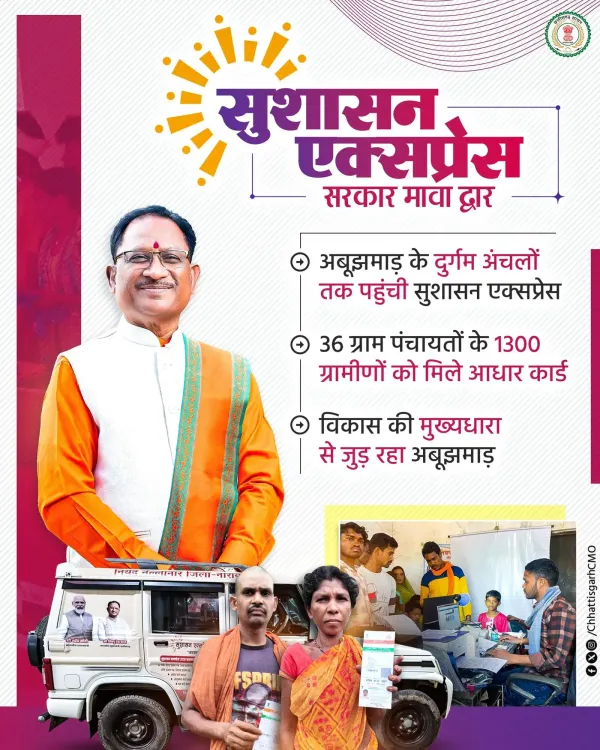
The Chhattisgarh government's mobile outreach programme 'Sushasan Express', under CM Vishnu Deo Sai, has distributed Aadhaar cards to 1,300 villagers across 36 gram panchayats in the remote Abujhmad region of Narayanpur district, marking a significant push to extend formal identity and welfare access to isolated tribal communities.
Key Takeaways
1,300 tribal villagers across 36 gram panchayats in Abujhmad received Aadhaar cards under the Sushasan Express initiative.
The drive is led by CM Vishnu Deo Sai and is framed as part of the BJP-led Chhattisgarh government's 'good governance' agenda.
Abujhmad , a densely forested region in Narayanpur district , has historically been among India's most isolated and under-served tribal zones.
Aadhaar , India's biometric identity programme, is a prerequisite for accessing most central and state welfare entitlements, making enrolment a critical first step for inclusion.
Outreach in Bastar-region districts carries a dual significance — developmental welfare delivery and formal state presence in insurgency-affected terrain.
Subsequent phases of the Sushasan Express in other Bastar districts will test whether the programme scales beyond symbolic milestones.
Deep inside Abujhmad — one of India's most isolated tribal regions, where roads thin out and the forest closes in — the Chhattisgarh government's outreach machine has arrived. The Chief Minister's Office of Chhattisgarh announced on Sunday, 9 August 2026 that the 'Sushasan Express' initiative, led by Chief Minister Vishnu Deo Sai, has delivered Aadhaar cards to 1,300 villagers across 36 gram panchayats in the region — pushing the formal identity network to corners of the state that have long existed outside it.
What the Sushasan Express is doing in Abujhmad
The Sushasan Express — loosely translated as the 'Good Governance Express' — is a mobile outreach programme that deploys administrative units directly into remote areas rather than expecting residents to travel to district headquarters. In Abujhmad, a densely forested zone primarily within Narayanpur district of Chhattisgarh's Bastar division, that distinction is everything. Terrain that makes routine travel difficult has historically kept tribal communities cut off from welfare programmes that require proof of identity to access.
The CMO's post stated: 'Sushasan Express abujhmad ke durgam anchalon tak pahunch rahi hai' — 'the Sushasan Express is reaching the remote corners of Abujhmad' — framing the drive as a deliberate push to bring governance to the last mile, not the other way around.
Why Aadhaar in Abujhmad carries extra weight
Aadhaar, India's biometric identity programme launched in 2009, is the gateway to a wide range of government subsidies and welfare entitlements — from food rations to direct benefit transfers. Without it, a villager is administratively invisible. In Bastar-region districts like Narayanpur, successive Chhattisgarh governments have run enrolment camps since the early 2010s, but coverage in the deepest pockets of Abujhmad has remained patchy. The current drive is the latest — and, by the state's account, one of the most penetrating — chapters in that longer effort.
The broader pattern matters here: identity-document outreach in Naxal-affected tribal zones is simultaneously a welfare measure and a governance signal. Bringing formal administration into areas that insurgent networks have historically contested is both developmental policy and a quiet assertion of state presence.
Abujhmad's slow turn toward the mainstream
CM Vishnu Deo Sai, who took office in December 2023 after the BJP's state assembly victory, has repeatedly cited integration of remote tribal areas as a priority of his administration's 'Sushasan' — good governance — agenda. The CMO post closed with a pointed line: 'Abujhmad tezi se vikas ki mukhyadhara se jud raha hai' — 'Abujhmad is rapidly connecting to the mainstream of development.'
Whether the pace matches the rhetoric will show in the next phases: whether the Sushasan Express extends to other Bastar-division districts, and whether Aadhaar coverage translates into measurable uptake of welfare schemes among the newly enrolled.
For now, 1,300 residents of one of India's most remote regions have an identity card. That is where the story starts.
Point of View
Or whether the camp remains a headline without a follow-through. Abujhmad's integration into formal governance systems is a generational project, and a single outreach round, however well-publicised, is a chapter, not a conclusion.
NationPress
9 Aug 2026
Frequently Asked Questions
What is the Sushasan Express in Chhattisgarh?
The Sushasan Express is a mobile outreach programme launched by the Chhattisgarh government under CM Vishnu Deo Sai that deploys administrative units directly into remote and tribal areas to deliver government services, including Aadhaar enrolment, without requiring residents to travel to district offices.
Where is Abujhmad located and why is it significant?
Abujhmad is a remote, densely forested tribal region located primarily in Narayanpur district of Chhattisgarh's Bastar division. It has historically been one of India's most geographically isolated areas, with limited access to formal governance, identity documents, and welfare schemes.
How many people received Aadhaar cards in the Abujhmad drive?
According to the Chief Minister's Office of Chhattisgarh, 1,300 villagers across 36 gram panchayats in Abujhmad were provided Aadhaar cards under the Sushasan Express initiative.
Why is Aadhaar enrolment important for tribal communities in Chhattisgarh?
Aadhaar is the primary identity document required to access most central and state government welfare schemes, including food subsidies and direct benefit transfers. Without it, residents are effectively excluded from the formal welfare system, making enrolment a foundational step toward inclusion.
Who is Vishnu Deo Sai and when did he become Chief Minister of Chhattisgarh?
Vishnu Deo Sai is the Chief Minister of Chhattisgarh from the BJP, who was sworn into office in December 2023 following the party's victory in the state assembly elections.