CM Samrat Choudhary backs India-Germany green energy push
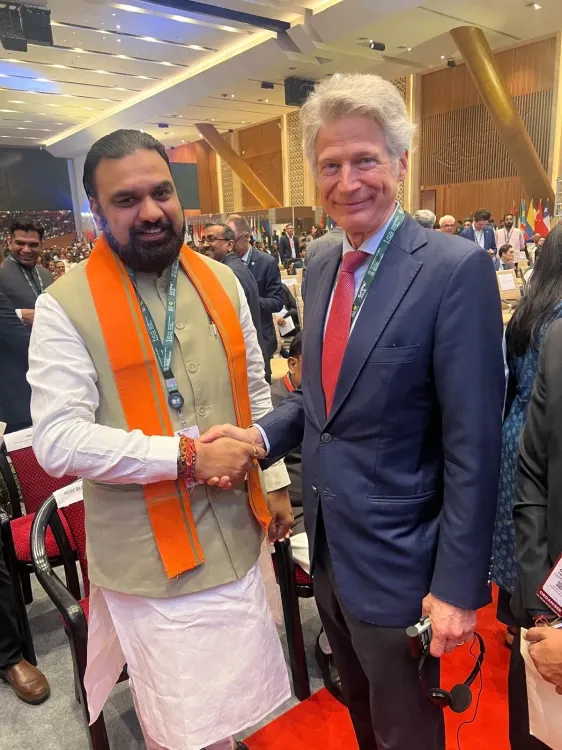
Synopsis
Bihar Chief Minister Samrat Choudhary on 5 November 2026 publicly aligned Bihar with India's deepening clean-energy partnership with Germany, citing PM Modi's leadership and pledging the state's commitment to the national green revolution under the Viksit Bharat framework.
Key Takeaways
Bihar CM Samrat Choudhary posted on 5 November 2026 backing the India-Germany renewable energy partnership.
He credited PM Narendra Modi with driving the bilateral collaboration on green growth and sustainable development.
Bihar declared its commitment to becoming a participant in India's broader green revolution.
India's Panchamrit climate pledge includes achieving 500 GW of non-fossil-fuel capacity by 2030 , first announced at COP26 in 2021 .
State governments are aligning with national-level international energy collaborations under the Viksit Bharat framework.
Specific Bihar-Germany project timelines remain unconfirmed in the public record.
A clean-energy partnership is quietly reshaping India's diplomatic calendar — and Bihar Chief Minister Samrat Choudhary wants his state at the heart of it. On Thursday, 5 November 2026, Choudhary took to X to declare Bihar's commitment to joining India's green revolution, framing the deepening India-Germany friendship as a 'powerful step towards a bright future through clean energy.'
Posting in Hindi, Choudhary wrote: 'Bharat aur Germany ki mitrata, swachh urja se ujjwal bhavishya ki or badhta ek sashakt kadam hai' — 'The friendship between India and Germany is a powerful step towards a bright future through clean energy.' He credited Prime Minister Narendra Modi's visionary leadership for energising a bilateral partnership he described as a 'new hope for green growth, sustainable progress, and a better tomorrow for future generations.'
Bihar's pledge inside a national green ambition
Choudhary's declaration is not simply rhetorical solidarity. State governments across India have been progressively aligning local energy policies with Modi's Panchamrit climate commitments, which include reaching 500 GW of non-fossil-fuel electricity capacity by 2030 — a target first announced at COP26 in 2021. For Bihar, a densely populated state still deepening its infrastructure base, plugging into Germany's technology-and-investment pipeline could translate into real capacity on the ground.
India has systematically expanded bilateral climate partnerships with European nations, and Germany occupies a central position in that strategy — bringing industrial expertise, green financing, and technology transfer. The Viksit Bharat framework, under which sub-national governments are encouraged to sync with national-level international collaborations, gives Chief Ministers like Choudhary a formal runway to articulate exactly this kind of commitment.
What a state-level buy-in signals
When a Chief Minister publicly aligns a state with a bilateral foreign-policy moment, the signal runs in two directions. Domestically, it signals to investors and project developers that Bihar is open for renewable business. Internationally, it adds state-level depth to India's negotiating position — demonstrating that the green energy consensus extends well beyond New Delhi's corridors.
The hashtags Choudhary chose — #IndiaGermany, #RenewableEnergy, #GreenEnergy, #SustainableDevelopment, #ViksitBharat, #SamriddhBihar — sketch the full architecture: a global bilateral, a national mission, and a state-level prosperity goal, all wired together.
Specific Indo-German project timelines for Bihar are yet to be confirmed in the public record — but the political will, clearly, has been declared. The next move belongs to the negotiating table.
Point of View
He simultaneously signals clean-energy ambition to investors and reinforces solidarity with the Modi government's global climate agenda. For the BJP, having state leaders amplify national foreign-policy wins is a well-worn playbook that stretches the resonance of a central achievement down to the grassroots. The reference to 'future generations' and the Samridh Bihar hashtag also serve a domestic electoral logic — framing development in aspirational, long-term terms. Watch whether this declaration is followed by concrete bilateral project announcements that give the rhetoric institutional weight.
NationPress
5 Nov 2026
Frequently Asked Questions
What did Bihar CM Samrat Choudhary say about India and Germany?
On 5 November 2026 , CM Samrat Choudhary praised the India-Germany friendship as a powerful step towards a clean-energy future, credited PM Modi for the bilateral partnership, and pledged that Bihar would participate in India's green revolution.
What is India's renewable energy target by 2030?
India committed to achieving 500 GW of non-fossil-fuel electricity capacity by 2030 under its Panchamrit climate pledges, first announced at COP26 in 2021 .
How is Bihar involved in India's green energy plans?
Bihar's Chief Minister has publicly committed the state to joining India's national green revolution, aligning with the Viksit Bharat framework that encourages states to partner with national-level international clean-energy collaborations.
Why is India partnering with Germany on clean energy?
Germany is a key European partner offering industrial expertise, technology transfer, and green financing. India has systematically expanded bilateral climate partnerships with European nations to support its renewable capacity addition and net-zero pathway.
What is Viksit Bharat and how does it relate to green energy?
Viksit Bharat is the Indian government's framework for developed-nation-level growth by 2047; state governments use it as a mandate to align local energy and development policies with national and international sustainability commitments.