CM Samrat Choudhary backs Amit Shah on Vande Mataram row

Synopsis
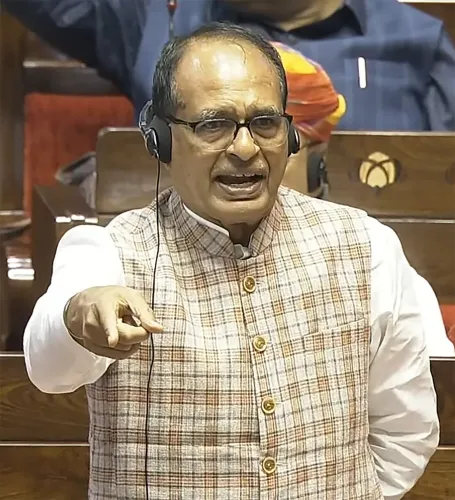
Bihar CM Samrat Choudhary amplified Home Minister Amit Shah's charge that Congress's reported decision to sing only two stanzas of Vande Mataram repeats a 1937 appeasement move and dishonours freedom fighters who made the song their rallying cry.
Key Takeaways
Bihar CM Samrat Choudhary shared Home Minister Amit Shah's statement attacking Congress over the Vande Mataram stanzas issue on 20 August 2026 .
Shah accused Congress of repeating its 1937 Working Committee decision to sing only the first two stanzas of the national song.
The post called the move an act of 'appeasement politics' and an insult to Bankim Chandra Chattopadhyay , the song's 19th-century author.
BJP has consistently promoted full recitation of Vande Mataram at official events, framing partial singing as minority appeasement.
The Congress party had not issued a formal response to the charge at the time of publication.
A song that once moved millions to defy colonial rule is at the centre of a fresh political storm. Bihar Chief Minister Samrat Choudhary on Thursday, 20 August 2026, amplified a sharp attack by Union Home Minister Amit Shah, targeting the Indian National Congress over its position on singing only two stanzas of Vande Mataram — calling it an act of appeasement that dishonours both the song's creator and India's freedom fighters.
Quoting Home Minister Amit Shah directly, CM Choudhary posted: 'कांग्रेस का वंदे मातरम् के केवल दो छंद गाने का निर्णय उसकी तुष्टिकरण की राजनीति को फिर उजागर करता है' — 'Congress's decision to sing only two stanzas of Vande Mataram once again exposes its politics of appeasement.' The post went on to accuse Congress of repeating its 1937 position and insulting the legacy of the countless freedom fighters who made the song their rallying cry.
The 1937 decision that refuses to stay buried
The controversy has deep roots. In 1937, the Congress Working Committee formally resolved that only the first two stanzas of Vande Mataram would be sung at party sessions, a decision taken in the context of concerns raised by Muslim leaders that later stanzas contained imagery they found objectionable. That resolution has shadowed the party ever since, periodically resurfacing as a flashpoint between secular and cultural-nationalist camps in Indian politics.
Bankim Chandra Chattopadhyay, the towering 19th-century Bengali novelist who composed the poem, originally published it in his 1882 novel Anandamath. The song became a battle cry of the independence movement — sung at protests, in jails, and on the gallows. Its adoption as India's national song in 1950 was a recognition of that sacrificial weight. To truncate it, BJP leaders argue, is to selectively honour that sacrifice.
BJP's cultural-nationalism playbook — and why Bihar's CM is amplifying it
This is not an isolated outburst. Successive BJP governments at the Centre have consistently promoted full recitation of Vande Mataram at official events, framing any partial singing as minority appeasement. By amplifying Shah's statement, CM Choudhary — a senior Bihar BJP leader — is reinforcing that line in a state where identity politics and cultural symbolism carry significant electoral weight.
The timing matters too. Any fresh Congress move on the stanzas question — if confirmed — hands the BJP a ready-made cultural wedge ahead of legislative sessions and state political cycles. The Congress has not yet issued a formal response to Shah's remarks as of the time of this report.
Vande Mataram has never been just a song. It has always been a political argument — about who owns the freedom struggle's memory, and who gets to define what patriotism looks like in a plural democracy. That argument, it turns out, is still very much alive.
Point of View
Reliably activated to frame Congress as soft on national symbols. By amplifying Amit Shah's statement, CM Choudhary signals Bihar BJP's alignment with the Centre's identity-politics messaging ahead of what could be a charged parliamentary session. The 1937 Congress decision — however contextually complex — remains a durable liability the BJP exploits with precision. Whether Congress chooses to engage or stay silent will itself be read as a political signal.
NationPress
5 Oct 2026
Frequently Asked Questions
Why does Congress sing only two stanzas of Vande Mataram?
In 1937 , the Congress Working Committee resolved to sing only the first two stanzas of Vande Mataram at party sessions, following objections from some Muslim leaders who found imagery in the later stanzas problematic. BJP leaders have long criticised this position as minority appeasement.
What did Amit Shah say about Vande Mataram and Congress?
Home Minister Amit Shah stated that Congress's decision to sing only two stanzas of Vande Mataram exposes its 'appeasement politics,' and accused the party of insulting both Bankim Chandra Chattopadhyay's creation and the freedom fighters who used the song as their rallying cry.
Who wrote Vande Mataram?
Bankim Chandra Chattopadhyay , a 19th-century Bengali novelist, composed Vande Mataram. It first appeared in his 1882 novel Anandamath and became a central anthem of India's independence movement before being adopted as the national song in 1950 .
What is Bihar CM Samrat Choudhary's role in the Vande Mataram controversy?
Bihar Chief Minister Samrat Choudhary amplified Home Minister Amit Shah's statement on the issue, signalling the Bihar BJP's alignment with the BJP's broader cultural-nationalist messaging on national symbols.
Is Vande Mataram India's national anthem or national song?
Vande Mataram is India's national song , not the national anthem. Jana Gana Mana is the national anthem. Vande Mataram was adopted as the national song in 1950 in recognition of its role in the independence movement.