CM Samrat Choudhary Backs BJP Chief's 'Democracy' Jab
Synopsis
Bihar CM Samrat Choudhary on October 29 shared a sharp quote by BJP National President Nitin Nabin, warning that those dreaming of 'regime change' fail to grasp the true strength of India's democracy — a pointed signal amid ongoing political tensions.
Key Takeaways
Bihar Chief Minister Samrat Choudhary amplified a statement by BJP National President Nitin Nabin on October 29, 2026 .
The quote warns: those dreaming of 'regime change' do not understand the real strength of India's democracy.
No specific opposition party or individual is named in the statement.
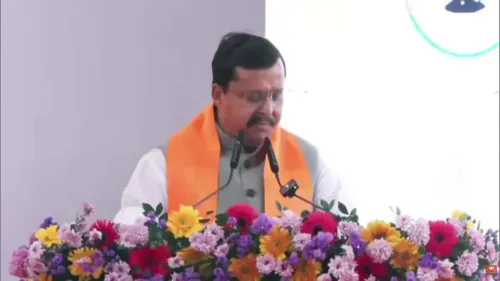
The post was shared with a video attached, suggesting the quote originates from a formal speech.
Bihar's 40 Lok Sabha seats make the state — and its CM — a key amplifier in BJP's national messaging strategy.
Opposition responses had not emerged at the time of publication.
A pointed political message ricocheted across Bihar's corridors of power on Thursday, October 29, 2026, as Bihar Chief Minister Samrat Choudhary amplified a sharp rebuke to anyone dreaming of 'regime change' in India — quoting BJP National President Nitin Nabin to drive home the point.
The post, shared by CM Choudhary on X, quotes the BJP chief as saying: 'Regime Change ke sapne dekhne waalon ko is desh ke loktantra ki vastavik taakat ka andaaza nahin hai' — 'Those dreaming of regime change have no idea of the real strength of this country's democracy.' No target is named. No occasion is specified. The message is the entirety of the statement — and it lands like a full stop.
The phrase 'Regime Change' and what it signals
The term 'regime change' carries particular charge in Indian political discourse. When BJP leaders deploy it, they typically frame it as an imported concept — an agenda driven by forces outside electoral arithmetic. By invoking it here, the BJP national president positions any challenge to the current government not as routine democratic opposition, but as something fundamentally at odds with India's own democratic tradition.
CM Choudhary's decision to amplify the quote — rather than issue his own original statement — is itself a political act. It signals alignment, and it widens the message's reach into Bihar, a state that has been a bellwether in national political calculations for decades.
Bihar's weight in BJP's national calculus
Bihar, with its 40 Lok Sabha seats, remains one of the most strategically consequential states on India's political map. A sitting Chief Minister amplifying the party president's rhetoric on democratic resilience underscores how seriously the BJP is treating any narrative that questions its mandate — at both state and national levels.
BJP leaders have consistently framed their electoral victories as popular verdicts that cannot be undone by elite commentary or opposition manoeuvring. This statement fits squarely into that pattern: confident, declarative, and aimed at pre-empting a challenge before it fully crystallises.
Opposition reactions to the statement had not emerged at the time of publication — but given the directness of the provocation, a response is unlikely to be long in coming.
Point of View
Allowing the party to occupy the ground of democratic legitimacy rather than merely partisan competition. By having the BJP national president articulate it and a sitting Chief Minister amplify it, the party signals a coordinated, top-down messaging discipline. In Bihar specifically, where coalition arithmetic is perpetually fluid, such declarations also serve an internal stabilising function — projecting confidence to local allies and cadre. The unanswered question is what specific event or narrative triggered this particular salvo at this particular moment.
NationPress
29 Oct 2026
Frequently Asked Questions
What did Bihar CM Samrat Choudhary post about regime change?
CM Samrat Choudhary shared a quote by BJP National President Nitin Nabin on October 29, 2026, stating that those dreaming of 'regime change' do not understand the true strength of India's democracy.
Who is Nitin Nabin and what is his role in BJP?
Nitin Nabin is the BJP National President who was quoted in the post. The post identifies him as the senior BJP leader who delivered the 'regime change' remark, which CM Choudhary amplified on X.
What does 'regime change' mean in Indian politics?
In Indian political discourse, 'regime change' is a phrase often used by ruling party leaders to describe efforts — real or perceived — to dislodge the government through means outside of electoral competition, framing such moves as undemocratic.
Why did Samrat Choudhary share this statement?
As Bihar CM and a senior BJP leader, Choudhary amplified the party president's statement to signal alignment with the national party message and extend its reach into Bihar's politically significant electorate.
What is Bihar's importance in Indian national politics?
Bihar sends 40 members to the Lok Sabha, making it one of the largest and most strategically important states in Indian national elections, which gives its Chief Minister significant weight as a political voice.