Tharoor flags Frontline piece on Rahul Gandhi's opposition rise
Synopsis
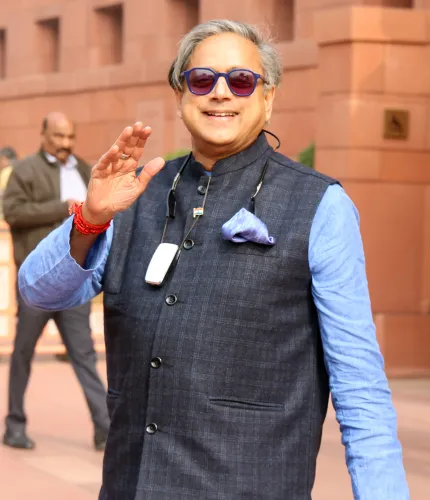
Congress MP Dr. Shashi Tharoor amplified a Frontline essay arguing Rahul Gandhi is becoming a self-made opposition stalwart against PM Modi — a skill, the analysis says, never part of his political inheritance. The signal lands as Congress eyes 2029.
Key Takeaways
Shashi Tharoor shared a Frontline analysis by Khalid Akhter on 29 October 2026 praising Rahul Gandhi 's evolution as an opposition figure.
The piece argues Gandhi's credibility as a challenger to PM Narendra Modi is an acquired skill, not a dynastic inheritance.
Rahul Gandhi led the Bharat Jodo Yatra — a 3,570 km march from Kanyakumari to Kashmir between September 2022 and January 2023 — as a key grassroots pivot.
Congress has been in national opposition since 2014 , with Gandhi resigning as party president after the 2019 defeat.
Tharoor's amplification of the piece carries internal-party significance as Congress positions itself ahead of the 2029 general election .
Can an heir apparent reinvent himself as a self-made challenger? That is the question at the heart of a political analysis Congress MP Dr. Shashi Tharoor highlighted on Thursday, 29 October 2026 — drawing attention to a Frontline essay arguing that Rahul Gandhi may be mastering an art of opposition that was never part of his political inheritance.
Tharoor quoted the analysis by writer Khalid Akhter, which argues that Gandhi's 'emergence as a more credible national challenger to Modi suggests that he may be mastering an art of opposition that was never part of his political inheritance.' The framing is pointed: not a dynastic gift, but a learned and earned skill.
From family legacy to foot-soldier of the opposition
The backdrop matters. Congress lost national power in 2014 and remained in opposition after 2019, a period during which Rahul Gandhi resigned as party president following the party's second consecutive general-election defeat. For years, critics across the spectrum — including within Congress — questioned whether he possessed the tenacity and strategic instinct for a long opposition haul against a dominant BJP under Prime Minister Narendra Modi.
The pivot the analysis points to is embodied most visibly in the Bharat Jodo Yatra — a 3,570 km march Gandhi led from Kanyakumari to Kashmir between September 2022 and January 2023. Built on themes of social cohesion and economic inequality, the Yatra was a deliberate break from the press conference and Parliament corridor model of opposition, trading institutional access for street-level reach. The optics shifted; so, analysts argued, did the perception of Gandhi's commitment and stamina.
Why Tharoor's signal amplification matters
Tharoor's decision to surface the piece is itself a political act — gentle but deliberate. As one of Congress's most prominent public intellectuals and an MP from Thiruvananthapuram, his endorsement of an analysis praising Gandhi's growth adds an internal-party dimension to an otherwise academic argument. It signals alignment within a party that has not always spoken with one voice about its leader's trajectory.
The timing, too, is not incidental. With state assembly elections on the horizon and Congress watching its opposition alliance-building ahead of the 2029 general election, any credible narrative of a revitalised challenger is politically useful currency.
The art nobody taught him
The Akhter piece, as quoted by Tharoor, frames Gandhi's evolution as an acquisition — something cultivated, not inherited. That is a more interesting argument than simple rehabilitation. It suggests that the Nehruvian surname, which once simultaneously opened doors and invited cynicism, is now less the story than the man navigating around it.
Whether the analysis holds up in ballot boxes remains the only test that matters in Indian politics. But in a landscape where opposition credibility is itself a contested resource, the very existence of this debate — carried in serious political journalism and amplified by a senior Congress colleague — marks a shift in how Gandhi's political standing is being narrated.
The heir who had to earn it: that is the story Congress most wants told heading into the next electoral cycle.
Point of View
However, is whether this narrative holds traction in state elections before the next Lok Sabha cycle.
NationPress
29 Oct 2026
Frequently Asked Questions
What did Shashi Tharoor say about Rahul Gandhi on X?
Tharoor shared a Frontline analysis by Khalid Akhter arguing that Rahul Gandhi is emerging as a more credible national challenger to PM Modi by mastering an art of opposition that was never part of his political inheritance.
What is the Bharat Jodo Yatra?
The Bharat Jodo Yatra was a 3,570 km march led by Rahul Gandhi from Kanyakumari to Kashmir between September 2022 and January 2023 , focused on themes of social unity and economic inequality.
Why did Rahul Gandhi resign as Congress president?
Rahul Gandhi resigned as Congress president in 2019 following the party's second consecutive general-election defeat to the BJP under Prime Minister Narendra Modi.
Is Rahul Gandhi a strong opposition leader against Modi?
A Frontline analysis highlighted by Tharoor argues that Gandhi's public campaigning — especially the Bharat Jodo Yatra — has strengthened his credibility as an opposition figure, though electoral results remain the definitive measure.
What is Congress's strategy ahead of the 2029 general election?
Congress is focused on rebuilding grassroots connect and opposition alliance formation, with Rahul Gandhi's evolved public profile and campaigns like the Bharat Jodo Yatra central to the party's positioning ahead of 2029 .