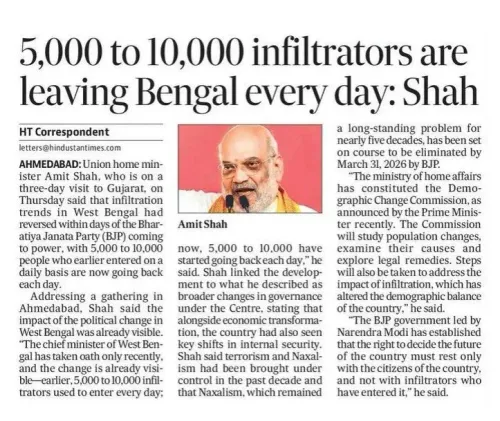
Mahua Moitra Cites EC Data to Challenge Shah's Infiltrator Claim
Synopsis
TMC MP Mahua Moitra has cited Election Commission SIR exercise data claiming only 1,600 foreigners were identified across 9.86 crore voters in six states, directly challenging Home Minister Amit Shah's repeated 'Ghoospetia' — illegal infiltrator — narrative that has anchored BJP campaigns in eastern India since 2014.
Key Takeaways
The Election Commission's Special Intensive Revision (SIR) exercise identified just 1,600 foreigners across 9.86 crore voters in six states , according to the data cited by Moitra — roughly 0.0016 percent of the sampled electorate.
TMC MP Mahua Moitra used the figure to directly challenge Union Home Minister Amit Shah 's 'Ghoospetia' (illegal infiltrator) narrative, calling it a claim 'repeated ad nauseum by every BJP illiterate.' BJP has deployed the infiltration argument extensively in West Bengal and Assam since at least 2014 , framing illegal immigration as a threat to electoral integrity.
The Assam NRC , finalised in 2019 under Supreme Court supervision, was the most exhaustive citizenship verification exercise in the region but left many cases unresolved.
Critics may argue the SIR exercise is not a forensic citizenship audit and detection rates depend on methodology and ground-level verification — meaning the figure does not definitively settle the debate in either direction.
The post intensifies a long-running political fault line in eastern India where immigration, identity politics, and electoral roll integrity remain deeply contested.
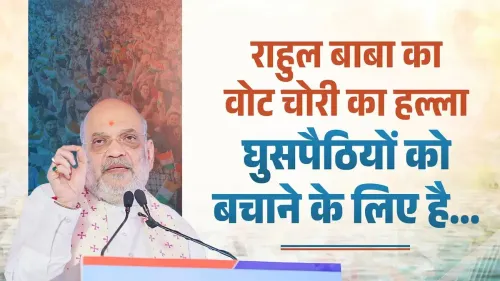
A number that is either a bombshell or a footnote — depending on which side of India's sharpest electoral argument you stand — landed on social media on Thursday, October 29, 2026. TMC MP Mahua Moitra cited what she described as Election Commission of India data showing just 1,600 foreigners identified across 9.86 crore voters in six states during a Special Intensive Revision (SIR) exercise, firing a direct broadside at Union Home Minister Amit Shah's long-running 'Ghoospetia' — illegal infiltrator — narrative.
Moitra framed the figure bluntly: 'Only 1600 foreigners found among 9.86 crore voters across 6 states. This is the reality of Amit Shah's Ghoospetia narrative repeated ad nauseum by every BJP illiterate.' The data point, if confirmed, would place the proportion of identified foreign voters at roughly 0.0016 percent of the sampled electorate — a vanishingly small fraction relative to the scale of the threat Shah has repeatedly invoked on campaign platforms.
Shah's 'Ghoospetia' Narrative and Its Electoral Life
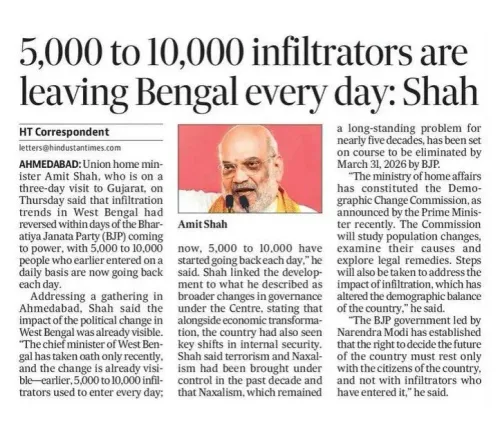
The infiltration argument has been a cornerstone of BJP electoral messaging in eastern India — particularly West Bengal and Assam — since at least 2014. Shah has deployed the 'Ghoospetia' charge at rally after rally, arguing that illegal immigrants from Bangladesh have penetrated voter rolls, skewing electoral outcomes and straining state resources. The message has had real political traction: it taps anxieties in border districts and frames immigration as an existential question for Indian democracy.
The Assam National Register of Citizens, finalised in 2019 under Supreme Court supervision after a years-long, resource-intensive exercise, was the most exhaustive attempt yet to separate citizens from non-citizens. Even that exercise produced contested results — with over 19 lakh people excluded, but many cases still unresolved years later — underlining how fraught the question of documentation remains in border regions.
What the SIR Exercise Found — and What It Does Not Settle
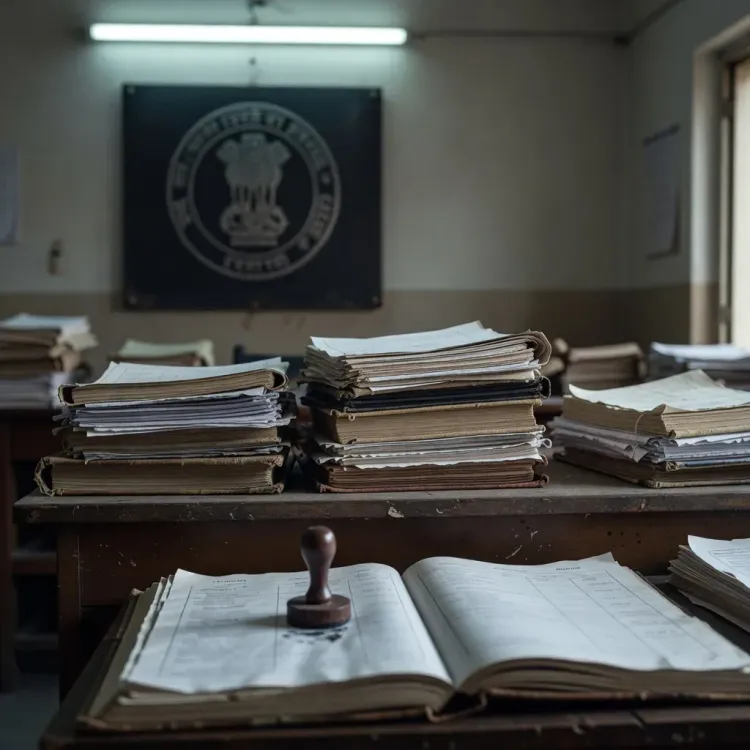
The Election Commission's Special Intensive Revision exercise is a periodic audit of electoral rolls, designed to add eligible voters, delete duplicates, and weed out ineligible entries including foreigners. That only 1,600 individuals across six states were flagged in this round is the data Moitra is wielding — but critics of her interpretation are likely to argue that an administrative exercise is not the same as a forensic investigation, and that detection rates depend heavily on the methodology, documentation requirements, and ground-level verification capacity deployed.
The Election Commission has neither historically claimed nor been resourced to conduct a full NRC-style exercise in every state. That limitation cuts both ways: it means the 1,600 figure may undercount the actual problem, but it also means the alarmist figures sometimes cited in political speeches have no more verified basis than the Commission's own modest count.
Why This Number Will Not End the Argument
Moitra's post arrives in a context where immigration, identity, and electoral integrity are deeply entangled with the politics of West Bengal — her own constituency of Krishnanagar sits in a state that borders Bangladesh and has seen intense political contestation over precisely these questions. For the TMC, pushing back on infiltration rhetoric is both a principled position and a strategic imperative: the party has consistently argued that BJP's campaign conflates Bengali Muslims with illegal immigrants, with consequences for millions of legitimate citizens.
For the BJP, the argument has never rested solely on verifiable vote-roll numbers — it is also about the broader claim of unchecked border crossings and demographic change, which sits outside the Election Commission's mandate entirely. Both sides, in other words, are talking past each other with numbers that measure different things.
The real test will come when Parliament or a court demands the full SIR methodology, state-by-state breakdowns, and the criteria used to flag — or clear — a voter as foreign. Until then, 1,600 is a number both sides will use as ammunition, and neither will treat as a verdict.
Point of View
The 1,600 figure risks being dismissed as an undercount by those who argue administrative roll revisions are structurally incapable of catching sophisticated documentation fraud. The deeper contest is not really about one number — it is about whose evidentiary standard governs a debate that has defined the politics of eastern India for over a decade.
NationPress
29 Oct 2026
Frequently Asked Questions
How many foreigners were found on voter rolls in the Election Commission SIR exercise?
According to the data cited by TMC MP Mahua Moitra, the Election Commission's Special Intensive Revision exercise identified just 1,600 foreigners across 9.86 crore voters in six states.
What is Amit Shah's 'Ghoospetia' narrative?
'Ghoospetia' is a Hindi term for illegal infiltrator. Home Minister Amit Shah has used it repeatedly in BJP campaign speeches — particularly in West Bengal and Assam — to argue that illegal immigrants from Bangladesh have entered India and been added to voter rolls, posing a threat to electoral integrity.
What is the Election Commission's Special Intensive Revision (SIR) exercise?
The SIR is a periodic audit of electoral rolls conducted by the Election Commission of India to add eligible voters, delete duplicates, and identify ineligible entries including foreigners — though it is an administrative exercise, not a forensic citizenship verification process.
What was the Assam NRC and what did it find?
The Assam National Register of Citizens was finalised in 2019 under Supreme Court supervision to separate citizens from non-citizens in Assam. Over 19 lakh people were excluded from the final list, but many cases remain legally unresolved years after publication.
Why does the infiltration debate matter for West Bengal politics?
West Bengal shares a long border with Bangladesh and has a large Bengali Muslim population, making immigration and identity deeply contested political issues. BJP's infiltration narrative targets these demographics, while TMC argues it conflates legitimate citizens with illegal immigrants — a dispute with direct consequences for voter confidence and communal relations.