CM Samrat Choudhary Leads 'Loktantra Bachao' March in Patna
Synopsis
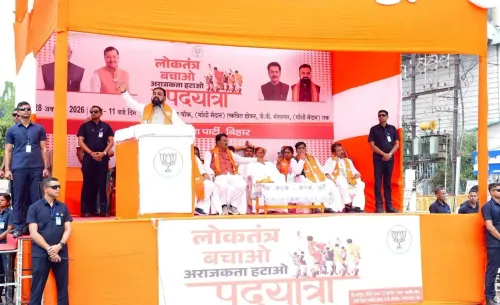
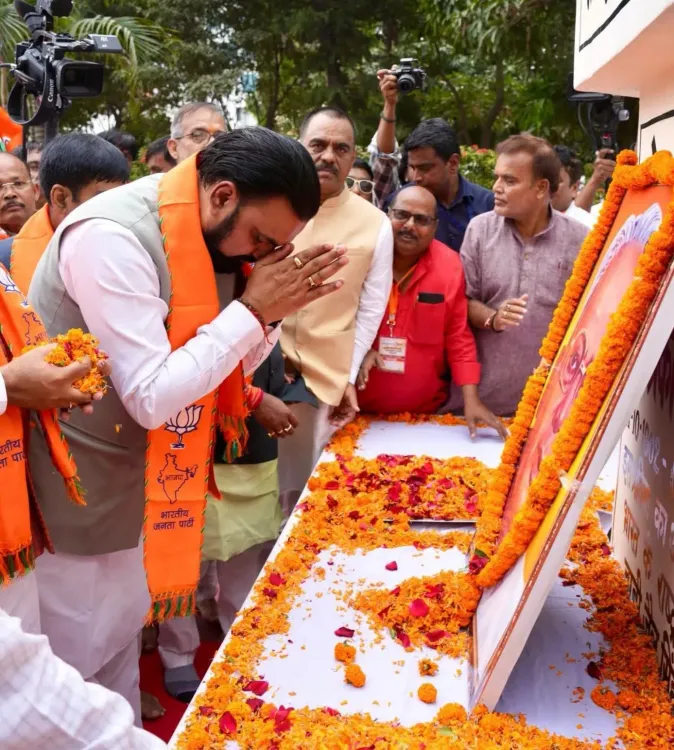
Bihar Chief Minister Samrat Choudhary participated in a large 'Loktantra Bachao, Arajakta Hatao' padyatra in Patna on October 28, 2026, accusing Congress of fomenting anarchy with alleged international backing and vowing a public reckoning.
Key Takeaways
Bihar CM Samrat Choudhary joined a padyatra titled 'Loktantra Bachao, Arajakta Hatao' in Patna on October 28, 2026 .
Choudhary accused Congress and allied parties of spreading anarchy in India with the support of what he called 'international forces'.
The march drew a large crowd in Patna, Bihar's capital and a high-stakes political arena given the state's 40 Lok Sabha seats .
The BJP has used similar 'democracy vs anarchy' framing in multiple states during periods of heightened political mobilisation against Congress-led alliances.
Opposition reactions and potential counter-marches in Patna are expected to follow in the coming days.
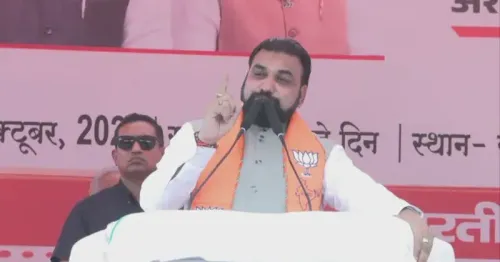
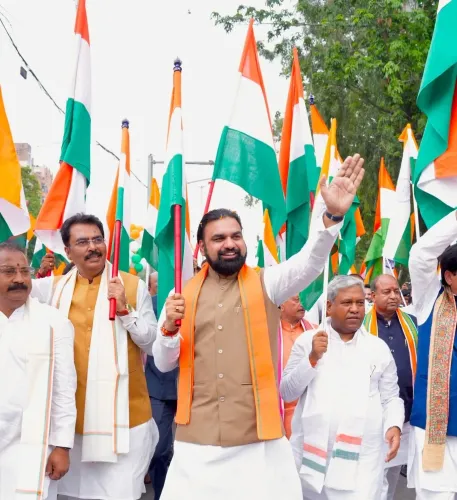
A sea of supporters filled the streets of Patna on Wednesday, October 28, 2026, as Bihar Chief Minister Samrat Choudhary joined a large-scale padyatra under the banner 'Loktantra Bachao, Arajakta Hatao' — 'Save Democracy, Remove Anarchy' — in a show of political muscle that reverberated through the state capital.
What the March Declared
Choudhary, a senior BJP leader, used the occasion to directly target the Indian National Congress and what he termed their 'entire gang', accusing them of harbouring a mindset aimed at spreading anarchy in the country with the backing of what he called 'international forces'. 'The public will give a befitting reply to the mentality of spreading anarchy in the country,' he wrote, framing the gathering as a democratic counter-punch from ordinary citizens.
The march's name — combining a defence of democracy with a call to end disorder — is a pointed political formulation, designed to invert the opposition's own democratic language and turn it back on them.
Patna as the Political Battleground
Choosing Patna as the venue is no accident. Bihar's capital has historically been a barometer of political momentum in a state that sends 40 Lok Sabha seats to Parliament — among the highest of any state — making its streets a prized symbolic stage. A well-attended padyatra in Patna signals organisational depth and the ability to mobilise at short notice.
The BJP has increasingly framed opposition street politics as destabilising rather than democratic, a rhetorical strategy deployed across multiple Indian states whenever political mobilisation intensifies between the BJP and Congress-led alliances. Choudhary's post fits squarely within that pattern — but the scale of the Patna gathering, if borne out, gives it local electoral weight beyond messaging alone.
The 'International Forces' Charge
The allegation of foreign backing for domestic opposition activity is a recurring and sharply contested line in Indian political discourse. By invoking it here, Choudhary escalates the rhetorical stakes: this is no longer framed as a local political rivalry but as a question of national sovereignty. Opposition parties are expected to reject the charge firmly. Whether counter-marches or formal responses emerge from Bihar's opposition in the coming days will indicate how seriously they treat the provocation.
For now, the streets of Patna have delivered Choudhary a visible, photogenic platform — and Bihar's voters are watching both sides to see who moves next.
Point of View
Rather than the incumbent being challenged. The 'international forces' allegation raises the rhetorical stakes beyond Bihar, tapping into a broader national-security frame the BJP has deployed successfully in previous election cycles. For Choudhary personally, commanding a mass street event in Patna reinforces his standing as the face of BJP governance in Bihar ahead of any future electoral test. The opposition's response — whether it counters on the streets or in the assembly — will define the next chapter of this political contest.
NationPress
28 Oct 2026
Frequently Asked Questions
What is the 'Loktantra Bachao, Arajakta Hatao' padyatra in Patna?
It is a political march organised in Patna on October 28, 2026, in which Bihar Chief Minister Samrat Choudhary participated. The march, whose name translates to 'Save Democracy, Remove Anarchy', was aimed at countering what the BJP describes as destabilising activity by Congress and allied opposition parties.
What did Samrat Choudhary say about Congress at the padyatra?
Choudhary accused Congress and their allies of spreading anarchy in India with the backing of international forces, and said the public would give them a 'befitting reply'.
Why did the BJP hold a padyatra in Patna specifically?
Patna is the capital of Bihar, a state that sends 40 MPs to Parliament — one of the largest contingents in the country. Holding a large-scale march there carries significant symbolic and electoral weight.
What does 'international forces' mean in Samrat Choudhary's post?
Choudhary's post alleges that foreign powers are backing the Congress-led opposition's efforts to spread disorder in India. The claim is a recurring and contested allegation in BJP political messaging; the opposition typically denies such charges.
What is likely to happen next after the Patna padyatra?
Observers are watching for formal responses from Bihar opposition parties and any counter-marches or public statements that may follow in Patna in the coming days.