CM Samrat Choudhary pays tribute to Ratan Tata on death anniversary
Synopsis
Bihar Chief Minister Samrat Choudhary marked the first death anniversary of industrialist and Padma Vibhushan recipient Ratan Tata on October 9, 2026, honouring his visionary leadership, humble character, and enduring contribution to India's nation-building.
Key Takeaways
Bihar Chief Minister Samrat Choudhary paid tribute to Ratan Tata on his first death anniversary, October 9, 2026 .
Tata was a Padma Vibhushan awardee, conferred in 2008 , India's second-highest civilian honour.
He chaired the Tata Group from 1991 to 2012 , overseeing major global acquisitions including Jaguar Land Rover .
CM Choudhary specifically praised Tata's 'visionary leadership,' 'simple personality,' and 'contribution to nation-building.' Tributes from political leaders across the spectrum reflect Tata's rare stature as a figure celebrated in both commerce and governance.
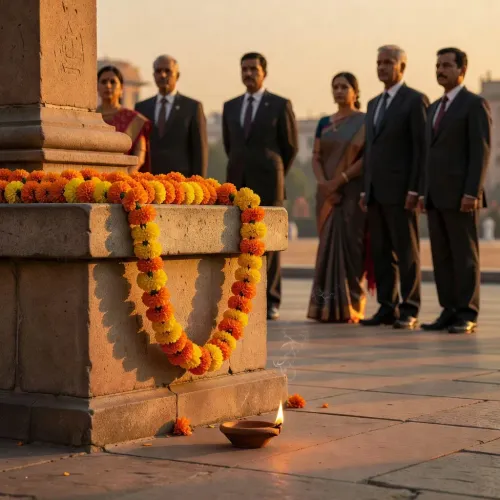
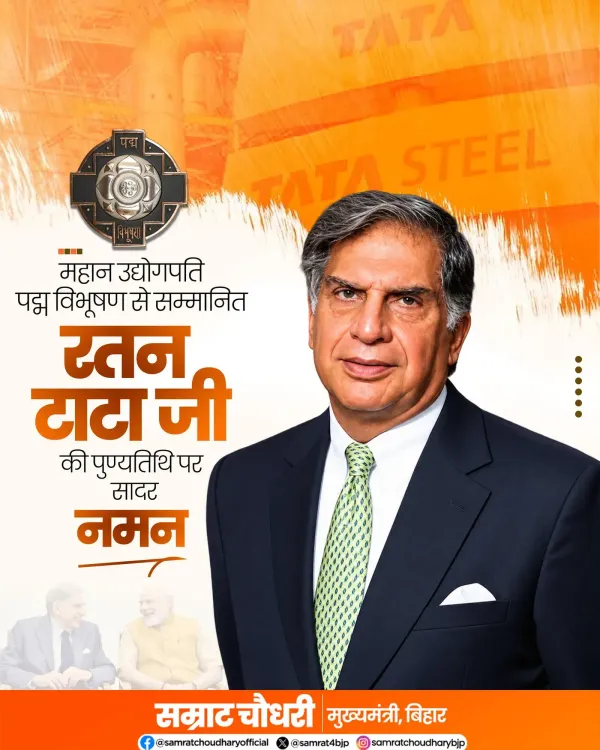
A year after India lost one of its most consequential industrialists, tributes continue to pour in from across the political spectrum. Bihar Chief Minister Samrat Choudhary on Friday, October 9, 2026, marked the first death anniversary of Ratan Tata — Padma Vibhushan awardee and former chairman of the Tata Group — with a heartfelt message of remembrance on X.
In his post, CM Choudhary wrote: 'Mahan udyogpati evam Padma Vibhushan se sammanit Ratan Tata ji ki punyatithi par unhe sadar naman.' ('On the death anniversary of the great industrialist and Padma Vibhushan honouree Ratan Tata, I offer my respectful homage.') He added that Tata's 'visionary leadership in the world of industry, his simple personality, and his contribution to nation-building will always be remembered.'
The legacy being remembered
Ratan Tata helmed the Tata Group as its chairman from 1991 to 2012, steering the conglomerate through transformative decades that included landmark global acquisitions — among them Jaguar Land Rover and Corus Steel — and a commitment to affordable innovation most visible in the Tata Nano project. He was widely regarded not just as a business titan but as a moral voice in Indian corporate life, known for his philanthropy and his understated personal style, qualities CM Choudhary's tribute specifically highlights.
Tata was conferred the Padma Vibhushan, India's second-highest civilian honour, in 2008, recognising a career that fundamentally shaped modern Indian industry. His death marked the end of an era for Indian business, and the anniversary has prompted reflection from leaders across government and commerce on what his model of 'nation-building through enterprise' means for India's next chapter.
The tribute from a sitting Chief Minister underscores how Tata's influence extended well beyond boardrooms — into the vocabulary of governance itself, where phrases like 'visionary leadership' and 'national contribution' are now routinely benchmarked against his example. Bihar, a state prioritising industrial investment and infrastructure, carries its own stake in that legacy as it courts private capital to drive growth.
One year on, Ratan Tata remains the rare figure both business leaders and politicians claim as common inspiration — a standard that will continue to shape how India measures corporate citizenship for decades to come.
Point of View
A framing that carries policy weight in states like Bihar actively seeking private investment. Choudhary's emphasis on 'nation-building' and 'visionary leadership' maps neatly onto the BJP's broader narrative of growth-through-enterprise. The annual recurrence of such tributes from across party lines also points to a political consensus around Tata as an untouchable icon — one whose memory can be invoked without controversy. That consensus itself shapes the standard against which future Indian industrialists will be publicly judged.
NationPress
9 Oct 2026
Frequently Asked Questions
When did Ratan Tata pass away?
Ratan Tata passed away in October 2025, and his first death anniversary falls on October 9, 2026.
What award did Ratan Tata receive from the Indian government?
Ratan Tata was conferred the Padma Vibhushan in 2008 , India's second-highest civilian honour, in recognition of his contributions to trade and industry.
Who is Samrat Choudhary?
Samrat Choudhary is the Chief Minister of Bihar and a senior leader of the Bharatiya Janata Party (BJP).
What was Ratan Tata's role in the Tata Group?
Ratan Tata served as chairman of the Tata Group from 1991 to 2012, leading the conglomerate through major global acquisitions including Jaguar Land Rover and Corus Steel.
Why do Indian politicians pay tribute to Ratan Tata?
Ratan Tata is widely regarded as a model of ethical entrepreneurship, philanthropy, and nation-building, making him a figure celebrated across political and corporate life in India.