CM Samrat Choudhary hails Agni-4 test as Atmanirbhar leap

Synopsis
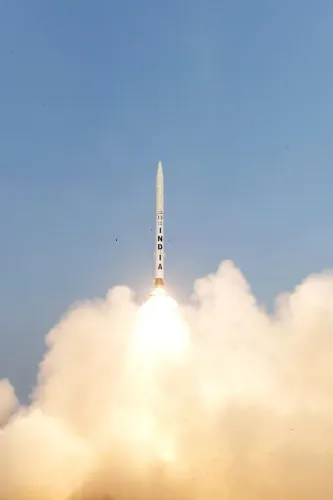
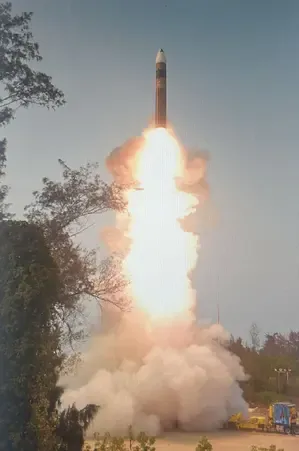
Bihar Chief Minister Samrat Choudhary hailed the successful test of India's Agni-4 intermediate-range ballistic missile on 7 August 2026, linking the achievement to PM Modi's Atmanirbhar Bharat drive and calling it a milestone for India's indigenous strategic capability.
Key Takeaways
Bihar Chief Minister Samrat Choudhary welcomed the successful test of the Agni-4 ballistic missile on 7 August 2026 .
The Agni-4 , developed by DRDO , is an intermediate-range ballistic missile and a key element of India's strategic deterrence architecture.
The missile's development traces back to the Integrated Guided Missile Development Programme launched in 1983 .
CM Choudhary framed the test within PM Modi's Atmanirbhar Bharat Abhiyan , announced in May 2020 , which prioritises indigenous defence manufacturing.
The Agni-4's first successful test flight was conducted in November 2012 from Wheeler Island , Odisha.
The BJP has consistently linked DRDO successes to the Atmanirbhar Bharat narrative as a whole-of-party communication strategy.
India's strategic arsenal just got a fresh vote of confidence. Bihar Chief Minister Samrat Choudhary on Friday, 7 August 2026, welcomed the successful test of the Agni-4 ballistic missile, calling it proof of the country's relentless march toward indigenous defence capability — and framing it squarely within Prime Minister Narendra Modi's Atmanirbhar Bharat vision.
Posting on X, CM Choudhary wrote: 'Agni-4 ballistik misail ka saphal parikshan Bharat ki swadeshi raksha kshamata aur takniki samarthya mein nirantar ho rahi pragati ka praman hai' — 'The successful test of the Agni-4 ballistic missile is proof of the continuous progress in India's indigenous defence capability and technological strength.' He added that under PM Modi's leadership, the nation is steadily reinforcing its strategic power in the spirit of a self-reliant India, and called the achievement 'a glorious milestone on the path to a strong and secure Bharat.'
Agni-4 and the missile that carries India's deterrence
The Agni-4 is an intermediate-range ballistic missile developed by the Defence Research and Development Organisation (DRDO) as a core pillar of India's strategic deterrence architecture. The missile first flew successfully in November 2012 from Wheeler Island off the Odisha coast, and successive tests since then have refined its reliability and readiness for induction into the Strategic Forces Command.
The Agni series itself traces its lineage to the Integrated Guided Missile Development Programme, launched in 1983 under the late Dr A.P.J. Abdul Kalam — a programme that transformed India from a missile importer into one of Asia's most capable indigenous developers. Each successful test is not just a technical milestone; it is a signal, calibrated and deliberate, read carefully in strategic capitals across the region.
Atmanirbhar Bharat's sharpest edge: defence indigenisation
When Prime Minister Modi announced the Atmanirbhar Bharat Abhiyan in May 2020, defence manufacturing was placed at the centre of the self-reliance push. India has since moved to restrict imports of hundreds of defence items, expand the private sector's role in weapons production, and accelerate DRDO-led programmes — of which the Agni series is the most visible symbol.
CM Choudhary's statement reflects a broader political consensus within the BJP that links every DRDO success to that larger policy narrative. The framing — 'Sashakt Bharat, Surakshit Bharat' ('A strong India, a secure India') — has become a consistent refrain as the government points to defence indigenisation as evidence that the Atmanirbhar agenda is delivering tangible, strategic results.
For DRDO scientists and the Indian Armed Forces, the successful test is a validation of years of engineering work. For policymakers, it is ammunition — in every sense — for the argument that India no longer needs to depend on foreign suppliers for its most critical deterrent capabilities. The next question the strategic community will be watching: when does Agni-4 reach full operational status across the Strategic Forces Command?
Point of View
Coming amid sustained pressure to demonstrate self-reliance in critical technologies, gives the ruling party a concrete, high-visibility data point. It also signals that strategic deterrence messaging is no longer confined to the defence ministry; it is now a whole-of-party communication effort. The consistency of this framing across BJP leaders reinforces the government's positioning of defence indigenisation as a core governance achievement ahead of the next electoral cycle.
NationPress
22 Sept 2026
Frequently Asked Questions
What is the Agni-4 missile?
The Agni-4 is an intermediate-range ballistic missile developed by India's DRDO as part of the Agni series, designed to strengthen India's strategic nuclear deterrence capability.
When was the Agni-4 missile first tested?
The Agni-4 first flew successfully in November 2012 from Wheeler Island off the Odisha coast, with further tests conducted to improve its reliability and readiness.
What is Atmanirbhar Bharat in defence?
Atmanirbhar Bharat Abhiyan, announced by PM Modi in May 2020, is a self-reliance initiative that includes restricting defence imports and boosting indigenous weapons development through DRDO and private sector participation.
Why did Bihar CM Samrat Choudhary comment on the Agni-4 test?
As a senior BJP leader, CM Choudhary praised the Agni-4 test to reinforce the party's narrative linking PM Modi's Atmanirbhar Bharat policy to tangible defence achievements.
What is the Strategic Forces Command in India?
The Strategic Forces Command is the Indian military body responsible for managing and operating India's nuclear weapons delivery systems, including ballistic missiles like the Agni series.