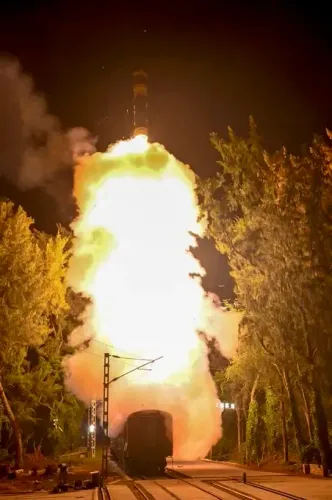
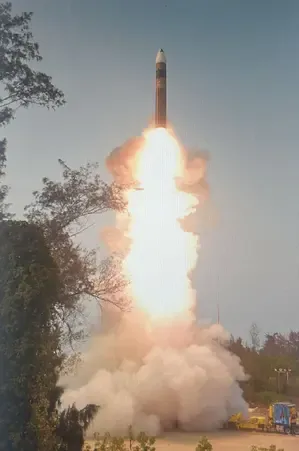
Rajnath Singh hails Agni-4 MRBM test as 'textbook mission'
Synopsis
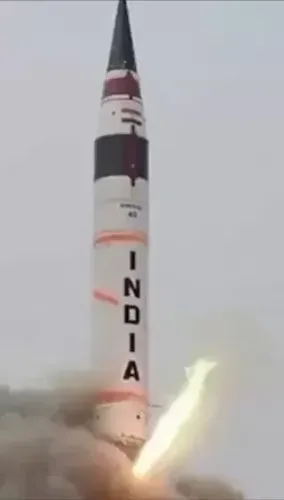
India's Strategic Forces Command and DRDO conducted a successful user trial of the Agni-4 medium-range ballistic missile from the Integrated Test Range in Odisha on 6 August 2026. Defence Minister Rajnath Singh hailed the launch as a 'textbook mission' reaffirming India's indigenous strategic deterrence capability.
Key Takeaways
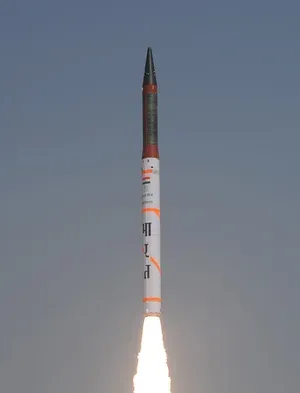
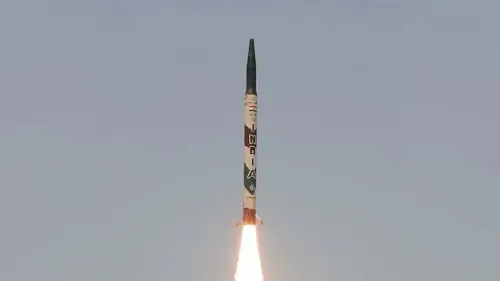
The Agni-4 MRBM , with a reported range of approximately 4,000 km , was successfully test-launched on 6 August 2026 from Chandipur, Odisha .
The trial was jointly conducted by the Strategic Forces Command and DRDO — a user trial, not a development test, signalling operational readiness.
Union Defence Minister Rajnath Singh described it as a 'textbook mission launch' and congratulated both organisations.
The Agni-4 is part of the Agni ballistic missile programme tracing its lineage to the IGMDP of the 1980s ; its first test flight was in November 2011 .
The test reinforces India's credible minimum deterrence doctrine through periodic validation of its land-based nuclear delivery systems.
India's nuclear deterrent got a sharp reaffirmation on 6 August 2026 — when the Strategic Forces Command (SFC) and the Defence Research and Development Organisation (DRDO) successfully launched the Agni-4 medium-range ballistic missile from the Integrated Test Range at Chandipur, Odisha. Union Defence Minister Rajnath Singh called it a 'textbook mission launch' that reaffirmed India's commitment to defend the nation with state-of-the-art technologies.
What the Agni-4 carries — and what it signals
The Agni-4 is a surface-to-surface ballistic missile with a reported range of approximately 4,000 km, placing it squarely in the medium-range class and capable of reaching targets deep into adversarial territory. Developed under DRDO's long-running Agni programme — itself a product of the Integrated Guided Missile Development Programme (IGMDP) initiated in the 1980s — the missile represents decades of indigenous engineering brought to operational maturity. Its first successful test flight was conducted in November 2011; what happened on 6 August is a different category of event entirely.
This was a user trial — conducted by the SFC, not DRDO alone. That distinction matters. A user trial signals that the system is no longer in development limbo; it is being validated for operational deployment by the command that would actually fire it in a crisis. The SFC, India's tri-service nuclear command, is the custodian of the country's strategic arsenal. When the SFC pulls the trigger on a test, the message is about readiness, not research.
Credible minimum deterrence in practice
India's nuclear doctrine rests on the principle of credible minimum deterrence — the assurance that a retaliatory second strike remains viable even after absorbing a first strike. Keeping that assurance credible requires periodic, rigorous validation of every link in the delivery chain: the missile's range, accuracy, reliability, and the command-and-control infrastructure around it. The Agni-4 test fits precisely into that pattern of periodic validation that the SFC and DRDO have maintained across successive governments.
Minister Singh's congratulations to 'SFC and DRDO for this textbook mission launch' — posted on the evening of the test itself — underscored the political salience the government attaches to demonstrating indigenous strategic capability. The phrase 'state of the art technologies' is a deliberate signal: India's deterrent is not a legacy system on life support, but an evolving, maintained force.
Odisha's Chandipur — India's missile proving ground
The Integrated Test Range at Chandipur on the Odisha coast has been the launchpad for virtually every major Indian ballistic and cruise missile trial. Its infrastructure — tracking radars, telemetry stations, and a sea range that allows missiles to fly long trajectories safely — makes it the irreplaceable node in India's missile testing architecture. The choice of ITR for an SFC user trial is standard practice, but the facility's track record lends each successful launch an institutional weight that goes beyond the single test.
With the Agni-4 user trial logged as a success, the next question the strategic community will watch is whether the SFC moves toward formal induction timelines — and whether the cadence of such trials accelerates as India's security environment continues to demand a sharper, faster deterrent.
Point of View
Not merely a technical milestone — it signals that India's land-based nuclear delivery chain is being actively maintained and validated under the command that would use it. Coming amid a period of sustained regional security pressure, the timing and the Defence Minister's swift public endorsement reflect a calibrated messaging strategy: India's strategic deterrent is indigenous, reliable, and ready. The emphasis on 'state of the art technologies' also feeds into the broader 'Atmanirbhar Bharat' defence narrative that has defined procurement and development policy since 2020. Analysts will watch whether this trial accelerates formal induction milestones for Agni-4 within the SFC's operational order of battle.
NationPress
21 Sept 2026
Frequently Asked Questions
What is the Agni-4 missile and what is its range?
The Agni-4 is an Indian surface-to-surface medium-range ballistic missile developed by DRDO with a reported range of approximately 4,000 km. It is part of the Agni series of missiles designed to deliver nuclear warheads as part of India's strategic deterrent.
Where was the Agni-4 missile tested on 6 August 2026?
The Agni-4 was launched from the Integrated Test Range located at Chandipur in Odisha, India's primary facility for ballistic and cruise missile trials.
What is the Strategic Forces Command and why did it conduct this test?
The Strategic Forces Command is a tri-service command of the Indian Armed Forces responsible for managing and operating India's nuclear weapons arsenal. Its involvement in this launch marks it as a user trial — validating the Agni-4 for operational deployment rather than for further development.
What did Rajnath Singh say about the Agni-4 test?
Union Defence Minister Rajnath Singh called it a 'textbook mission launch' and congratulated the Strategic Forces Command and DRDO, saying the test reaffirmed India's commitment to defend the nation with state-of-the-art technologies.
What is India's credible minimum deterrence doctrine?
Credible minimum deterrence is India's stated nuclear doctrine under which the country maintains a nuclear arsenal sufficient to guarantee a viable retaliatory second strike, while pledging no-first-use. Regular missile user trials like the Agni-4 test are part of keeping this deterrent operationally credible.