CM Samrat Choudhary Hails Padma Shri for Late Folk Guru Vishwa Bandhu
Synopsis
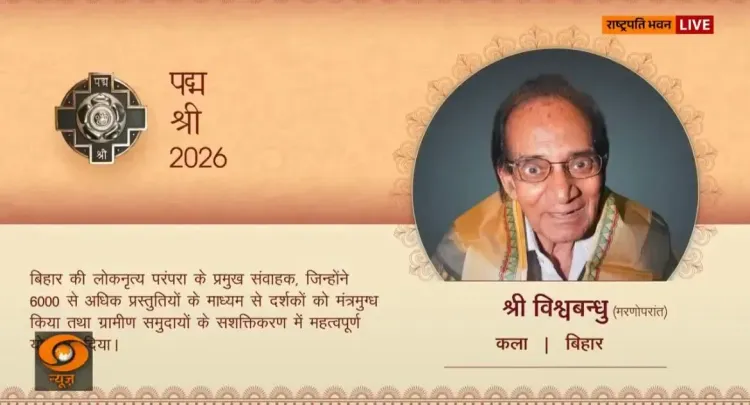
Bihar Chief Minister Samrat Choudhary on 25 May 2026 welcomed the Padma Shri conferred by the Government of India on late folk artist and dance guru Vishwa Bandhu, praising his role in reviving the Domkach dance and training thousands of students in Bihar's folk traditions.
Key Takeaways
Bihar Chief Minister Samrat Choudhary publicly welcomed the Padma Shri award conferred on late folk artist and dance guru Vishwa Bandhu by the Government of India .
Vishwa Bandhu is credited with training thousands of students in folk dance and reviving fast-disappearing traditional dance forms in Bihar.
He played a central role in popularising the Domkach dance , a traditional folk form associated with Bihar's rural communities, and reconnecting village society to it.
The Padma awards , instituted in 1954 , are among India's highest civilian honours, with the Padma Shri recognising distinguished contributions in arts and culture.
CM Choudhary described the recognition as an honour to Bihar's folk art, culture, and tradition and expressed hope it would inspire future generations to preserve their cultural heritage.
Bihar Chief Minister Samrat Choudhary on Monday, 25 May 2026 paid tribute to late folk artist and dance guru Vishwa Bandhu, welcoming the Government of India's decision to confer the Padma Shri award on him posthumously, calling it an honour to Bihar's folk art, culture, and tradition.
Context
In a post on X, Chief Minister Choudhary wrote that the Padma Shri recognition for the late Vishwa Bandhu was 'बिहार की लोककला, संस्कृति और परंपरा का सम्मान' — 'an honour to Bihar's folk art, culture, and tradition.' He noted that through his distinctive dance style and extraordinary artistic devotion, Vishwa Bandhu trained thousands of students in the art of dance and gave folk culture a new identity.
The Chief Minister further highlighted that the late guru had revived dying folk-dance traditions and connected them to the mainstream. He described Vishwa Bandhu's contribution to popularising the Domkach dance form and linking rural communities to it as 'incomparable and inspirational.'
Policy Backdrop
The Padma awards were instituted by the Government of India in 1954 and are among the country's highest civilian honours, conferred annually for distinguished contributions across fields including arts, culture, and public affairs. The Padma Shri is the fourth-highest of these awards and has historically been used to recognise practitioners of regional and folk traditions who might otherwise receive limited national attention.
Recognising folk artists from states such as Bihar forms part of a broader pattern of efforts by both central and state governments to document, preserve, and mainstream intangible cultural heritage. Traditional performances rooted in rural communities — including dance, music, and oral storytelling — are increasingly being brought into public discourse through such institutional acknowledgements.
Stakeholders and Impact
The Domkach is a traditional folk-dance form associated with Bihar's rural communities, particularly performed during weddings and festive occasions. Vishwa Bandhu is credited with rescuing this and other fast-disappearing folk-dance traditions from obscurity, training a large body of students and ensuring the forms survived into contemporary practice.
For Bihar's community of folk artists and rural cultural practitioners, the Padma Shri recognition signals national acknowledgement of their craft. The award is also seen as an encouragement to younger artists to engage with and carry forward indigenous performance traditions that face pressure from changing cultural tastes.
What's Next
Chief Minister Choudhary expressed hope that Vishwa Bandhu's artistic legacy would continue to inspire future generations to remain connected to their cultural heritage. The recognition is likely to renew attention to state-level programmes aimed at documenting Bihar's folk-dance repertoire and supporting festivals that platform traditional performers.
Observers will watch whether the Bihar government follows the national honour with dedicated institutional support — such as archival projects or state cultural festivals — centred on the Domkach and allied folk traditions that Vishwa Bandhu spent his life preserving.
Point of View
' the statement also subtly positions the ruling dispensation as a guardian of Bihar's intangible cultural legacy ahead of any electoral or policy calendar. The posthumous nature of the honour adds moral weight to the recognition, making it harder to contest politically. More broadly, such acknowledgements reflect a growing institutional push to bring oral and performative traditions from eastern India into the national cultural mainstream.
NationPress
10 Oct 2026
Frequently Asked Questions
Who is Vishwa Bandhu and why did he receive the Padma Shri?
Vishwa Bandhu was a late Bihar-based folk artist and dance guru known for reviving dying folk-dance traditions, particularly the Domkach dance, and training thousands of students. The Government of India conferred the Padma Shri on him in recognition of his distinguished contributions to folk art and culture.
What is the Domkach dance?
Domkach is a traditional folk-dance form from Bihar, historically performed during weddings and festive occasions in rural communities. Vishwa Bandhu is widely credited with popularising the form and reconnecting village society to this tradition.
What did Bihar CM Samrat Choudhary say about the Padma Shri for Vishwa Bandhu?
Chief Minister Samrat Choudhary said the award was an honour to Bihar's folk art, culture, and tradition. He praised Vishwa Bandhu's role in training thousands of students, reviving disappearing folk-dance forms, and giving folk culture a new identity.
What is the Padma Shri award?
The Padma Shri is the fourth-highest civilian honour conferred by the Government of India, instituted in 1954. It is awarded annually for distinguished contributions in fields including arts, culture, science, and public service.
How does recognising folk artists with Padma awards help preserve culture?
Padma awards for folk artists bring national attention to regional and often marginalised performance traditions, encouraging documentation, state support, and wider public interest. Such recognition forms part of broader government efforts to mainstream intangible cultural heritage from rural India.