CM Samrat Choudhary pays tribute to Sister Nivedita on her birth anniversary
Synopsis
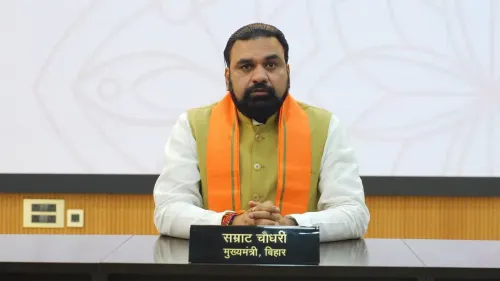
Bihar Chief Minister Samrat Choudhary paid tribute to Sister Nivedita on her birth anniversary, honouring the Irish-born disciple of Swami Vivekananda whose 20th-century schools for Bengali girls made her a pioneering figure in India's women's education movement.
Key Takeaways
Bihar Chief Minister Samrat Choudhary posted a tribute to Sister Nivedita on her birth anniversary on 28 October 2026 .
Sister Nivedita , born Margaret Elizabeth Noble in Ireland , was a disciple of Swami Vivekananda who established girls' schools in Bengal in the early 20th century .
CM Choudhary called her contribution to women's education 'unparalleled' and said her ideals continue to inspire efforts toward women's empowerment.
BJP leaders regularly reference Vivekananda -linked figures to highlight cultural and educational heritage in political messaging.
The tribute aligns with a broader national emphasis on female literacy and empowerment prominent in Indian public discourse.
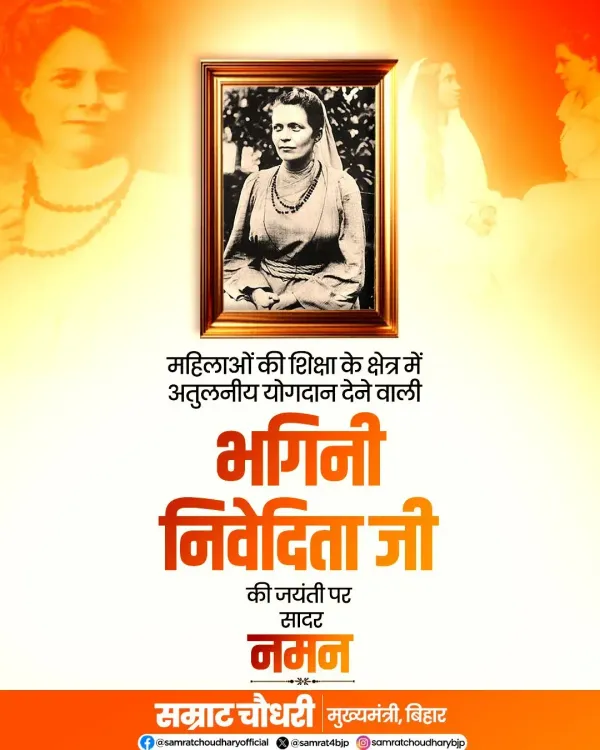
She left Ireland, crossed oceans, and built schools for Indian girls at a time when most doors were closed to them. On Wednesday, October 28, 2026, Bihar Chief Minister Samrat Choudhary marked the birth anniversary of Sister Nivedita with a heartfelt tribute on X, honouring her 'unparalleled contribution to women's education.'
In his post, CM Choudhary wrote: 'महिलाओं की शिक्षा के क्षेत्र में अतुलनीय योगदान देने वाली भगिनी निवेदिता जी की जयंती पर सादर नमन।' — 'Respectful tribute on the birth anniversary of Sister Nivedita, who made an unparalleled contribution to women's education.' He added that her dedication to education and social service 'will always remain inspirational,' and that her ideas continue to guide efforts toward women's empowerment and the building of an educated society.
Who was Sister Nivedita?
Born Margaret Elizabeth Noble in Ireland, Sister Nivedita came to India as a disciple of Swami Vivekananda and devoted her life to the country's social and educational upliftment. She established schools for girls in Bengal at the turn of the 20th century — a radical act in an era when female literacy was systematically suppressed. Her conviction that educated women were the bedrock of a strong nation made her a forerunner of the women's empowerment movement that Indian leaders still invoke today.
Her intellectual and spiritual partnership with Swami Vivekananda shaped her worldview: she believed social service and national awakening were inseparable, a philosophy she translated into direct, ground-level work with Bengali women and children.
Why BJP leaders invoke the Vivekananda legacy
BJP functionaries have long drawn from the well of Vivekananda-linked figures to anchor their cultural and educational messaging. Tributes to Sister Nivedita fit naturally within that tradition — she represents a strand of reformist nationalism that emphasises Hindu cultural revival alongside modern education. For CM Choudhary, the tribute also carries a local resonance: Bihar has in recent years pushed schemes aimed at improving girl-child enrolment and literacy, making Nivedita an apt symbol on which to hang state-level education aspirations.
Across party lines, Indian political leaders routinely mark the birth anniversaries of social reformers associated with women's upliftment — a ritual that keeps these figures alive in public memory and signals continuity with progressive nationalist traditions.
Nearly a century and a quarter after she set up her first school, Sister Nivedita's insistence that no society can afford to leave its women uneducated remains the sharpest possible rebuttal to any argument for inaction.
Point of View
Where female literacy indicators have historically lagged national averages, associating state leadership with Nivedita's legacy sends a signal about educational priorities — even if it remains a symbolic one without an accompanying policy announcement. Watch whether the tribute is followed by any state-level event or scheme rollout targeting girls' education, which would convert symbolism into substance.
NationPress
28 Oct 2026
Frequently Asked Questions
Who was Sister Nivedita and why is she remembered?
Sister Nivedita, born Margaret Elizabeth Noble in Ireland, was a disciple of Swami Vivekananda who came to India and established schools for girls in Bengal in the early 20th century. She is remembered for her pioneering work in women's education and social reform at a time when female literacy was rare.
When is Sister Nivedita's birth anniversary?
Sister Nivedita was born on 28 October 1867 , and her birth anniversary is observed on 28 October each year.
What did Bihar CM Samrat Choudhary say about Sister Nivedita?
CM Samrat Choudhary described her contribution to women's education as 'unparalleled,' saying her dedication to education and social service will always remain inspirational and that her ideas continue to guide women's empowerment efforts.
What is the connection between Sister Nivedita and Swami Vivekananda?
Sister Nivedita was a direct disciple of Swami Vivekananda. His teachings on social service and national awakening deeply shaped her decision to move to India and dedicate her life to educating women and uplifting marginalised communities.
Why do BJP leaders frequently pay tribute to Sister Nivedita?
BJP leaders often reference figures linked to Swami Vivekananda, including Sister Nivedita, to highlight the party's connection to a tradition of cultural nationalism and social reform centred on education and women's upliftment.