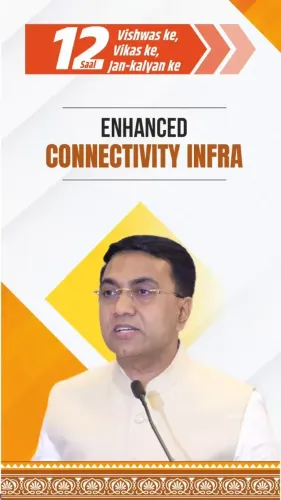
CM Sawant backs 57th GST Council outcomes as Next Gen reform push

Synopsis
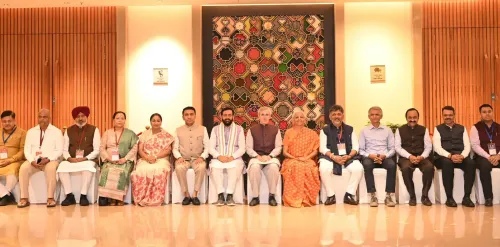
Goa Chief Minister Pramod Sawant hailed the 57th GST Council Meeting on 8 October 2026, calling its outcomes a decisive advance in Next Gen GST Reforms centred on trust-based, technology-driven compliance that allows businesses to focus on growth.
Key Takeaways
Goa CM Pramod Sawant publicly endorsed the outcomes of the 57th GST Council Meeting on 8 October 2026 .
He framed the decisions under the Next Gen GST Reforms banner, highlighting enforcement, compliance, and credit as the three focus areas.
The stated goal is a trust-based, technology-driven GST that reduces procedural burden on businesses.
The endorsement connects federal tax policy to Goa's own Ease of Doing Business pitch to investors.
The GST Council is a constitutional body requiring broad consensus; a state CM's endorsement signals cross-level alignment on reform messaging.
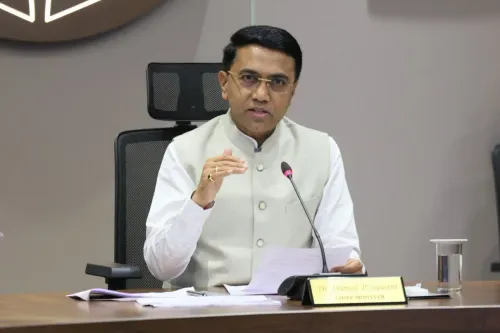
A trust-based, technology-driven tax system — that is the standard Goa Chief Minister Pramod Sawant is now publicly holding the Goods and Services Tax regime to, as he welcomed the outcomes of the 57th GST Council Meeting on Thursday, 8 October 2026.
What the 57th GST Council signalled
In his post, CM Sawant described the Council's decisions as 'another decisive step in strengthening Ease of Doing Business,' framing them explicitly under the banner of Next Gen GST Reforms. The three pillars he highlighted — enforcement, compliance, and credit — point to a reform agenda that touches every stage of the tax lifecycle, from how authorities pursue evasion to how businesses claim refunds on input costs.
The emphasis on a 'trust-based' approach is notable: it signals a stated shift away from presumptive scrutiny of taxpayers and toward systems where compliant businesses face fewer procedural hurdles. Technology, in this framing, becomes the enforcement layer rather than the taxpayer becoming the default suspect.
Why Ease of Doing Business is the chosen frame
Ease of Doing Business rankings have been a live political metric in India for over a decade, directly tied to how the Centre and state governments pitch themselves to domestic and foreign investors. For a coastal tourism-and-services economy like Goa, where small hospitality businesses interact with GST on nearly every transaction, any reduction in compliance friction carries real commercial weight.
By anchoring his endorsement to that framework, CM Sawant connects a federal tax-council decision directly to Goa's own investment pitch — a rhetorical move that doubles as a signal to the state's business community that the ruling dispensation is tracking their concerns at the national table.
The broader Next Gen GST arc
The 'Next Gen GST' label has been in circulation as a reform umbrella, encompassing proposals around real-time invoice matching, AI-assisted anomaly detection, and a rationalisation of the rate structure to reduce classification disputes. If the 57th Council's decisions advance any of these tracks, the downstream effect for businesses would be faster credit flows and fewer notices — exactly the outcome Sawant's post is projecting.
The GST Council is a constitutional body that brings together the Union Finance Minister and state finance ministers; its decisions require broad consensus, making each reform cycle a negotiation across political lines. A BJP chief minister amplifying the Council's outcomes is also, implicitly, a show of alignment with the Centre's economic communication strategy heading into the next investment-summit season.
If the 57th Council's reforms land as advertised, India's GST architecture moves one step closer to the promise made at its 2017 launch: one nation, one tax, zero friction. The real test will be whether businesses in Goa — and across India — feel the difference on the ground.
Point of View
He signals that the political cost of intrusive enforcement is being recognised at the highest federal levels. For Goa, a services-heavy economy where MSMEs live and die by cash-flow cycles, credit and compliance simplification carry outsized practical weight. The 'Next Gen GST' framing also positions reforms as a technology story rather than a political one — a softer, more durable sell across party lines.
NationPress
9 Oct 2026
Frequently Asked Questions
What was decided at the 57th GST Council Meeting?
The 57th GST Council Meeting, held in October 2026, produced decisions focused on Next Gen GST Reforms covering enforcement, compliance, and input tax credit — aimed at making the system more trust-based and technology-driven for businesses.
What are Next Gen GST Reforms in India?
Next Gen GST Reforms is an umbrella reform agenda under the GST Council that encompasses real-time invoice matching, AI-assisted anomaly detection, rate rationalisation, and compliance simplification to reduce the burden on honest taxpayers.
Why did Goa CM Pramod Sawant comment on the GST Council meeting?
As a state chief minister and BJP leader, Pramod Sawant participates in the broader federal economic discourse. His endorsement signals alignment with the Centre's reform narrative and addresses the concerns of Goa's business community, which is heavily dependent on GST-linked hospitality and services sectors.
How does the GST Council work in India?
The GST Council is a constitutional body comprising the Union Finance Minister and state finance ministers. It recommends GST rates, exemptions, and procedural changes through a consensus-based voting mechanism, making every reform decision a negotiation across the political spectrum.
What does 'trust-based GST' mean for businesses?
'Trust-based GST' refers to a compliance philosophy where technology — not routine scrutiny of all taxpayers — flags anomalies, reducing the frequency of notices and audits for businesses with clean compliance records and allowing faster input tax credit flows.