CM Sawant Hails Goa Fisherman's Bid to Save Female Crabs
Synopsis
Goa CM Pramod Sawant praised young fisherman Arnold D'Silva for voluntarily releasing berried female mud crabs, highlighting his initiative as a model of responsible fishing that could inspire Goa's wider coastal community to protect crab populations.
Key Takeaways
Goa CM Pramod Sawant personally met and praised fisherman Arnold D'Silva on August 18, 2026 for his conservation initiative.
D'Silva has been voluntarily releasing berried (egg-carrying) female mud crabs rather than harvesting them, protecting future crab stocks.
Harvesting berried females is a key driver of crab population decline along India's west coast; voluntary release is a recognised low-cost remedy.
Mud crabs are commercially significant to Goa's coastal economy and the livelihoods of tens of thousands of fisherfolk.
Sawant's public endorsement uses social proof to encourage broader community adoption of responsible fishing practices.
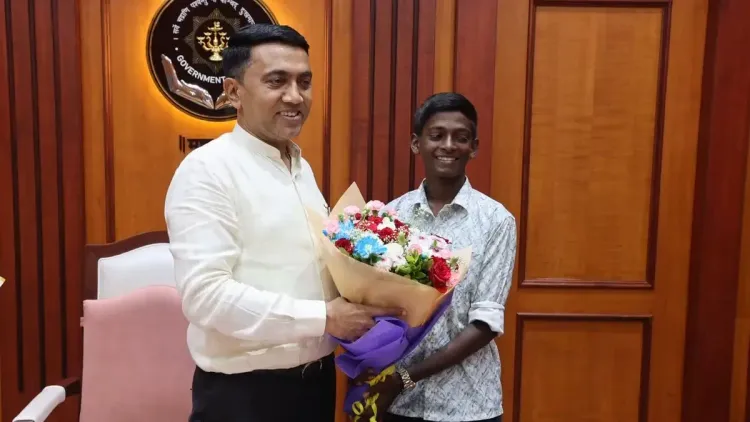
A young fisherman from Goa is making waves — not for his catch, but for what he chose to release. Goa Chief Minister Pramod Sawant on Tuesday, August 18, 2026, publicly praised Arnold D'Silva, a local fisherfolk who has been saving berried female mud crabs instead of harvesting them — a quiet act of conservation that the Chief Minister called a 'commendable example of responsible fishing.'
Arnold D'Silva's One-Man Conservation Push
Berried female crabs — females carrying eggs on their undersides — are the reproductive engine of any crab population. Harvesting them collapses future stocks before the next generation can hatch. D'Silva's decision to release these crabs rather than sell them represents exactly the kind of voluntary, ground-up conservation that fisheries departments across coastal India have struggled to enforce through regulation alone.
CM Sawant, who interacted with D'Silva personally, said the young fisherman's actions 'shall inspire fellow fisherfolk to follow his example and help protect Goa's crab population.' The public acknowledgement from the state's top elected official gives D'Silva's initiative a platform that could translate individual habit into community norm.
Why Mud Crabs Matter to Goa's Coastal Economy
Mud crabs — particularly the species Scylla serrata — are among the most commercially valuable catches in Goa's coastal waters, prized in local markets and exported across the region. Overharvesting of berried females has been a documented pressure on crab populations along India's west coast. Voluntary release programmes, where fishers return egg-bearing females to the sea, are widely recognised by marine biologists as one of the most effective low-cost interventions to sustain wild crab stocks.
Goa's fishing community numbers in the tens of thousands, and the state's blue economy is a significant contributor to coastal livelihoods. A shift in practice — even among a fraction of active fishers — can have measurable downstream effects on stock recovery.
Grassroots Conservation as State Policy Signal
By spotlighting D'Silva, Sawant is doing something subtler than issuing a directive: he is using social proof. When a Chief Minister personally meets a young fisherman and broadcasts the encounter, it signals to the broader community that conservation behaviour carries official recognition — and perhaps, future support. Whether that signal is followed by formal incentive schemes or regulatory backing remains to be seen, but the optics are deliberate.
One fisherman's choice to let a crab go. That is where sustainable fisheries — and smart governance — actually begin.
Point of View
High-visibility governance move — using individual social proof to nudge community behaviour rather than relying on enforcement. It fits a broader pattern among coastal-state leaders of framing voluntary conservation as civic virtue, ahead of any formal regulatory push. The gesture also positions the BJP-led Goa government as environmentally attentive in a state where fishing communities are an electorally significant constituency. The real test will be whether this recognition is followed by structured incentives — buy-back schemes, certification, or market premiums — that make conservation economically rational for all fishers, not just the conscientious few.
NationPress
3 Oct 2026
Frequently Asked Questions
Who is Arnold D'Silva and what did he do?
Arnold D'Silva is a young fisherman from Goa who gained recognition for releasing berried female mud crabs — egg-carrying females — back into the sea instead of harvesting them, helping protect the local crab population's reproductive capacity.
What are berried female crabs and why does saving them matter?
Berried female crabs are females carrying eggs on their undersides. Releasing them allows the eggs to hatch and replenish wild crab stocks, making it one of the most effective low-cost ways to sustain crab populations in coastal waters.
What did Goa CM Pramod Sawant say about Arnold D'Silva?
CM Sawant called D'Silva's initiative a 'commendable example of responsible fishing' and expressed hope that his actions would inspire fellow fisherfolk to protect Goa's crab population.
Why are mud crabs important to Goa's economy?
Mud crabs are among the most commercially valuable catches in Goa's coastal waters, supporting thousands of fishing livelihoods and contributing to the state's blue economy through local markets and regional trade.
Does Goa have any policy for protecting female crabs?
No formal state scheme has been confirmed in this context. CM Sawant's public praise for D'Silva signals official support for voluntary conservation, but structured incentive or regulatory programmes have not been announced alongside this interaction.