CM Sawant Calls for Local Conservation Action on Biodiversity Day
Synopsis
Goa Chief Minister Pramod Sawant marked International Day for Biological Diversity on 22 May 2026 by calling for renewed local commitment to conservation and sustainable living, tying the appeal to this year's UN theme of acting locally for global environmental impact.
Key Takeaways
Goa CM Pramod Sawant posted a statement on 22 May 2026 for the International Day for Biological Diversity .
This year's UN theme is 'Acting locally for global impact' , which Sawant explicitly cited.
Goa hosts part of the Western Ghats UNESCO World Heritage Site , one of the world's most biodiverse regions.
India ratified the Convention on Biological Diversity in 1994 and enacted the Biological Diversity Act in 2002 .
Goa's State Biodiversity Board has been operational since 2004 , overseeing local resource documentation and access regulation.
Attention now turns to Goa's State Biodiversity Strategy and Action Plan for 2026-27 as a measure of follow-through.
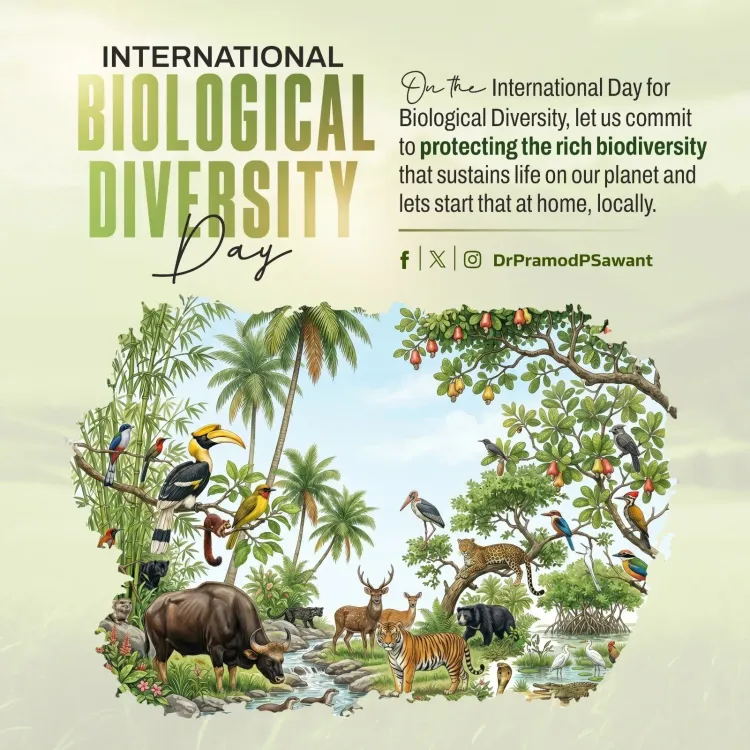
Goa Chief Minister Pramod Sawant on Friday, 22 May 2026, marked the International Day for Biological Diversity by calling on citizens to recommit to conservation, sustainable living, and environmental protection, linking local efforts to global ecological outcomes.
Context
The International Day for Biological Diversity is observed every year on 22 May under the framework of the United Nations Convention on Biological Diversity (CBD). The day has been observed globally since 2000 to spotlight the accelerating loss of species and ecosystems. This year's theme, 'Acting locally for global impact', underscores the role of sub-national governments and local communities in driving conservation outcomes.
CM Sawant wrote: 'Let us reaffirm our commitment to protecting the rich biodiversity that sustains life on our planet. Every local effort towards conservation, sustainable living, and environmental protection contributes to a healthier and more balanced world.'
Policy Backdrop
India ratified the Convention on Biological Diversity in 1994 and enacted the Biological Diversity Act in 2002 to give domestic force to its obligations, establishing the National Biodiversity Authority and corresponding State Biodiversity Boards. Goa constituted its own State Biodiversity Board in 2004, tasked with documenting local biological resources and regulating access to them.
India updated its National Biodiversity Action Plan in 2019 to align with the Aichi Targets and, subsequently, with the goals of the Kunming-Montreal Global Biodiversity Framework. State-level strategies and action plans are the principal instruments through which these national commitments translate into on-the-ground measures.
Stakeholders and Impact
Goa sits at the edge of the Western Ghats, a UNESCO World Heritage Site recognised for exceptional levels of endemism in flora and fauna and as a critical watershed. The state's coastal belt and forest zones support fishing communities, indigenous groups, and a multi-billion-rupee tourism economy — all of which are sensitive to biodiversity loss.
Conservation groups operating in the Western Ghats have long pressed state authorities to tighten enforcement of eco-sensitive zone regulations and strengthen benefit-sharing mechanisms with local communities under the Biological Diversity Act. The fisheries and tourism sectors, meanwhile, have a direct economic stake in the health of marine and forest ecosystems.
What's Next
Observers will watch for Goa's updated State Biodiversity Strategy and Action Plan for 2026-27, which would signal how the state intends to operationalise the commitments signalled in CM Sawant's message. Any new notifications under the Biological Diversity Act governing access and benefit-sharing of genetic resources in the state would be a concrete follow-through.
As India advances its reporting obligations under the Kunming-Montreal Global Biodiversity Framework, statements from state leaders on 22 May carry increasing significance as indicators of sub-national political will — a factor international biodiversity bodies explicitly track in assessing national implementation progress.
Frequently Asked Questions
When is International Day for Biological Diversity observed?
International Day for Biological Diversity is observed every year on 22 May , a date established under the UN Convention on Biological Diversity and marked globally since 2000 .
What is the theme of International Day for Biological Diversity 2026?
The theme for 2026 is 'Acting locally for global impact' , which emphasises the role of local communities and sub-national governments in driving global conservation outcomes.
Why is Goa significant for biodiversity in India?
Goa contains portions of the Western Ghats , a UNESCO World Heritage Site recognised for exceptional endemism in plant and animal species and as a key watershed, making it one of India's most ecologically sensitive states.
What is India's Biological Diversity Act?
The Biological Diversity Act, 2002 gives domestic legal force to India's obligations under the Convention on Biological Diversity , establishing the National Biodiversity Authority and mandating State Biodiversity Boards in every state.
What is Goa's State Biodiversity Board?
The Goa State Biodiversity Board , constituted in 2004 , is the statutory body responsible for documenting the state's biological resources and regulating access to them under the Biological Diversity Act .