CM Sawant marks International Tiger Day, calls to protect forests
Synopsis
On International Tiger Day, 29 July 2026, Goa Chief Minister Pramod Sawant called for the protection of tigers and their forest habitats, echoing India's decades-long conservation push under Project Tiger and the Global Tiger Initiative.
Key Takeaways
Goa CM Pramod Sawant marked International Tiger Day on 29 July 2026 with a call to preserve tigers and forests.
International Tiger Day is observed globally every 29 July to raise awareness on tiger conservation.
Project Tiger , launched in 1973 , is India's flagship programme for protecting tigers and their habitats.
The Wildlife Protection Act of 1972 provides the legal framework underpinning India's conservation efforts.
Goa is part of the Western Ghats tiger corridor, a critical ecological network spanning multiple states.
India's commitments under the Global Tiger Initiative make state-level political support for conservation a key variable.
Every 29 July, the world pauses to reckon with one of conservation's most consequential fights — and Goa Chief Minister Pramod Sawant used International Tiger Day 2026 to add his voice to that call, urging citizens to value and protect tigers and the forests they inhabit.
A day with deep roots in India's conservation story
International Tiger Day has been observed globally every 29 July since its establishment to raise awareness about tiger conservation. For India, the occasion carries particular weight: the country is home to the world's largest wild tiger population, a recovery built on decades of deliberate policy effort.
That effort traces back to Project Tiger, launched in 1973 under the central government, which created a network of protected reserves and gave tigers a fighting chance against habitat loss and poaching. The Wildlife Protection Act of 1972 provided the legal backbone for that framework. Together, these measures helped reverse what had been a catastrophic decline.
Goa's place in the Western Ghats tiger corridor
Goa sits within the Western Ghats biodiversity hotspot, a landscape that functions as a critical tiger corridor connecting protected areas across multiple states. The forests that run through Goa's eastern belt are part of this broader ecological network — meaning the health of Goa's forest cover has consequences well beyond the state's borders.
CM Sawant's message aligns with India's commitments under the Global Tiger Initiative, the international compact that set an ambitious goal of doubling wild tiger numbers. Annual observances like today's serve as a checkpoint — a reminder that political will at every level of government, including state leadership, is part of what keeps that commitment alive.
The next All India Tiger Estimation report will be the clearest measure of whether the trajectory holds. Until then, messages from state leaders reinforce the conservation consensus that tigers and intact forests are inseparable — lose one, and you lose both.
Point of View
It also reinforces the party's broader narrative of building on central conservation frameworks like Project Tiger. The real test of such commitments, however, lies in state-level forest policy decisions and corridor protection notifications, not in social media observances. Watch whether Goa's forest department follows up with any concrete habitat or corridor protection measures in the weeks ahead.
NationPress
28 Oct 2026
Frequently Asked Questions
When is International Tiger Day celebrated?
International Tiger Day is observed every year on 29 July to raise global awareness about tiger conservation and the need to protect their natural habitats.
What is Project Tiger in India?
Project Tiger is a central government conservation programme launched in 1973 to protect tigers and their forest habitats across India through a network of dedicated tiger reserves.
Does Goa have tigers?
Goa is part of the Western Ghats biodiversity hotspot, which contains tiger corridors connecting protected areas across several states. The forests in Goa's eastern region form part of this broader ecological network.
What did Goa CM Pramod Sawant say on Tiger Day 2026?
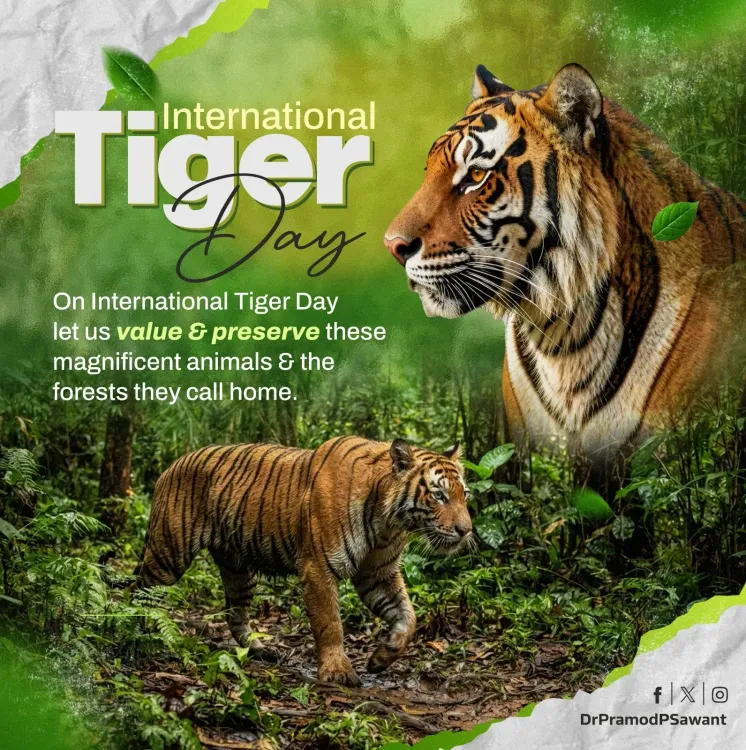
On 29 July 2026 , Goa Chief Minister Pramod Sawant posted a message urging people to 'value and preserve these magnificent animals and the forests they call home' on the occasion of International Tiger Day.
What is the Global Tiger Initiative?
The Global Tiger Initiative is an international conservation compact that set the goal of doubling wild tiger populations. India is a signatory and has reported steady growth in tiger numbers through successive national censuses.