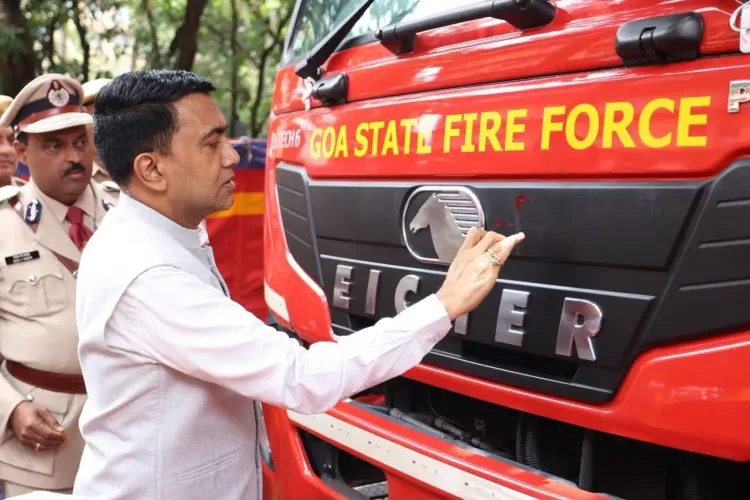
CM Sawant flags off new fire fleet for Goa under 15th Finance Commission
Synopsis
Chief Minister Pramod Sawant flagged off a major fleet of firefighting vehicles in Panaji on 4 August 2026, including 8 water tenders, a HazMat vehicle, and a 42-metre Turn Table Ladder, funded jointly by the 15th Finance Commission and the Goa government.
Key Takeaways
8 Mid-Sized Water Tenders inducted into Goa Fire & Emergency Services on 4 August 2026 .
A 42-metre Turn Table Ladder (TTL) provides high-rise rescue capability up to approximately the 14th floor.
A dedicated HazMat Response Vehicle adds chemical and industrial hazard containment capacity.
Procurement funded jointly by the 15th Finance Commission grant and Government of Goa allocation.
Fleet flagged off at Directorate of Fire & Emergency Services, St.
Inez, Panaji by CM Pramod Sawant.
Operational support motorcycles included to improve last-mile emergency response across the state.
Goa's fire services got a serious upgrade on Tuesday, 4 August 2026, as Chief Minister Pramod Sawant flagged off a new fleet of modern firefighting and emergency response vehicles at the Directorate of Fire & Emergency Services, St. Inez, Panaji — a procurement that brings high-rise rescue capability and hazardous-material response to the state for the first time at this scale.
What rolled out of St. Inez today
The induction is substantial. The fleet includes 8 Mid-Sized Water Tenders, a dedicated Hazardous Materials (HazMat) Response Vehicle, a 42-metre Turn Table Ladder (TTL) built specifically for high-rise rescue operations, and a set of operational support motorcycles. Together, they represent a multi-hazard upgrade — from chemical spills and industrial fires to rescues in taller buildings that older equipment simply could not reach.
Funding came through a dual channel: the 15th Finance Commission grant and direct Government of Goa allocation. That combination signals deliberate planning rather than a one-off purchase — central devolution money matched with state commitment.
Why the 42-metre TTL matters for Goa
The Turn Table Ladder is the headline piece of kit. At 42 metres, it can reach roughly the 12th to 14th floor of a residential tower — critical as Goa's coastal towns have seen a steady rise in mid- and high-rise construction over the past decade. Without aerial ladder capacity at that height, firefighters are effectively grounded when a blaze breaks out above the reach of standard equipment. That gap closes today.
The HazMat vehicle adds a different dimension: the ability to respond to chemical, biological, or industrial hazard incidents with specialised containment and decontamination gear — a capability most tier-2 Indian cities still lack.
Goa's broader push on disaster preparedness
CM Sawant framed the flag-off as 'another major step in strengthening Goa's disaster preparedness and public safety infrastructure,' and the scale of the single-day induction backs that framing. Eight water tenders deployed at once suggest a state-wide redistribution of fire-cover, not just a top-up for Panaji. Support motorcycles — nimble first-responder units — fill the last-mile gap in Goa's narrow coastal lanes where larger vehicles struggle to reach quickly.
With the 15th Finance Commission cycle running through 2025–26, this procurement also signals that Goa moved quickly to utilise devolved disaster-management funds before the window closed — a detail that will matter when the next Finance Commission cycle is negotiated.
For a state that draws millions of tourists annually and hosts a dense coastal population, faster, better-equipped emergency response is not a bureaucratic checkbox. It is a direct public-safety dividend — and today's fleet makes that dividend visible.
Point of View
And this closes a genuine gap. Politically, the flag-off lets CM Sawant demonstrate tangible governance delivery on infrastructure rather than welfare announcements — a useful contrast ahead of any electoral cycle. The HazMat vehicle quietly signals Goa's ambition to handle industrial and tourism-linked chemical incidents without depending on mutual aid from neighbouring states.
NationPress
4 Aug 2026
Frequently Asked Questions
What new vehicles were added to Goa's fire services in August 2026?
Goa inducted 8 Mid-Sized Water Tenders , a Hazardous Materials (HazMat) Response Vehicle , a 42-metre Turn Table Ladder , and operational support motorcycles into its Fire & Emergency Services on 4 August 2026 .
Who funded the new firefighting vehicles for Goa?
The fleet was procured using funds from the 15th Finance Commission grant and direct Government of Goa budget allocation.
What is a Turn Table Ladder and why does Goa need a 42-metre one?
A Turn Table Ladder is an aerial rescue and firefighting vehicle. At 42 metres , Goa's new TTL can reach upper floors of high-rise buildings — critical as the state's coastal towns have seen growing mid- and high-rise construction that older equipment could not safely address.
Where was the Goa fire fleet flag-off held?
The flag-off was held at the Directorate of Fire & Emergency Services, St. Inez, Panaji , by Chief Minister Pramod Sawant on 4 August 2026 .
What does a HazMat Response Vehicle do?
A HazMat (Hazardous Materials) Response Vehicle is equipped to handle chemical, biological, or industrial hazard incidents, providing containment and decontamination capability that standard fire tenders do not carry.