CM Sawant: Goa tops Access (In)Equality Index 2026

Synopsis
Goa has topped India's Access (In)Equality Index 2026 published by O.P. Jindal Global University with a score of 0.68, leading on basic facilities and healthcare while ranking second in education. Chief Minister Pramod Sawant shared the finding, underscoring the state's progress in equitable service delivery.
Key Takeaways
Goa ranked first among all 28 Indian states in the Access (In)Equality Index 2026 with an overall score of 0.68 .
The index is published by O.P.
Jindal Global University and measures equitable access to basic services across states.
Goa secured first place in basic facilities and healthcare , and second place in education access.
Key indicators include piped water, housing quality, healthcare availability, and internet access in schools.
Goa has a consistent track record of top performance in National Family Health Survey rounds on health and education metrics.
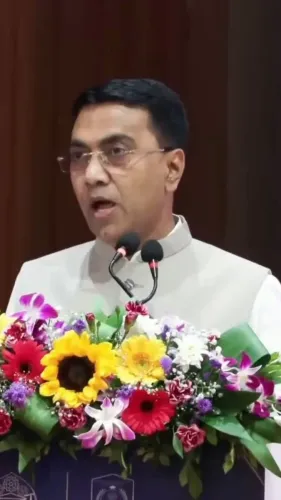
CM Pramod Sawant highlighted the ranking as evidence of the state's progress in providing essential services to residents.
Goa has claimed the number-one spot among all 28 Indian states in the Access (In)Equality Index 2026, published by O.P. Jindal Global University, scoring 0.68 overall — a result Goa Chief Minister Pramod Sawant highlighted on Thursday, 19 November 2026 as evidence of the state's steady gains in equitable service delivery.
What the 0.68 score actually measures
The Access (In)Equality Index ranks states on how equitably residents can access foundational services — piped water, adequate housing, healthcare, and internet connectivity in schools. Goa's 0.68 overall score placed it first on basic facilities and healthcare, and second on education. That two-domain podium finish, across indicators ranging from rural tap-water coverage to school broadband, is the architecture behind the headline rank.
O.P. Jindal Global University, a private research university based in Sonipat, Haryana, produces composite indices on social access and inequality that are increasingly cited in state-level policy conversations. The index is designed to surface not just average service levels but how evenly those services reach different sections of the population — making a top score harder to game through aggregate data alone.
Goa's track record in national welfare surveys
The result is not an outlier. Goa has consistently featured among the top performers in successive rounds of the National Family Health Survey, which tracks health and education access across states. The state's relatively compact geography, higher urbanisation rate, and tourism-driven fiscal base have historically allowed it to sustain per-capita public spending above the national average.
The second-place finish in education access is particularly notable — a category that tracks metrics such as school enrolment, retention, and digital infrastructure. Internet access in schools, one of the specific indicators cited, reflects a convergence of connectivity policy and education investment that larger states have struggled to replicate at scale.
What the ranking signals for Goa's governance agenda
Chief Minister Sawant, who has led Goa since 2019, framed the ranking as a marker of progress in providing essential services to Goan residents. For a state whose public narrative is often dominated by tourism and real-estate debates, a welfare-access ranking of this kind repositions the development conversation around measurable delivery — piped water reaching households, hospital access, housing quality.
The next edition of the index and Goa's performance in upcoming NFHS rounds will test whether the state can hold — or improve — a ranking achieved under conditions of a maturing tourism economy and rising infrastructure expectations from residents.
Top of the ladder today. The question is whether the state's governance engine can keep it there as the bar keeps rising.
Point of View
The ranking reflects a structural reality: Goa's small size and relatively higher per-capita fiscal capacity give it an inherent advantage over populous states in translating welfare spending into measurable outcomes. The more significant policy question is whether the state can sustain this edge as infrastructure demands from a growing resident population begin to rival the claims of its tourism economy.
NationPress
19 Nov 2026
Frequently Asked Questions
What is the Access (In)Equality Index 2026?
The Access (In)Equality Index 2026 is a research ranking published by O.P. Jindal Global University that evaluates how equitably India's states provide access to basic services including water, housing, healthcare, and digital infrastructure in schools.
Which state topped the Access (In)Equality Index 2026?
Goa topped the Access (In)Equality Index 2026 among all 28 Indian states, scoring 0.68 overall and ranking first in basic facilities and healthcare.
What score did Goa get in the Access (In)Equality Index 2026?
Goa received an overall score of 0.68 in the Access (In)Equality Index 2026, placing it first among India's 28 states.
Who is Pramod Sawant and why is he sharing this ranking?
Pramod Sawant is the Chief Minister of Goa and a BJP leader who has held the position since 2019. He highlighted the ranking to underscore the state government's progress in equitable service delivery across healthcare, education, and basic facilities.
What services does Goa rank highly for in the 2026 index?
Goa ranks first in basic facilities and healthcare access, and second in education access, with strong performance specifically on piped water coverage, housing, healthcare availability, and internet connectivity in schools.