CM Sawant Leads Candle March for Partition Remembrance Day
Synopsis
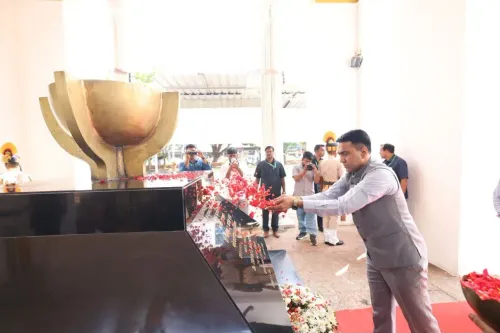
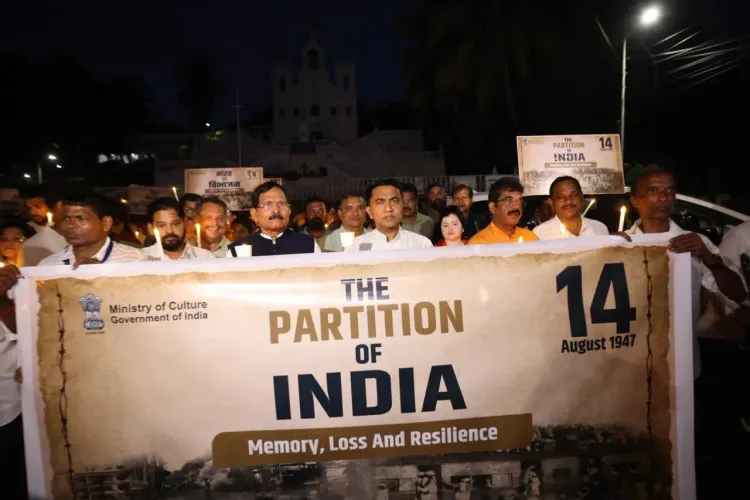
Goa Chief Minister Pramod Sawant led a candle march from Church Square to Azad Maidan in Panaji on 14 August to observe Partition Horrors Remembrance Day, joined by Union Minister Shripad Naik and several state ministers and MLAs, and visited an exhibition on Partition memory and resilience.
Key Takeaways
CM Pramod Sawant led a candle march in Panaji on 14 August to mark Vibhajan Vibhishika Smriti Diwas .
The march ran from Church Square to Azad Maidan , Panaji's historic civic ground.
Union Minister Shripad Naik , MP Sadanand Shet , two state ministers, and three MLAs participated.
The delegation visited a Partition memory exhibition at Azad Maidan documenting displacement and resilience.
14 August was designated Partition Horrors Remembrance Day by the Government of India in 2021 .
Goa, though not directly affected by the 1947 Partition, joins national commemorations annually under its BJP-led government.
Candles lit the path from Church Square to Azad Maidan in Panaji on the night of 14 August as Goa Chief Minister Pramod Sawant joined a solemn march to observe Vibhajan Vibhishika Smriti Diwas — Partition Horrors Remembrance Day — honouring the millions who endured displacement, loss, and grief when India was divided in 1947.
A Walk Through Memory in Panaji
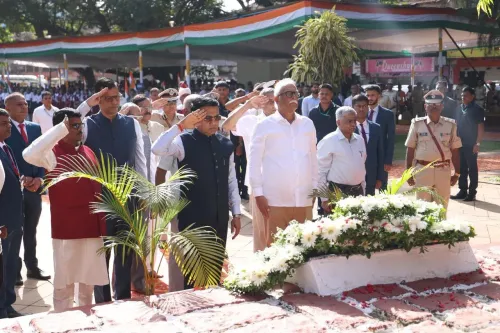
The march drew a cross-section of Goa's political leadership. Union Minister Shripad Yesso Naik, MP Sadanand Shet, and Ministers Rohan Khaunte and Babush Monserrate walked alongside the Chief Minister. MLAs Nilesh Cabral, Premendra Shet, and Rajesh Faldessai were also present — a visible show of both state and central government solidarity on a night of national remembrance.
After the march, the delegation visited an exhibition at Azad Maidan that documented the memory, loss, and resilience of Partition survivors — curating personal histories of displacement and hardship that official history often leaves in the margins.
Why 14 August Carries This Weight
The date is deliberate. In 2021, the Government of India formally designated 14 August as Partition Horrors Remembrance Day, marking the eve of Independence with a reckoning for the human cost that came with it — an estimated 10 to 20 million people uprooted and hundreds of thousands killed in communal violence. The day asks the nation to hold both truths at once: the joy of freedom and the wound of division.
Goa, though geographically removed from the 1947 territorial partition, has consistently joined these national commemorations under its BJP-led administration, reflecting the central government's push for state-level participation through candle marches, exhibitions, and public programmes every year since the day's formal designation.
Sawant's Words at the Maidan
CM Sawant said the occasion called on all Indians to 'remember those who suffered during Partition and salute the courage and resilience with which millions rebuilt their lives.' The framing was one of tribute, not politics — grief acknowledged, survival honoured.
That register matters. Partition Remembrance Day has at times drawn debate about its political framing, but on the ground in Panaji, the evening centred on the exhibition and the march itself — the act of walking together in the dark, candles in hand, as a form of collective memory.
As 14 August becomes a more established fixture on India's civic calendar, the question is not whether states will observe it, but how deeply its exhibitions, testimonies, and educational components will reach beyond the political class and into classrooms and communities.
Point of View
With BJP-governed states like Goa deploying senior leadership to signal alignment with New Delhi's historical-memory agenda. Sawant's march — flanked by a Union Minister and multiple MLAs — underscores how the day functions simultaneously as civic tribute and political choreography. The inclusion of an exhibition at Azad Maidan points to a gradual deepening of the commemorative format beyond symbolic gestures. Whether these state-level programmes translate into sustained educational outreach or remain annual set-pieces will define the day's long-term civic legacy.
NationPress
29 Sept 2026
Frequently Asked Questions
What is Vibhajan Vibhishika Smriti Diwas?
Vibhajan Vibhishika Smriti Diwas, also called Partition Horrors Remembrance Day, is observed every year on 14 August to commemorate the suffering, displacement, and loss of millions of people during the 1947 Partition of India. The Government of India formally designated this date in 2021.
Why is Partition Remembrance Day observed on 14 August and not 15 August?
14 August is the eve of India's Independence Day and also the date Pakistan marks its independence. Placing the remembrance on 14 August acknowledges that the moment of freedom was inseparable from the trauma of Partition that preceded it.
What did CM Pramod Sawant do on Partition Horrors Remembrance Day 2026?
CM Pramod Sawant participated in a candle march from Church Square to Azad Maidan in Panaji, Goa, and visited an exhibition on Partition memory and resilience at Azad Maidan, joined by Union Minister Shripad Naik, MP Sadanand Shet, two state ministers, and three MLAs.
Was Goa affected by the 1947 Partition of India?
Goa was not directly affected by the 1947 territorial Partition, as it remained under Portuguese administration until 1961. However, Goa's BJP-led government participates in national Partition Remembrance Day observances as part of the central government's countrywide programme.
Who is Shripad Yesso Naik?
Shripad Yesso Naik is a Union Minister from Goa and a senior BJP leader who frequently represents the central government at state-level national commemorations and public events in Goa.