CM Sawant Remembers Vikram Sarabhai on Birth Anniversary
Synopsis
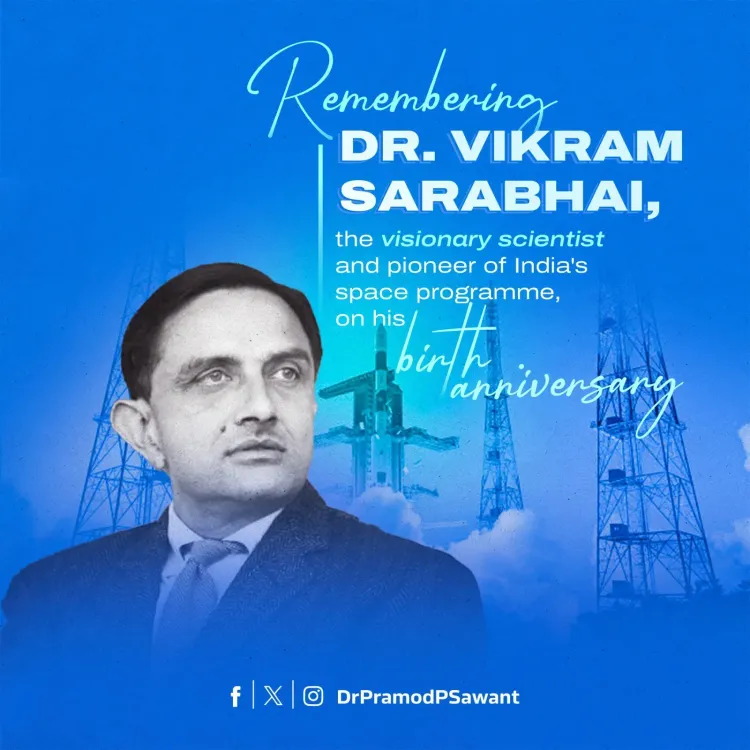
Goa Chief Minister Pramod Sawant remembered Dr. Vikram Sarabhai on his birth anniversary, saluting the physicist who founded INCOSPAR in 1962 and set India on its path to becoming a major space-faring nation through ISRO and beyond.
Key Takeaways
Goa CM Pramod Sawant paid tribute to Dr.
Vikram Sarabhai on his birth anniversary on 12 August 2026 .
Sarabhai founded the Indian National Committee for Space Research (INCOSPAR) in 1962 , serving as its first chairman.
ISRO was formally established in 1969 as the successor to INCOSPAR, carrying forward Sarabhai's development-first space philosophy.
Sarabhai's core belief was that space technology should serve national development — a mandate that has guided every subsequent Indian space mission.
India's current space ambitions, including the crewed Gaganyaan mission, are direct extensions of the institutional foundation Sarabhai built.
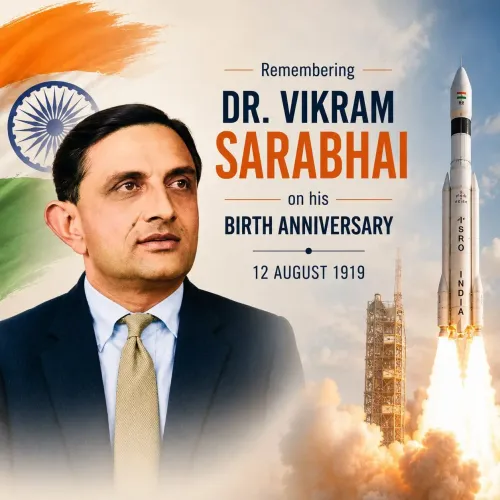
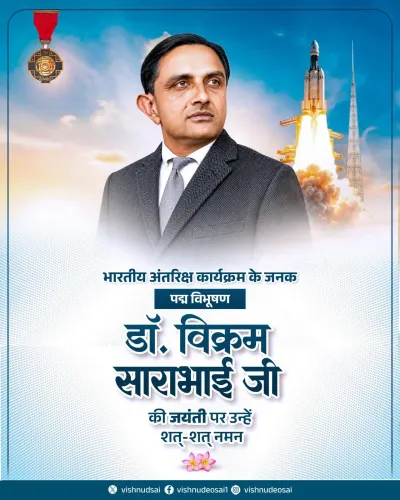
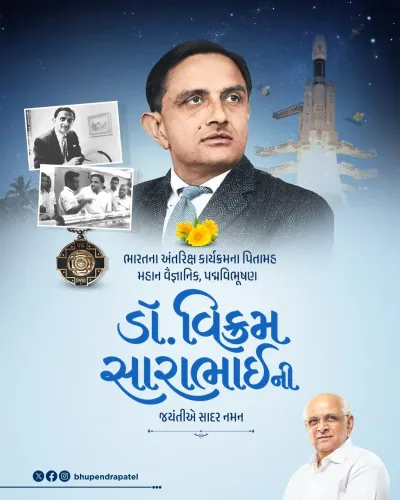
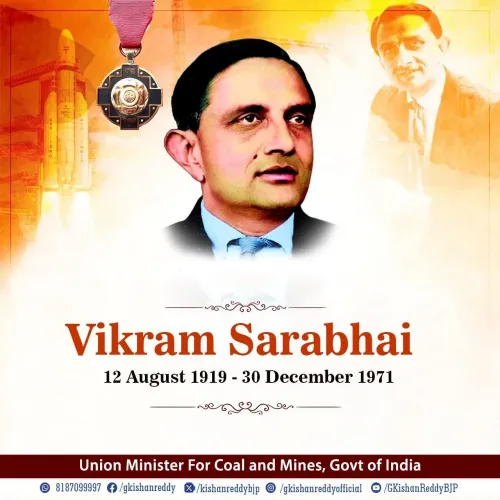
Before India had a rocket, it had a vision — and that vision belonged to one man. Goa Chief Minister Pramod Sawant paid tribute to Dr. Vikram Sarabhai on his birth anniversary on Wednesday, 12 August 2026, honouring the physicist whose institutional ambition gave India its place among the stars.
Sawant wrote that Sarabhai's 'remarkable vision, scientific spirit and belief in using space technology for national development laid the foundation for India's journey towards becoming a leading space-faring nation.' The tribute, brief in words, carries the weight of six decades of Indian space history behind it.
The man who built India's space architecture from scratch
Dr. Vikram Sarabhai founded the Indian National Committee for Space Research (INCOSPAR) in 1962 and served as its first chairman — creating the institutional scaffolding on which everything that followed would be built. His core conviction was unambiguous: space technology was not a trophy for superpowers, but a tool for developing nations to solve real problems on the ground.
That philosophy — peaceful, applied, development-first — became the founding DNA of the Indian Space Research Organisation (ISRO), which formally took shape in 1969 as the direct successor to INCOSPAR. Every indigenous launch vehicle, every communication satellite, every planetary mission since has been an extension of the mandate Sarabhai set.
A legacy that keeps launching
India's space programme has grown far beyond what even Sarabhai's formidable imagination might have mapped. Indigenous launch vehicles now carry commercial payloads. Satellite constellations support agriculture, disaster management, and navigation across the subcontinent. Planetary missions have placed India in a club of very few nations. The current policy framework pushes further still, with the crewed Gaganyaan mission representing the most ambitious chapter yet.
Each of these milestones traces a direct line back to the institutions Sarabhai built and the culture of scientific self-reliance he insisted upon. Politicians across the spectrum invoke his name on his birth anniversary — Sawant's tribute is part of that national ritual of remembrance, but the substance it points to is real and consequential.
Sarabhai once said that there should be no second thoughts about India's relevance in space — a nation of India's size and need could not afford to be left behind. Six decades on, the programme he seeded has made that argument definitively.
Point of View
But the substance beneath them reflects a genuine bipartisan consensus on space as a national priority. Sawant's homage, coming from a BJP chief minister, reinforces the ruling dispensation's consistent messaging around scientific nationalism and indigenous capability — a narrative that has grown louder with each ISRO milestone. The emphasis on Sarabhai's 'development-first' philosophy also quietly legitimises the current government's push to open the space sector to private players, framing commercialisation as an extension of, not a departure from, Sarabhai's original vision. As Gaganyaan approaches, expect invocations of Sarabhai to intensify across the political spectrum.
NationPress
26 Sept 2026
Frequently Asked Questions
Who was Dr. Vikram Sarabhai?
Dr. Vikram Sarabhai was an Indian physicist who founded the Indian National Committee for Space Research (INCOSPAR) in 1962 and is widely regarded as the father of India's space programme.
What did Vikram Sarabhai found?
Vikram Sarabhai founded INCOSPAR in 1962, which later evolved into the Indian Space Research Organisation (ISRO) in 1969.
Why is Vikram Sarabhai remembered on his birth anniversary?
Sarabhai is remembered as the visionary who built the institutional and philosophical foundation of India's space programme, emphasising peaceful and development-oriented applications of space technology.
What is ISRO's connection to Vikram Sarabhai?
ISRO was established in 1969 as the direct successor to INCOSPAR, the organisation Sarabhai founded in 1962, and continues to operate on the development-first mandate he established.
What did Goa CM Pramod Sawant say about Vikram Sarabhai?
CM Sawant said Sarabhai's 'remarkable vision, scientific spirit and belief in using space technology for national development laid the foundation for India's journey towards becoming a leading space-faring nation.'