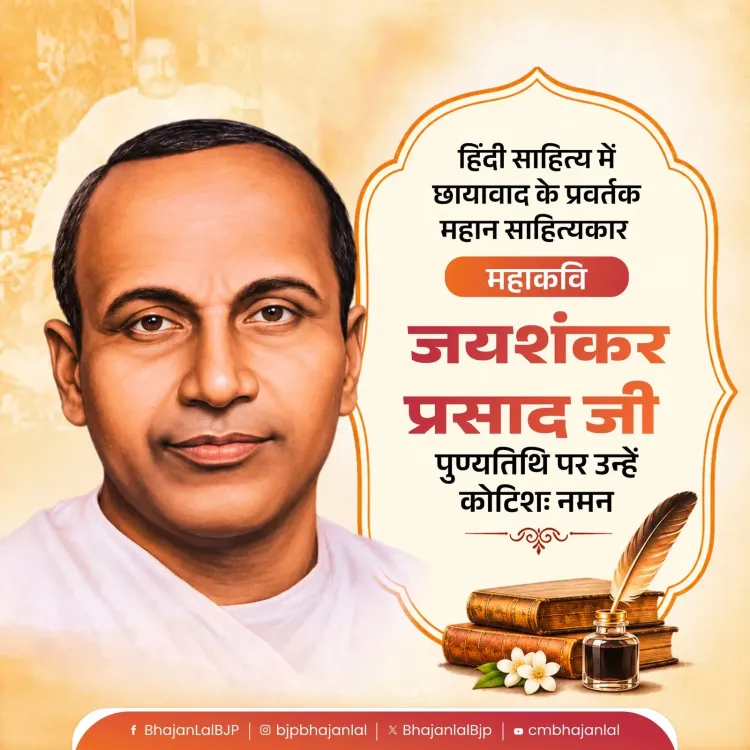
CM Bhajan Lal Sharma pays tribute to Jaishankar Prasad
Synopsis
On Jaishankar Prasad's death anniversary, Rajasthan CM Bhajan Lal Sharma paid tribute to the Chhayavad pioneer and author of the 1936 epic Kamayani, calling his literary legacy an enduring inspiration for generations to come.
Key Takeaways
Rajasthan CM Bhajan Lal Sharma posted a tribute on 15 November 2026 , marking the death anniversary of poet Jaishankar Prasad .
Prasad is recognised as the founder of Chhayavad , the romantic-mystical school that transformed twentieth-century Hindi poetry.
His epic Kamayani , published in 1936 , is considered one of the greatest works in modern Hindi literature.
Sharma described Prasad as a convergence of Indian culture, philosophy, and human sensitivity in a single literary voice.
Indian political leaders routinely mark such anniversaries as an act of cultural custodianship for the nation's literary heritage.
A century after Jaishankar Prasad reshaped the Hindi literary imagination, his death anniversary on 15 November 2026 drew a heartfelt tribute from Rajasthan Chief Minister Bhajan Lal Sharma, who honoured the poet as the founding voice of Chhayavad and an enduring conscience of Indian letters.
In his post, CM Sharma called Prasad a 'yugadrashta kavi' — a seer-poet of his age — and saluted him as the author of the immortal epic 'Kamayani' and as a towering playwright. 'Indian culture, philosophy, and human sensitivity find a remarkable convergence in his literary creations,' Sharma wrote. 'His unparalleled contribution to enriching Hindi literature will always be remembered, and his works will continue to inspire future generations toward literature and creative expression.'
The movement Prasad built — and what it meant
Jaishankar Prasad was the principal architect of Chhayavad, the romantic-mystical movement that dominated Hindi poetry in the early twentieth century, lifting the language from didactic verse into rich, inward, philosophical terrain. His landmark work Kamayani, published in 1936, is widely regarded as one of the greatest epics in modern Hindi — a sweeping allegory of human desire, reason, and emotion drawn from Vedic mythology.
Beyond poetry, Prasad wrote plays and essays that wove Indian philosophical traditions into accessible, emotionally resonant prose. His body of work became a cornerstone of how Hindi literature understands itself: as a vehicle not just for story, but for civilisational memory.
Why political tributes to literary figures carry weight
Indian political leaders across party lines mark the birth and death anniversaries of major literary figures as a matter of cultural statecraft — a way of signalling that the state remains a custodian of the nation's intellectual heritage. For Hindi literature specifically, these tributes carry extra resonance: the language's champions fought hard for its recognition, and remembering them publicly reinforces its place in India's official cultural identity.
CM Sharma's tribute fits squarely in that tradition — dignified, specific in its literary references, and aimed at a broad public that may know Kamayani from school curricula without always knowing the poet behind it.
Point of View
Invoking Prasad — a Varanasi-born poet whose work is deeply embedded in the Hindi belt's school curricula — speaks to a core BJP cultural narrative that valorises the Hindi literary tradition as inseparable from national identity. The gesture costs nothing politically and signals everything symbolically: that governance and civilisational memory are, in this framing, one project. What matters longer term is whether such tributes translate into sustained institutional support for Hindi literary scholarship and archival work.
NationPress
15 Nov 2026
Frequently Asked Questions
Who was Jaishankar Prasad?
Jaishankar Prasad was a pioneering Hindi poet, playwright, and essayist, best known as the founder of the Chhayavad literary movement and the author of the 1936 epic Kamayani, one of the most celebrated works in modern Hindi literature.
What is Chhayavad in Hindi literature?
Chhayavad was a romantic and mystical movement in Hindi poetry that flourished in the early twentieth century. It shifted Hindi verse toward introspection, nature imagery, and philosophical depth, moving away from earlier didactic styles.
What is the significance of Kamayani?
Kamayani, published in 1936, is an allegorical epic poem by Jaishankar Prasad based on Vedic mythology. It explores the interplay of human desire, reason, and emotion and is widely regarded as a landmark of modern Hindi literature.
Why did CM Bhajan Lal Sharma post a tribute to Jaishankar Prasad?
15 November is observed as Jaishankar Prasad's death anniversary. Rajasthan CM Bhajan Lal Sharma posted the tribute to honour the poet's literary legacy and his contribution to Hindi literature and Indian cultural identity.
When did Jaishankar Prasad die?
Jaishankar Prasad passed away on 15 November 1937, and his death anniversary is marked annually by literary institutions, academics, and public figures across India.