CM Bhajan Lal Sharma lays foundation for tribal hostels, police housing in Udaipur
Synopsis
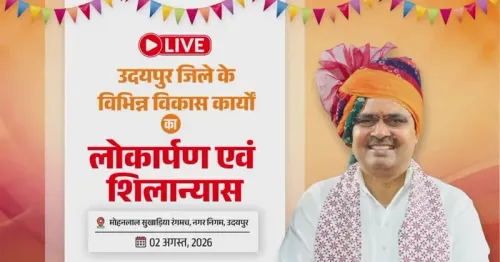
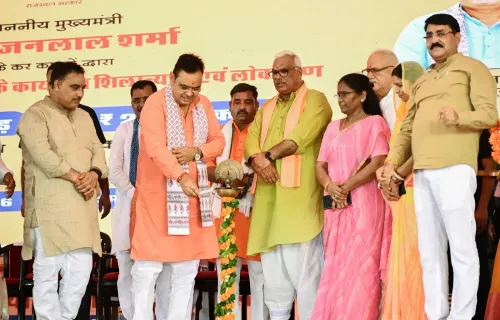
Chief Minister Bhajan Lal Sharma laid foundation stones for over ₹25 crore worth of projects in Udaipur district on 3 August 2026, including two tribal boys' hostels in Gogunda and Jhadol, 12 police residential quarters, a service road at Sukher, and a submersible bridge on the Banas River.
Key Takeaways
₹4.5 crore Rajkiya Janjati Balak Ashram hostel foundation laid at Gogunda . ₹3.8 crore tribal boys' hostel sanctioned for the Dhimdi area, Jhadol tehsil .
12 residential quarters for police officers at Police Lines, Udaipur at ₹4.5 crore .
Service road at Sukher to be built at approximately ₹3.67 crore .
Submersible bridge on the Banas River on the Paner–Kelthara route near Gogunda sanctioned for over ₹6 crore .
Projects are part of the Sharma government's Aapno Agrani Rajasthan tribal and rural development push in Udaipur district .
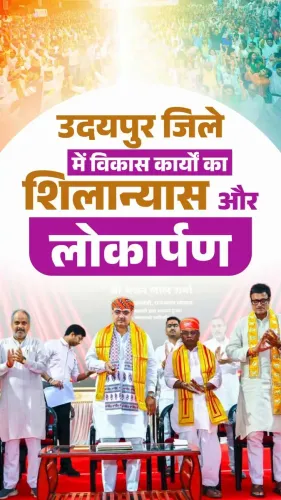
Tribal students in the remote hills of Udaipur district and police officers stationed in the city are set to get upgraded facilities, as Chief Minister Bhajan Lal Sharma laid the foundation stones for a cluster of infrastructure projects worth over ₹25 crore on Monday, 3 August 2026 — spanning residential hostels, police housing, rural roads, and a river crossing.
What is being built, and where
The biggest-ticket items are two Rajkiya Janjati Balak Ashram Chhatrawas — state-run tribal boys' residential hostels — one at Gogunda at a cost of ₹4.5 crore, and another in the Dhimdi area of Jhadol tehsil at ₹3.8 crore. These hostels are designed to bring secondary schooling within reach of tribal boys from villages where daily commutes to school are simply not viable.
For the state's police force, 12 new residential quarters for officers are planned at the Police Lines, Udaipur, at a cost of ₹4.5 crore. Alongside that, a service road at Sukher will be built for ₹3.67 crore, improving last-mile connectivity in the urban fringe of Udaipur city.
A submersible bridge on the Banas — and why it matters
Perhaps the most consequential announcement for rural connectivity is the foundation stone for a submersible bridge (submerged causeway) on the Banas River, on the Paner–Kelthara route near Gogunda, at a cost of over ₹6 crore. Submersible bridges are low-level crossings engineered to go under water during monsoon floods and re-emerge for use once waters recede — a practical, cost-effective solution for seasonal river crossings in hilly tribal terrain where full elevated bridges are expensive to build and maintain.
For villages on either side of the Banas in this stretch, the monsoon months currently mean near-total isolation. A submersible crossing changes that calculus meaningfully.
Southern Rajasthan's infrastructure deficit — and the political arithmetic
Gogunda and Jhadol are both tehsils in Udaipur district, part of the southern Rajasthan tribal belt — home to a large Scheduled Tribe population, predominantly Bhil and Meena communities. Infrastructure deficits in education and connectivity here are well-documented, and successive state governments have used foundation-laying events in these constituencies to signal commitment to tribal welfare.
The Bhajan Lal Sharma government, which came to power after the BJP's victory in the December 2023 Rajasthan assembly elections, has framed its tribal outreach under the banner 'Aapno Agrani Rajasthan' ('Our Leading Rajasthan') — the hashtag that accompanied this official post. The cluster-announcement format — multiple projects, multiple tehsils, a single event — is a deliberate signal to a dispersed constituency.
Whether these projects translate from foundation stones to functional buildings on schedule will be the real measure. Rajasthan's tribal welfare infrastructure has a patchy completion record — something the government's own budget documents and tribal welfare reports have periodically flagged. The students and officers waiting on these buildings will be watching.
Point of View
Which inherited a tribal welfare infrastructure backlog, converting these foundation stones into completed, functional buildings will be the harder political test. The submersible bridge on the Banas is the most structurally significant of the lot — rural connectivity in flood-prone tribal belts has a direct multiplier on school attendance and economic mobility, making it a credible policy intervention rather than mere optics.
NationPress
17 Sept 2026
Frequently Asked Questions
What projects did CM Bhajan Lal Sharma inaugurate in Udaipur district?
CM Bhajan Lal Sharma laid foundation stones for two tribal boys' residential hostels in Gogunda and Jhadol, 12 police residential quarters at Udaipur Police Lines, a service road at Sukher, and a submersible bridge on the Banas River near Gogunda — totalling over ₹25 crore.
What is a Rajkiya Janjati Balak Ashram Chhatrawas?
A Rajkiya Janjati Balak Ashram Chhatrawas is a state-run residential hostel for tribal boys, designed to provide accommodation near schools in remote areas where daily commuting is not feasible, improving access to education for Scheduled Tribe communities.
Why is a submersible bridge being built on the Banas River near Gogunda?
A submersible bridge is a low-level crossing that goes underwater during monsoon floods and reopens once water levels drop. It is a cost-effective solution for seasonal river crossings in tribal hill terrain, and will prevent villages on the Paner–Kelthara route from being cut off during the monsoon.
How much will the police housing project at Udaipur Police Lines cost?
The 12 new residential quarters for police officers at Udaipur Police Lines will cost ₹4.5 crore, according to the Chief Minister's Office announcement.
What is 'Aapno Agrani Rajasthan'?
'Aapno Agrani Rajasthan' — meaning 'Our Leading Rajasthan' — is the Bhajan Lal Sharma government's campaign hashtag used to frame its development and tribal welfare initiatives across the state.