CM Shivakumar Inaugurates 'Karnataka Parva 2026' at Palace Grounds
Synopsis
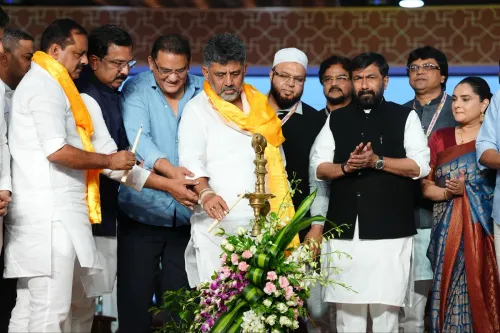
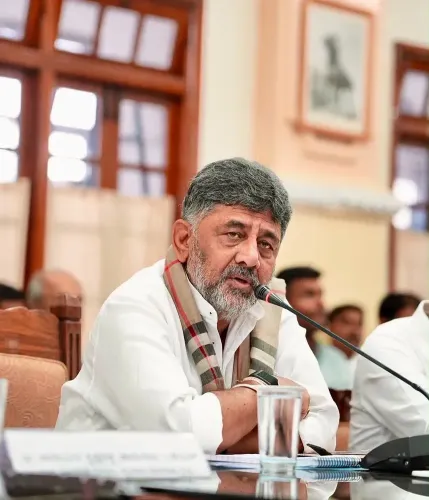
Chief Minister D.K. Shivakumar inaugurated 'Karnataka Parva 2026' at Bengaluru Palace Grounds, a cultural festival by the Minority Welfare, Haj and Waqf Department showcasing local arts, crafts, cuisine and performances, attended by ministers, legislators and former India cricket captain Mohammad Azharuddin.
Key Takeaways
Shivakumar inaugurated Karnataka Parva 2026 at Bengaluru Palace Grounds on September 26, 2026 .
The festival was organised by the Karnataka Minority Welfare, Haj and Waqf Department , spotlighting local arts, handicrafts, cuisine and cultural performances.
Khader and Rizwan Arshad , along with Rajya Sabha members Mansoor Ali Khan and Dr.
Syed Naseer Hussain , attended the inauguration.
Telangana's Minority Welfare Minister was present, reflecting regional coordination on minority welfare themes.
Former India cricket captain Mohammad Azharuddin and former parliamentarian Ramya were among notable guests at the event.
The event combined minority community outreach with a public marketplace for local artisans and small enterprises.
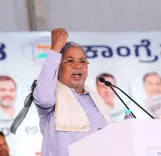
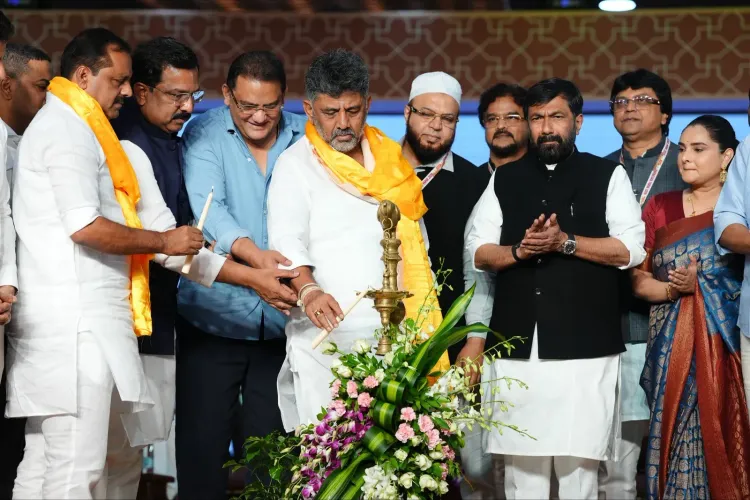
At Bengaluru Palace Grounds on Saturday, September 26, 2026, the Karnataka Minority Welfare, Haj and Waqf Department turned one of the city's most storied venues into a living showcase of the state's cultural plurality — and Chief Minister D.K. Shivakumar formally opened the curtain on Karnataka Parva 2026, a festival designed to put local artisans, craftspeople, food producers and performers on a single, unified stage.
What 'Karnataka Parva 2026' put on display
The festival, organised by the state's Minority Welfare, Haj and Waqf Department, brought together local arts, handicrafts and distinctive regional products alongside small enterprises rooted in Karnataka's minority communities. Traditional cuisine, children's programmes and a range of cultural performances ran simultaneously — the kind of concentrated, cross-disciplinary showcase that turns a welfare department's mandate into something the public can walk through and touch.
The premise was straightforward: cultural visibility and economic opportunity in the same venue, on the same afternoon. For artisans and small traders whose work rarely travels far from its origin district, an event at Bengaluru Palace Grounds — a central, high-footfall venue with a long record of major state functions — is a rare chance at a wider audience.
A cross-party, cross-state gathering at the inauguration
The lineup of dignitaries at the inauguration read as a deliberate signal of inclusive reach. Karnataka ministers U.T. Khader and Rizwan Arshad, both closely associated with minority welfare portfolios in the Congress-led government, were present. Legislative Council Chairman Saleem Ahmed and Rajya Sabha members Mansoor Ali Khan and Dr. Syed Naseer Hussain added legislative weight to the occasion.
The presence of Telangana's Minority Welfare Minister pointed to the routine but meaningful regional coordination that has grown around minority welfare themes — a reminder that these policy conversations rarely stop at state borders. Former India cricket captain Mohammad Azharuddin, now a Congress politician, attended alongside former parliamentarian Ramya, State Guarantee Committee Vice-President Mehroz Khan, and legislators Khaneez Fatima, Rahim Khan and Pathan Yaseen Ahmed Khan.
Karnataka's long record of department-led cultural outreach
The Minority Welfare, Haj and Waqf Department sits at the intersection of religious administration — coordinating Haj facilitation, managing Waqf properties — and broader social welfare covering education scholarships and skill development programmes that have been a feature of Karnataka governance since the early 2000s. Events like Karnataka Parva represent a third lane: cultural festivals that make the department's work visible and give minority communities a public platform beyond bureaucratic processes.
That formula — combine welfare outreach with the warmth of regional food, craft and performance — has become a recognisable playbook for successive Karnataka governments. What varies is the scale, the venue and the political moment in which it lands.
For a state government that has staked significant political capital on its 'guarantee' welfare programmes, an event that puts minority artisans and their produce literally at the centre of a Bengaluru landmark is, at minimum, a vivid piece of governance optics — and at best, a genuine marketplace for people who needed one.
Point of View
Or remain a high-profile but episodic intervention.
NationPress
26 Sept 2026
Frequently Asked Questions
What is Karnataka Parva 2026?
'Karnataka Parva 2026' is a cultural festival organised by Karnataka's Minority Welfare, Haj and Waqf Department at Bengaluru Palace Grounds, showcasing local arts, handicrafts, regional cuisine, small enterprises and cultural performances from across the state.
Who inaugurated Karnataka Parva 2026?
Chief Minister D.K. Shivakumar inaugurated Karnataka Parva 2026 at Bengaluru Palace Grounds on September 26, 2026 .
Which ministers attended Karnataka Parva 2026?
Ministers U.T. Khader and Rizwan Arshad , Legislative Council Chairman Saleem Ahmed , Rajya Sabha members Mansoor Ali Khan and Dr. Syed Naseer Hussain , and Telangana's Minority Welfare Minister were among the dignitaries present.
What does the Karnataka Minority Welfare, Haj and Waqf Department do?
The department oversees welfare schemes for religious minorities in Karnataka, including education scholarships, skill development, Haj facilitation and the administration of Waqf properties.
Why was Mohammad Azharuddin at Karnataka Parva 2026?
Former India cricket captain and Congress politician Mohammad Azharuddin attended as a notable public figure at the inauguration of Karnataka Parva 2026, joining ministers and legislators at the event.