CM Shivakumar Lays NLSIU Foundation Stone in Bengaluru
Synopsis
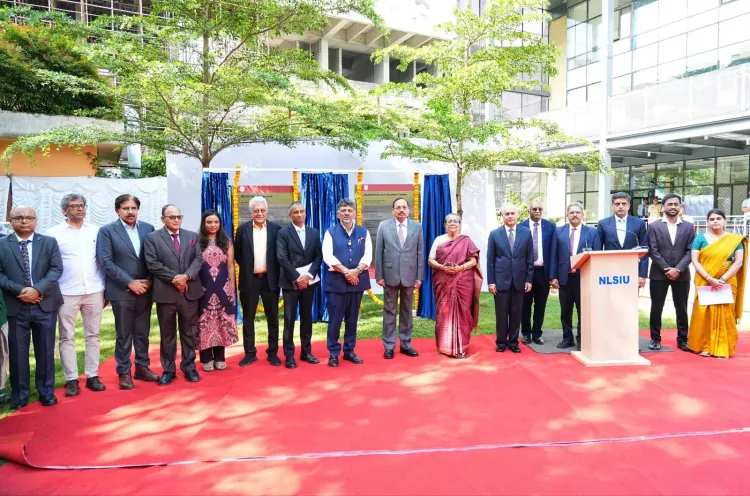
Chief Minister D. K. Shivakumar, flanked by the Chief Justice of India and the Chief Justice of the Karnataka High Court, laid the foundation stone for NLSIU Bengaluru's new South Block, auditorium and student centre on 17 October 2026, marking a major expansion of India's premier law university.
Key Takeaways
Shivakumar performed the foundation-stone laying for NLSIU's new South Block, auditorium and student centre in Bengaluru on 17 October 2026 .
Chief Justice of India Justice Surya Kant and Karnataka High Court Chief Justice Justice Vibhu Bakhru were present at the ceremony.
NLSIU was established in 1986 under Karnataka Act No.
22 as India's first national law university.
Bar Council of India Chairman Manan Kumar Mishra and NLSIU Vice-Chancellor Prof.
Sudhir Krishnaswamy were among the dignitaries at the event.
The new facilities are intended to expand capacity for legal education, research and student life at the nation's top-ranked law school.
Construction timeline and funding details are yet to be officially announced.
India's oldest and most storied law school is about to grow — and the top of the country's judicial hierarchy showed up to mark the moment. Chief Minister D. K. Shivakumar performed the foundation-stone laying ceremony on Saturday, 17 October 2026, for a new South Block, auditorium and student centre at the National Law School of India University (NLSIU), Bengaluru, in the presence of the Chief Justice of India, Justice Surya Kant, and the Chief Justice of the Karnataka High Court, Justice Vibhu Bakhru.
The ceremony brought together a rare constellation of legal authority and state power on one stage. Bar Council of India Chairman Manan Kumar Mishra, Karnataka Advocate General K. Shashi Kiran Shetty, NLSIU Vice-Chancellor Prof. Sudhir Krishnaswamy, theatre personality and Ranga Shankara co-founder Smt. Arundhati Nag, and the Chief Minister's Economic Advisor L. K. Atheeq were among the dignitaries who attended. Their collective presence underscored that this expansion is being read as far more than a construction project.
What the New Campus Blocks Will Add to NLSIU
NLSIU was established under Karnataka Act No. 22 of 1986 as India's first national law university — a bold experiment that rewrote the template for legal education across the subcontinent. Decades later, the campus that pioneered the five-year integrated LLB programme is expanding its physical footprint to match its intellectual ambition. The new South Block will add academic and administrative space, while the auditorium and student centre are designed to enrich campus life and support moot courts, symposia, and student-led legal aid activity.
Karnataka governments have periodically backed NLSIU's infrastructure to keep it ahead of the 23 newer National Law Universities that have emerged since the NLU model was replicated nationwide. The investment signals that the state intends to protect NLSIU's pole position as competition in legal academia intensifies.
Bengaluru's Quiet Bet on Legal Talent
The expansion fits a deliberate pattern: successive Karnataka administrations have linked NLSIU's growth to Bengaluru's broader identity as a hub for professional education — not just technology. The city's legal community feeds directly into the Supreme Court Bar, major corporate law practices, and the judiciary itself. A larger, better-equipped NLSIU means more capacity to train the lawyers who will argue tomorrow's landmark cases.
The Chief Minister's Office described the new facilities as 'an important step towards strengthening Karnataka's ecosystem for world-class legal education, research and institution-building, while expanding opportunities for future generations of legal professionals.' The phrase 'ecosystem' is deliberate — it frames NLSIU not as an isolated institution but as infrastructure for the state's professional class.
Details on the construction timeline, funding source, and any accompanying state grants are yet to be officially announced. But with the Chief Justice of India wielding the ceremonial spade alongside the Chief Minister, the political signal is unambiguous: this expansion carries the weight of the state and the court alike. NLSIU's next chapter has been set in stone — literally.
Point of View
Attended by both the Chief Justice of India and the Karnataka High Court Chief Justice, is a rare public alignment of judicial and executive prestige around a single institution — a signal that goes beyond routine infrastructure politics. Karnataka has long used NLSIU's brand as evidence of its commitment to professional excellence, and this expansion comes precisely when newer NLUs are closing the reputational gap. For CM Shivakumar, the event also serves a domestic political purpose: positioning the Congress-led government as an investor in aspirational, knowledge-economy infrastructure rather than purely welfare spending. The key question going forward is whether the state backs the ceremony with a transparent funding commitment and a credible construction timeline.
NationPress
17 Oct 2026
Frequently Asked Questions
What is NLSIU Bengaluru?
NLSIU (National Law School of India University) is India's first national law university, established in Bengaluru in 1986 under Karnataka Act No. 22. It pioneered the five-year integrated LLB programme and is consistently ranked as the country's top law school.
What new facilities were announced at NLSIU in 2026?
A new South Block, auditorium and student centre at NLSIU Bengaluru were announced, with Chief Minister D. K. Shivakumar laying the foundation stone on 17 October 2026 .
Who attended the NLSIU foundation-stone ceremony?
The ceremony was attended by Chief Justice of India Justice Surya Kant , Karnataka High Court Chief Justice Justice Vibhu Bakhru , Bar Council of India Chairman Manan Kumar Mishra , NLSIU Vice-Chancellor Prof. Sudhir Krishnaswamy , and several other dignitaries.
Why is NLSIU Bengaluru significant for legal education in India?
NLSIU was the first institution to introduce the integrated five-year LLB model in India, inspiring the creation of over two dozen National Law Universities across the country. Its graduates populate the Supreme Court Bar, top corporate law firms and the judiciary.
What is the Bar Council of India's role in legal education?
The Bar Council of India is a statutory body that regulates both the legal profession and legal education across India. Its chairman's presence at the NLSIU ceremony reflects the institution's national importance in shaping legal training standards.