CM Shivakumar: No forced land acquisition for Bidadi Township
Synopsis
Deputy CM D.K. Shivakumar has assured Bidadi-area farmers that no land will be taken forcibly for the proposed Bidadi Township. Willing farmers may receive compensation in exchange for their land, and a committee will be formed to manage the process smoothly.
Key Takeaways
Shivakumar declared that land for the Bidadi Township project will not be acquired forcibly.
Farmers who wish to participate may voluntarily give their land in exchange for compensation.
A committee will be constituted to ensure the process proceeds smoothly.
The announcement was made on 15 July 2026 via the official Chief Minister's Office of Karnataka X account.
The Bidadi area lies in Ramanagara district on the outskirts of Bengaluru , a key growth corridor.
The Karnataka Industrial Areas Development Board (KIADB) is the agency typically responsible for such township development.
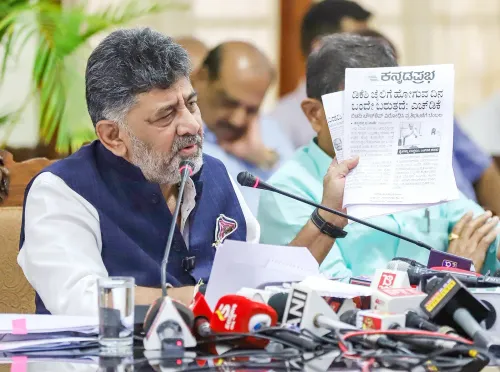
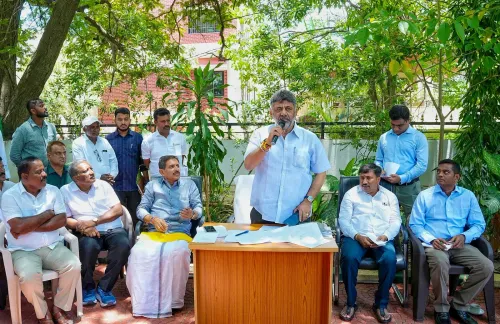
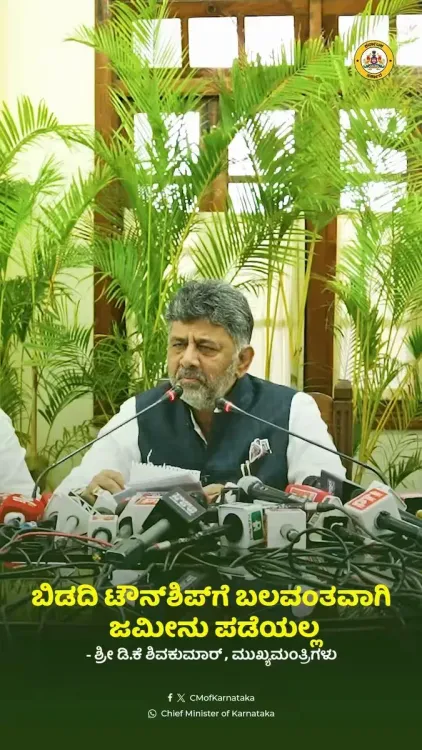
Deputy Chief Minister D.K. Shivakumar on Wednesday, 15 July 2026, assured farmers in the Bidadi area that the government will not forcibly acquire land for the proposed Bidadi Township project, stating that participation would be entirely voluntary and that a committee would be formed to oversee the process smoothly.
Context
Speaking on the matter, Shivakumar said — in Kannada — 'ಬಿಡದಿ ಟೌನ್ಶಿಪ್ಗೆ ಬಲವಂತವಾಗಿ ಜಮೀನು ತೆಗೆದುಕೊಳ್ಳುವುದಿಲ್ಲ' ('Land will not be taken forcibly for the Bidadi Township'). He added that farmers who are willing may give their land in exchange for compensation, and that a committee would be constituted to ensure the subsequent process proceeds smoothly.
The statement, posted by the Chief Minister's Office of Karnataka on its official X account, signals a shift toward a consent-based approach for the Bidadi project, which falls in Ramanagara district on the outskirts of Bengaluru.
Policy Backdrop
Land acquisition for large infrastructure and township projects in India is governed by the Right to Fair Compensation and Transparency in Land Acquisition, Rehabilitation and Resettlement Act, 2013, which mandates farmer consent and higher compensation norms before land can be acquired for such purposes.
The Karnataka Industrial Areas Development Board (KIADB) is the state agency typically tasked with land acquisition and development of industrial and urban townships. Projects in the Bengaluru periphery have historically involved KIADB, and the Bidadi corridor has long been identified as a growth zone to ease pressure on the city.
Stakeholders and Impact
Farmers and landowners in and around Bidadi stand at the centre of this development. Successive Karnataka governments have faced protests from agricultural communities over compulsory acquisition tied to large-scale projects near Bengaluru, making voluntary participation assurances politically significant.
By committing to a committee-led, voluntary framework, Shivakumar aims to reduce the risk of litigation and local opposition that has stalled similar projects in the past. The compensation package details and committee composition will be closely watched by landowners deciding whether to participate.
What's Next
The immediate next step is the formation of the committee announced by Shivakumar, which is expected to define the compensation framework and consultation process for willing farmers. Any formal notifications from KIADB regarding the Bidadi Township project will serve as a key indicator of how the government intends to proceed.
The broader trajectory of the Bidadi Township project — including its scale, investment targets, and timelines — will depend significantly on the level of voluntary farmer participation secured through this new process.
Point of View
The government attempts to align with the spirit of the 2013 land acquisition law while keeping the Bidadi Township project on track. The committee mechanism also provides political cover — shifting responsibility for pace and outcomes to a consultative body rather than the administration alone. Whether this framework translates into genuine farmer agency or becomes a managed consent exercise will define the project's credibility.
NationPress
15 Jul 2026
Frequently Asked Questions
Will land be forcibly acquired for Bidadi Township?
No. Deputy CM D.K. Shivakumar has explicitly stated that land will not be taken forcibly for the Bidadi Township project; only willing farmers who choose to participate will provide their land in exchange for compensation.
What is the Bidadi Township project in Karnataka?
The Bidadi Township is a proposed large-scale urban and industrial development project in Ramanagara district on the outskirts of Bengaluru , aimed at creating a planned township to spur economic growth in the region.
What compensation will Bidadi farmers get for their land?
Specific compensation figures have not yet been announced. Shivakumar has said a committee will be formed to oversee the process, and details of the compensation package are expected to emerge from that committee's work.
What is KIADB's role in the Bidadi Township project?
The Karnataka Industrial Areas Development Board (KIADB) is the state agency typically responsible for land acquisition and development of industrial and urban townships in Karnataka, and is expected to play a central role in the Bidadi project.
What law governs land acquisition for such projects in India?
The Right to Fair Compensation and Transparency in Land Acquisition, Rehabilitation and Resettlement Act, 2013 governs land acquisition in India, mandating farmer consent and higher compensation norms for projects of this nature.