CM Siddaramaiah Honours Nehru on Children's Day in Bengaluru
Synopsis
Karnataka Chief Minister Siddaramaiah paid floral tributes to Jawaharlal Nehru on Children's Day at KPCC's Bharat Jodo Bhavan in Bengaluru, crediting Nehru's Five Year Plans, irrigation projects and democratic institution-building — and directly criticising the BJP's reading of the Nehru–Patel legacy debate.
Key Takeaways
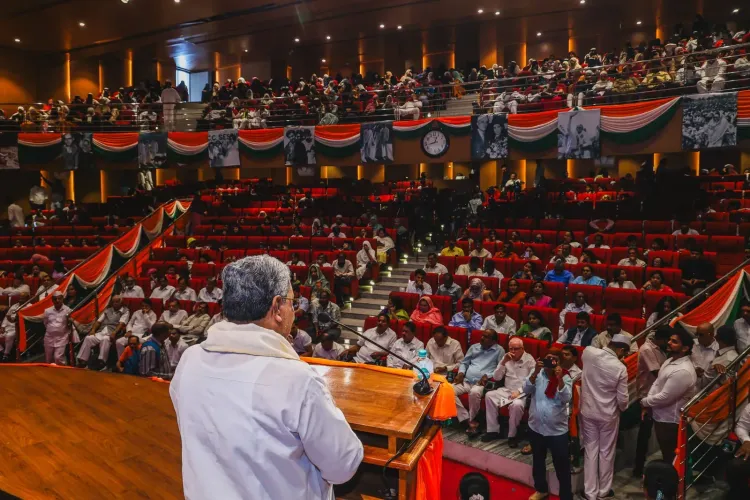
CM Siddaramaiah attended a Children's Day event at KPCC's Bharat Jodo Bhavan, Bengaluru on 14 November 2026 , Nehru's birth anniversary.
He credited Five Year Plans (from 1951) and projects like Bhakra Nangal, Hirakud, Nagarjuna Sagar and the Damodar Valley scheme for laying India's agricultural and industrial foundations.
Siddaramaiah linked the Green Revolution to Nehru's irrigation groundwork, naming Indira Gandhi, M.S.
Swaminathan and Jagjivan Ram as key contributors in the chain.
He directly accused the BJP of ideological opposition to Nehru's secularism and pluralism, alleging Sardar Patel is being politically weaponised against Nehru's legacy.
Nehru spent nearly 9 years in prison and served as Prime Minister for 17 continuous years , Siddaramaiah recalled.
The Chief Minister called on citizens — especially children and youth — to adopt scientific temper, rationalism, and secular values as the true tribute to Nehru.
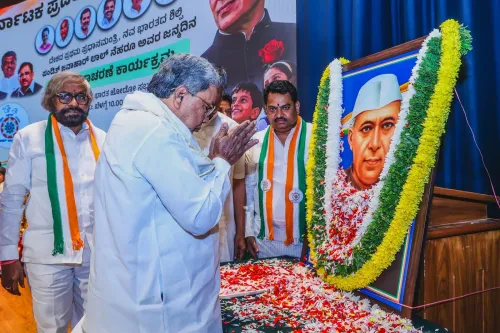
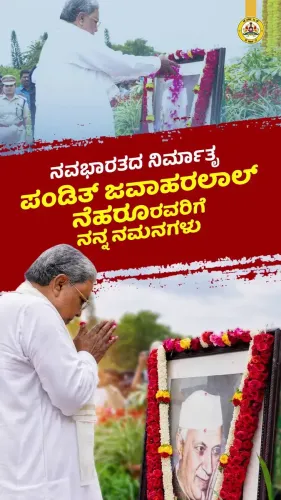
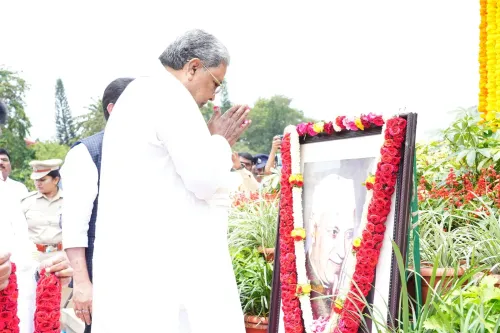
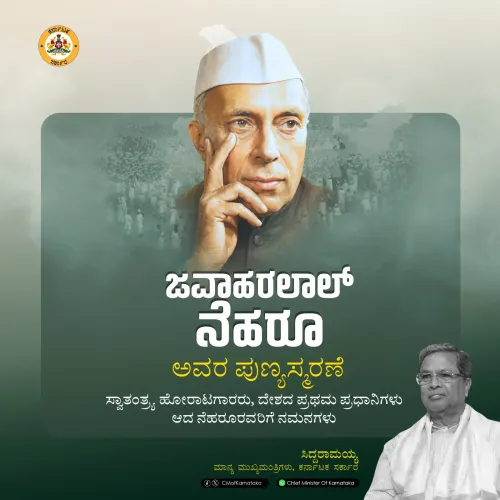
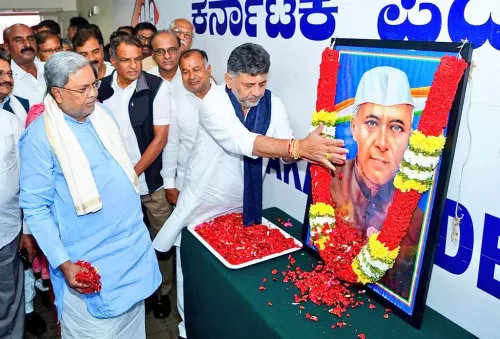
On Jawaharlal Nehru's 137th birth anniversary — observed across India as Children's Day — Karnataka Chief Minister Siddaramaiah paid floral tributes to the first Prime Minister at a commemorative event held at the KPCC office's Bharat Jodo Bhavan in Bengaluru on Saturday, 14 November 2026, and delivered a wide-ranging tribute to Nehru's role in building modern India.
Nehru's nation-building record, recalled in full
Siddaramaiah's tribute went far beyond ceremony. Speaking after offering flowers before Nehru's portrait, the Chief Minister invoked a sweeping catalogue of contributions: food security, irrigation, industry, science, education, and the consolidation of democratic institutions. He pointed specifically to the Five Year Plans launched in 1951, which he described as Nehru's core instrument for pulling a newly independent nation out of food scarcity, poverty, communal violence, and economic distress.
The Chief Minister named four landmark river-valley projects — Bhakra Nangal, Nagarjuna Sagar, Hirakud, and the Damodar Valley scheme — as the irrigation foundations that enabled Indian agriculture to eventually sustain itself. He credited Indira Gandhi's subsequent stewardship, alongside the work of agricultural scientist M.S. Swaminathan, with translating that infrastructure into the Green Revolution of the late 1960s. The arc, Siddaramaiah argued, runs directly from Nehru's dams to India's food surplus today — a chain that also carries the contributions of leaders like Jagjivan Ram.
The Nehru–Patel debate and the BJP charge
The sharpest lines of the post were reserved for contemporary politics. Siddaramaiah stated plainly that BJP's political ideology stands opposed to Nehru's vision of democracy, secularism, pluralism, and equality — and that this ideological opposition, in his view, drives the persistent attacks on Nehru's personality and achievements by BJP leaders. He went further, asserting that Sardar Vallabhbhai Patel is being 'used politically to counter Nehru' — a pointed reading of a debate that has animated Indian political discourse for over a decade as the ruling party at the Centre has emphasised Patel's legacy through initiatives like the Statue of Unity.
The Congress leader did not name specific BJP figures or cite specific recent statements, keeping the critique structural rather than personal.
Children's Day as a political and moral call
Nehru was famously fond of children — comparing them to buds blooming on plants — and believed today's children are tomorrow's nation. Siddaramaiah wove this directly into a civic appeal: give children quality education, cultivate in them a scientific and rational temperament, and shape them into responsible citizens. He called it every person's duty to dedicate time to children.
He broadened the message into an urgent social demand, noting that nearly eight decades after Independence, caste discrimination, poverty, and social inequality persist. 'A truly equal society cannot be built without eliminating caste and inequality,' he said. 'We must first learn to live as human beings — to love, respect, and treat everyone as equals.'
Nehru's personal sacrifice, the 17-year prime ministership
The Chief Minister also recalled the biographical arc: Nehru abandoning a life of privilege to join Mahatma Gandhi's freedom struggle, spending nearly nine years in prison, and writing significant literary works on world history and Indian civilisation even from behind bars. He served as Prime Minister for a continuous 17 years, Siddaramaiah noted, using that tenure to entrench democratic norms — public-sector enterprises, research institutions, and scientific centres becoming the institutional skeleton of the modern republic.
The tribute closed on a forward-looking note: Nehru's birth anniversary must not be reduced to ritual observance. Carrying his ideas on secularism and constitutional values to the next generation — and resisting 'the politics of division' — is the truest form of honour India can offer its first Prime Minister.
Point of View
Five Year Plans, public-sector enterprises — he anchors Congress's developmental legitimacy against BJP's alternative historical framing. The pointed allegation that Patel is being 'politically appropriated' to diminish Nehru signals that the Congress is not content to defend Nehru defensively but intends to call out the strategy explicitly. The pivot to contemporary concerns — caste inequality, constitutional values, the 'politics of division' — threads Nehruvian ideology directly into present-day electoral messaging, particularly relevant ahead of state-level contests. Children's Day, with its built-in emotional resonance around youth and the future, provides an unusually effective platform for that synthesis.
NationPress
14 Nov 2026
Frequently Asked Questions
Why is 14 November celebrated as Children's Day in India?
14 November is Children's Day (Bal Diwas) in India because it marks the birth anniversary of Jawaharlal Nehru , India's first Prime Minister, who was famously affectionate towards children and believed they were the nation's future.
What did CM Siddaramaiah say about Nehru on Children's Day 2026?
Siddaramaiah credited Nehru with laying the foundations of modern India through the Five Year Plans , large-scale irrigation projects, public-sector industries, and democratic institution-building, while also criticising the BJP for what he called persistent attacks on Nehru's legacy.
What is Siddaramaiah's view on the Nehru–Patel debate?
Siddaramaiah stated that BJP leaders are using Sardar Vallabhbhai Patel politically to counter and diminish Nehru's legacy, arguing that the two leaders are being pitted against each other for ideological reasons rather than honest historical assessment.
Which irrigation projects did Nehru initiate according to Siddaramaiah?
Siddaramaiah named Bhakra Nangal, Nagarjuna Sagar, Hirakud and the Damodar Valley project as the major irrigation schemes championed under Nehru that formed the agricultural backbone enabling the later Green Revolution.
Where was the Children's Day event in Bengaluru held?
The event was held at the KPCC office's Bharat Jodo Bhavan in Bengaluru , where CM Siddaramaiah paid floral tributes to Nehru's portrait and addressed the gathering on 14 November 2026 .