CM Siddaramaiah invokes Basavanna at Basava Jayanti event
Synopsis
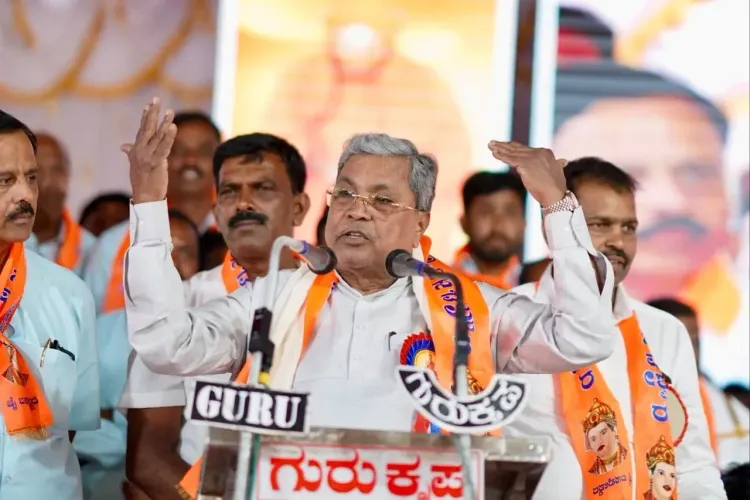
Karnataka CM Siddaramaiah invoked Basavanna's 12th-century equality teachings at a Basava Jayanti event in Mysuru district, drew a philosophical line to Ambedkar's Constitution, and reaffirmed his government's pledge to complete the ₹280 crore Anubhava Mantapa reconstruction.
Key Takeaways
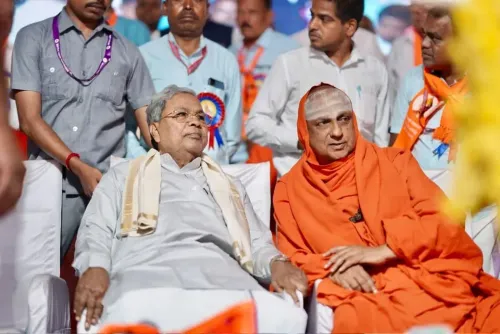
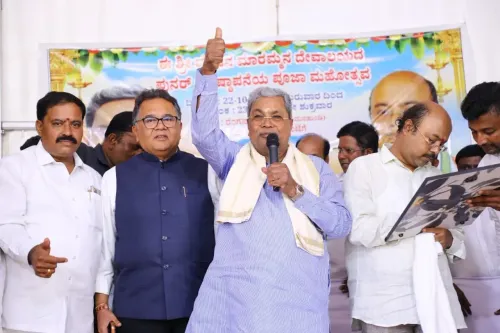
Siddaramaiah addressed a Basava Jayanti event organised by the Akhila Bharata Veerashaiva Lingayat Mahasabha in K.R.
Nagara, Mysuru district on 28 October 2026 .
He argued that Basavanna's ideals of caste-free, gender-equal society — articulated 900 years ago — remain unrealised, with caste hostility and untouchability still persisting.
He drew a philosophical lineage from Buddha (2,500 years ago) through Basavanna (900 years ago) to Ambedkar's Constitution , calling all three expressions of the same equality principle.
He stated that during his previous term he released ₹280 crore for reconstruction of the Anubhava Mantapa following a committee report by G.R.
Channabasappa , and pledged to complete the project.
He noted that he first took oath as Karnataka CM on Basava Jayanti, 13 May 2013 , describing the coincidence as personally significant.
He said he had directed Karnataka's schools and colleges to recite the Preamble to the Constitution as a civic education measure linked to Basavanna's values.
Nine hundred years after a 12th-century philosopher-saint challenged the caste order in medieval Karnataka, Karnataka Chief Minister Siddaramaiah stood before a Basava Jayanti gathering in K.R. Nagara, Mysuru district, on 28 October 2026 and declared that Basavanna's dream society remains unbuilt — and that finishing it is the task of this generation.
Speaking at the event organised by the Akhila Bharata Veerashaiva Lingayat Mahasabha and a coalition of Veerashaiva Lingayat organisations, the Chief Minister drew a continuous line from the 12th-century reformer through Gautama Buddha to Dr B.R. Ambedkar — arguing that the equality ideals articulated 2,500 years ago by Buddha and 900 years ago by Basavanna were ultimately codified in India's Constitution.
The vachana that still cuts deep
Siddaramaiah quoted one of Basavanna's most famous vachanas: 'Ivanārava ivanārava ivanāravanendennadi rayya, iva nammava iva nammava iva nammavane ndenniri rayya' — 'Do not ask who this person is or where he belongs; say instead, he is ours, he is ours, he is ours.' The verse, he said, was Basavanna's declaration of universal human belonging — and a rebuke to the caste-based exclusion that, the CM lamented, still persists in contemporary society.
Siddaramaiah's address was direct about the gap between ideal and reality: caste hierarchies, untouchability, inter-religious friction and communal hostility between jatis all continue, he said, sustained by 'entrenched vested interests that sow and nurture caste and hatred.' The frustration was explicit — 900 years of teaching, and the society Basavanna imagined has not arrived.
The Anubhava Mantapa — a 12th-century parliament, still under reconstruction
The Chief Minister returned to a project from his earlier term: the reconstruction of the Anubhava Mantapa, Basavanna's open assembly in which people of all castes — including women — debated spiritual and social questions freely. Presided over by the Lingayat saint Allama Prabhu, the institution gave even the most marginalised a formal seat, centuries before representative democracy existed as a concept anywhere in the world.
Siddaramaiah said he constituted a committee under G.R. Channabasappa during his previous tenure specifically for the Anubhava Mantapa's reconstruction, and released ₹280 crore based on the committee's report, with work begun during that administration. 'Completing the Anubhava Mantapa is our resolve,' he said, framing it as both an architectural project and a symbolic commitment to Basavanna's egalitarian legacy.
Constitution as the living vachana
The rhetorical centrepiece of the speech was the triangle of Basavanna, Buddha, and Ambedkar: three figures across three millennia, each insisting that no person should be ranked below another by birth. Siddaramaiah argued that Ambedkar's Constitution is the institutional expression of that chain of thought — and that every Indian has an obligation to read it, understand it, and live by it.
It is a commitment he has tied to policy. He told the gathering that during his tenure as Chief Minister he ordered every school and college in Karnataka to recite the Preamble to the Constitution — an initiative he described as a direct extension of Basavanna's mission of making values accessible to all, not just the learned or privileged.
He also invoked Basavanna's twin principles of Kayakave Kailasa (labour is worship) and Dasoha (community sharing of the fruits of labour) as a framework for economic equality: no one should live without honest work, and the rewards of work must not accumulate only with a few.
Basava Jayanti oath — a memory that still anchors the Chief Minister
Siddaramaiah noted a coincidence that carries personal weight: on 13 May 2013 — Basava Jayanti that year — he took oath as Chief Minister of Karnataka for the first time. 'That the chance to assume office fell on Basava Jayanti was a coincidence,' he said, 'but it brought great joy to my life.' The personal aside was more than sentiment — it stitched his political identity firmly to the saint's legacy in front of an audience drawn from Lingayat and Veerashaiva communities.
The real tribute to Basavanna, Siddaramaiah concluded, is not ceremony but construction: 'Building a society rooted in mutual love, coexistence, equality and humaneness — that is the true respect we owe to Vishwaguru Basavanna.'
Point of View
Simultaneously reaching Veerashaiva communities and projecting a Constitutionalist, Ambedkarite identity. By framing the Anubhava Mantapa reconstruction as an unfinished mission of his own tenure — with a ₹280 crore budget already released — he converts a ceremonial occasion into a governance accountability statement. The Buddha-Basavanna-Ambedkar triangle is a deliberate ideological construction that links Karnataka's regional reformist tradition to national Dalit-rights symbolism, broadening the CM's appeal beyond a single caste bloc. The subtext is also defensive: asserting that Congress, not rival parties, is the true heir to Basavanna's legacy ahead of any community consolidation attempts by the BJP or other groups.
NationPress
28 Oct 2026
Frequently Asked Questions
What did CM Siddaramaiah say about Basavanna at the Basava Jayanti event?
Siddaramaiah said Basavanna led a social revolution in the 12th century against caste discrimination, untouchability and gender inequality, and that 900 years later his dream of an equal society remains unbuilt. He called on all Indians to imbibe Basavanna's values of equality, coexistence and humaneness.
What is the Anubhava Mantapa and why is Siddaramaiah associated with its reconstruction?
The Anubhava Mantapa was an open assembly founded by Basavanna in the 12th century for inclusive spiritual and social debate, open to all castes and women. Siddaramaiah says he constituted a committee under G.R. Channabasappa during his earlier term as CM and released ₹280 crore for its reconstruction, with work already started.
How does Siddaramaiah connect Basavanna to Ambedkar and the Indian Constitution?
He argues that equality principles articulated by Buddha 2,500 years ago and Basavanna 900 years ago were institutionalised by Ambedkar in the Constitution, making all three figures part of a single chain of egalitarian thought. He says every Indian must read, understand and live by the Constitution as a direct expression of that legacy.
Why did Siddaramaiah order schools to read the Constitution's Preamble?
As Chief Minister, Siddaramaiah directed all Karnataka schools and colleges to recite the Preamble to the Constitution, describing it as an extension of Basavanna's mission of making core human values accessible to everyone, not just the privileged.
What is the significance of Siddaramaiah taking oath on Basava Jayanti in 2013?
Siddaramaiah took oath as Karnataka Chief Minister for the first time on 13 May 2013, which fell on Basava Jayanti that year. He called it a coincidence but said it brought great personal joy, publicly linking his political career to Basavanna's reformist legacy.