CM Siddaramaiah Remembers Kalam on Death Anniversary
Synopsis
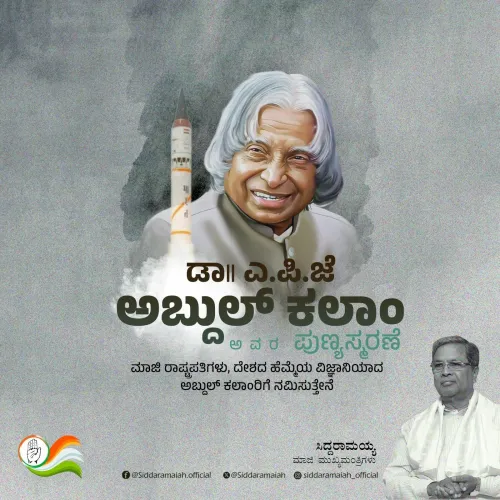
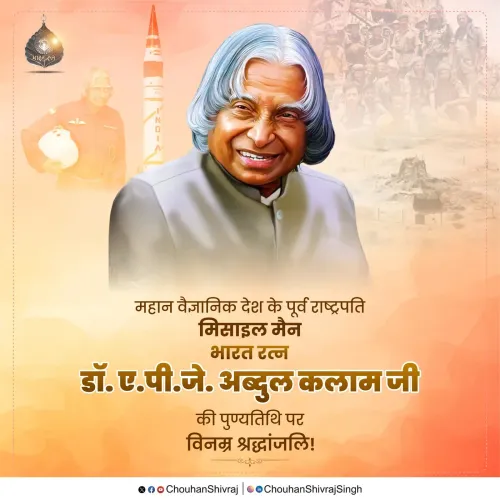
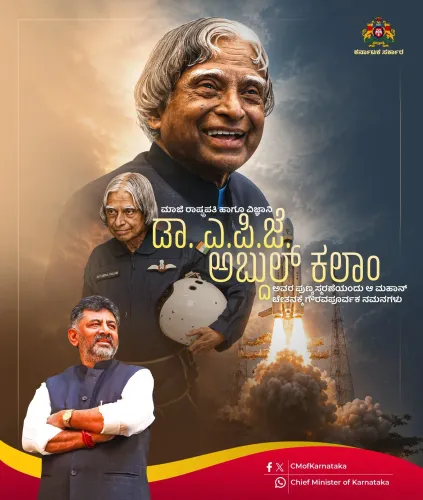
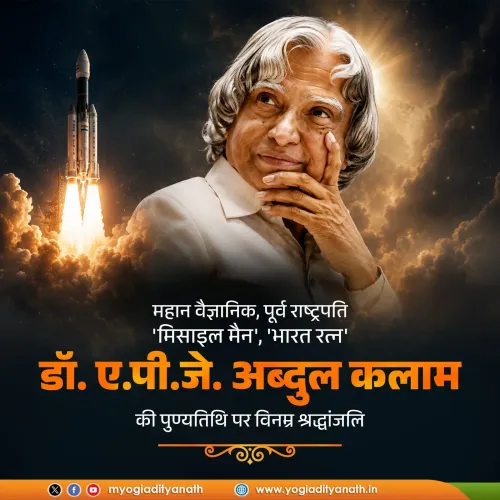
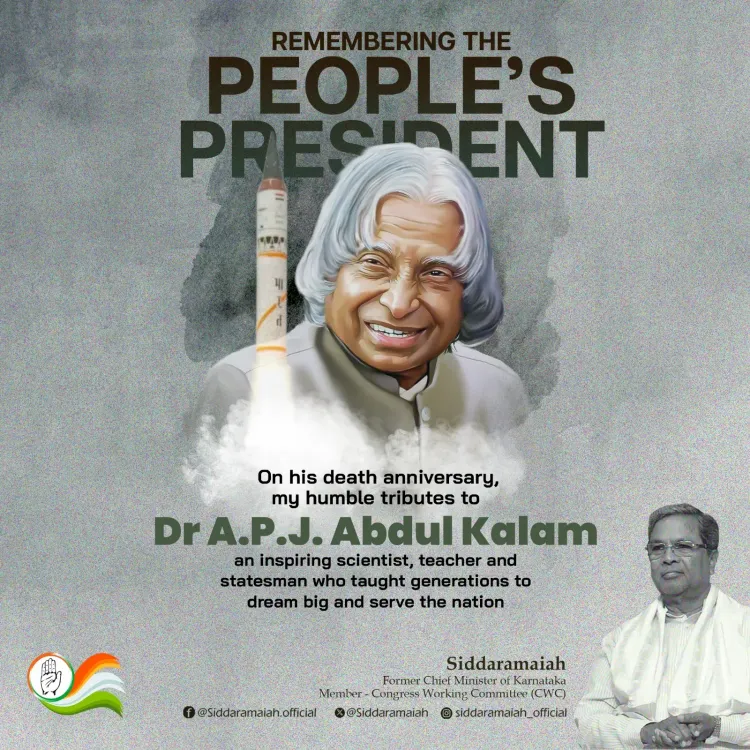
Karnataka Chief Minister Siddaramaiah paid tribute to Dr A.P.J. Abdul Kalam on his death anniversary, honouring the 'People's President' for transforming India's space and missile capabilities and inspiring generations of young Indians through science and service.
Key Takeaways
CM Siddaramaiah paid tribute to Dr A.P.J.
Abdul Kalam on his death anniversary, 27 July .
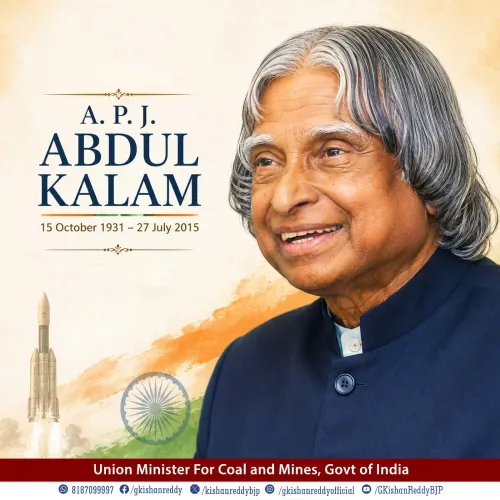
Kalam served as India's 11th President from 2002 to 2007 , earning the title 'People's President.' He led the SLV-III project at ISRO and the IGMDP at DRDO , producing the Agni and Prithvi missile systems.
Known as the 'Missile Man of India,' Kalam's work underpins India's current space and strategic defence programmes.
His birth anniversary, 15 October , is observed as World Students' Day , with STEM and youth initiatives expected from state governments.
Karnataka Chief Minister Siddaramaiah paid tribute to former President Dr A.P.J. Abdul Kalam on his death anniversary, 27 July, honouring the scientist-statesman's contributions to India's space and defence programmes and his enduring influence on the country's youth.
Context
In his post, CM Siddaramaiah described Kalam's life as 'a remarkable journey of science, service and nation-building,' recalling his role in strengthening India's space and missile programmes before he went on to serve as the 11th President of India. The Chief Minister underscored Kalam's 'humility, vision and unwavering belief in India's youth' as a legacy that continues to resonate across generations.
Kalam passed away on 27 July 2015 while delivering a lecture at the Indian Institute of Management, Shillong. Each year, political leaders, scientists, and educators across the country mark the occasion with tributes reflecting on his multifaceted career.
Policy Backdrop
Dr Kalam served as India's 11th President from 2002 to 2007, but his scientific legacy predates that role by decades. At ISRO, he led the SLV-III project, which successfully placed the Rohini satellite in orbit in 1980 — a milestone in India's indigenous space capability. At DRDO, he spearheaded the Integrated Guided Missile Development Programme (IGMDP), which produced the Agni and Prithvi missile systems, earning him the title 'Missile Man of India.'
His presidency was marked by an unusual closeness to students and young citizens, a quality that earned him the popular sobriquet 'People's President.' He consistently advocated for STEM education and set a goal of making India a developed nation by 2020, a vision he articulated in his book India 2020.
Stakeholders and Impact
Kalam's work at ISRO and DRDO laid foundational infrastructure that continues to underpin India's space and strategic defence programmes today. His advocacy for science education has influenced generations of students, and his books — including Wings of Fire — remain widely read in schools and colleges across the country.
Indian political leaders from multiple parties routinely issue statements on this anniversary, reflecting a cross-partisan consensus around Kalam's contributions to national self-reliance in strategic sectors. CM Siddaramaiah's tribute follows this broader pattern of institutional remembrance that spans state and central governments alike.
What's Next
Kalam's birth anniversary on 15 October — observed nationally as World Students' Day — is expected to see further commemorations, including potential announcements of STEM initiatives, memorial lectures, and scholarship programmes by state governments. Karnataka and other states have in the past used both anniversaries to spotlight youth-focused education and science policy. The legacy of indigenous capability-building that Kalam championed continues to inform debates around India's defence and space ambitions.
Point of View
Reflecting a rare area of political consensus in an otherwise polarised landscape. By emphasising Kalam's 'belief in India's youth,' the Chief Minister implicitly aligns the Congress-led Karnataka government with a nationally resonant development narrative centred on science and self-reliance. The tribute also signals the enduring electoral and symbolic value of Kalam's image — one that transcends party lines and speaks to aspirational voters. As India's space and defence ambitions grow, invoking Kalam's legacy serves as a shorthand for indigenous capability-building, a theme that cuts across ideological divides.
NationPress
27 Jul 2026
Frequently Asked Questions
When did APJ Abdul Kalam pass away?
Dr A.P.J. Abdul Kalam passed away on 27 July 2015 while delivering a lecture at the Indian Institute of Management, Shillong. He was 83 years old at the time of his death.
Why is APJ Abdul Kalam called the Missile Man of India?
Kalam earned the title 'Missile Man of India' for leading the Integrated Guided Missile Development Programme (IGMDP) at DRDO , which produced indigenous missile systems including Agni and Prithvi , significantly advancing India's strategic defence capabilities.
Which President number was APJ Abdul Kalam?
Dr A.P.J. Abdul Kalam served as the 11th President of India , holding office from 2002 to 2007 . He was popularly known as the 'People's President' for his close connection with students and ordinary citizens.
What did Siddaramaiah say about APJ Abdul Kalam?
Karnataka Chief Minister Siddaramaiah described Kalam's life as 'a remarkable journey of science, service and nation-building,' highlighting his contributions to India's space and missile programmes and his 'humility, vision and unwavering belief in India's youth.'
What is World Students' Day and why is it linked to Kalam?
World Students' Day is observed on 15 October — Dr Kalam's birth anniversary — in recognition of his lifelong commitment to education, science, and inspiring young people. The day is marked by STEM events, memorial lectures, and youth-focused initiatives across India.