CM Sukhu flags HP health staffing crisis, vows AIIMS-level upgrade
Synopsis
CM Sukhvinder Singh Sukhu reveals that HP's health department was running at just 35% doctor and nurse capacity when Congress took office in 2022. He outlines ongoing fixes: AIIMS-benchmarked medical colleges, radiographer recruitments, X-ray deployments across PHCs, and a pending Nahan hospital space case.
Key Takeaways
When CM Sukhu reviewed the health department after taking office in December 2022 , only 35 of 100 required doctors and nurses were in post.
Radiographers and operation theatre assistants were available at just 20–30 percent of sanctioned strength.
State medical colleges are being upgraded with technology comparable to AIIMS Delhi .
Facilities at PHC, CHC, Zonal and District Hospital levels are all being strengthened simultaneously.
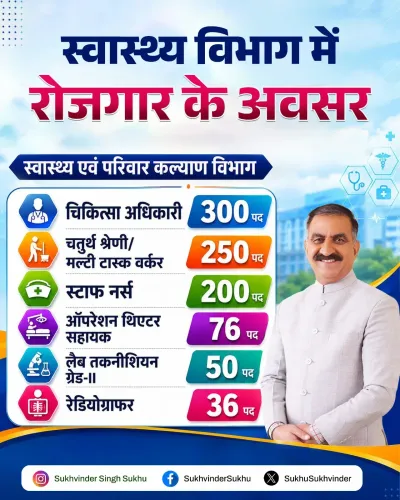
Fresh radiographer appointments and X-ray machine procurement are actively underway.
A case related to hospital space in Nahan , Sirmaur district, is set to be filed soon.
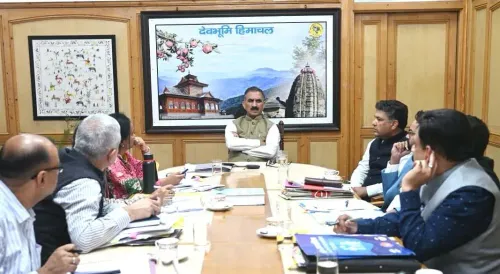
When Himachal Pradesh Chief Minister Sukhvinder Singh Sukhu first convened a health department review after taking office in December 2022, the numbers on the table were stark: only 35 of every 100 required doctors and nurses were actually in place, and radiographers and operation theatre assistants were available at a mere 20–30 percent of sanctioned strength. That gap, he says, set the reform agenda — and on Friday, 30 October 2026, he went public with a progress report.
A health system running on a third of its staff
Sukhu's post, written in Hindi, laid out the crisis in blunt arithmetic. Against a requirement of 100 staff nurses, only 35 were available. The same ratio held for doctors — 35 functional against 100 needed. Diagnostic cadres were even thinner on the ground, with radiographers and OTAs filling barely a quarter of sanctioned posts. The Directorate of Health Services, Himachal Pradesh — the state agency responsible for public health delivery and hospital operations — was, by the Chief Minister's own account, severely understaffed at the moment Congress assumed power.
These are not merely bureaucratic deficits. In a hilly state where the nearest district hospital can mean a two-hour mountain drive, a missing radiographer or an absent doctor is a life-safety gap. Sukhu framed the inherited shortfall not as an accusation but as a baseline — the floor from which his government has been building up.
From PHC to medical college: the upgrade now underway
The Chief Minister listed four distinct lines of action now in motion. State medical colleges are being equipped with technology benchmarked against AIIMS Delhi — a pointed aspiration that signals both the ambition and the distance still to travel. Simultaneously, health infrastructure is being strengthened across the full care pyramid: Primary Health Centres (PHC), Community Health Centres (CHC), Zonal Hospitals and District Hospitals are all named as targets. Radiographer recruitments are actively underway, and X-ray machines are being procured and deployed — a tangible, equipment-level fix to what was previously a 70–80 percent diagnostic blackout in that cadre.
A fourth item stands apart in specificity: a pending case related to hospital space in Nahan, the headquarters of Sirmaur district, will be uploaded for resolution. Nahan's mention — without elaboration — suggests a local infrastructure dispute or land-use issue that the Chief Minister has flagged as a near-term deliverable.
What the Nahan case and recruiter timelines will reveal
The real test of Sukhu's health overhaul will arrive in the details his post does not yet provide: how many radiographers have been appointed versus how many are still pending, whether the X-ray machine deployments have reached the most remote PHCs, and what exactly the 'Nahan case' resolves. The next state health budget will be the clearest signal of whether these reforms are funded to completion or remain aspirational. For the rural patients and healthcare workers who live inside the gap between the 35-percent reality and the 100-percent requirement, the arithmetic — not the announcement — is what matters.
Point of View
Where proximity to tertiary care is both a genuine problem and a powerful electoral symbol. The specific mention of Nahan is worth tracking: district-level hospital disputes often carry outsized local political weight in Himachal Pradesh's fragmented constituency map. If recruitment and equipment numbers are published transparently in the next budget session, the reform narrative holds; if they are not, the gap between the 35-percent baseline and the claimed progress becomes a liability.
NationPress
30 Oct 2026
Frequently Asked Questions
What was the doctor and nurse shortage in Himachal Pradesh when CM Sukhu took office?
CM Sukhu stated that when he reviewed the health department after taking office in December 2022, only 35 out of every 100 required doctors and 35 out of every 100 required staff nurses were actually in post — a roughly 65 percent vacancy rate in both cadres.
What upgrades is CM Sukhu making to Himachal Pradesh medical colleges?
State medical colleges are being equipped with advanced technology benchmarked against AIIMS Delhi, according to CM Sukhu's announcement on 30 October 2026.
What is the Nahan hospital case CM Sukhu mentioned?
Sukhu referred to a pending matter related to hospital space in Nahan, the headquarters of Sirmaur district, stating that the case will be uploaded for resolution. No further details were provided in his post.
Is the Himachal Pradesh government recruiting radiographers?
Yes. CM Sukhu confirmed that radiographer appointments are actively being made and X-ray machines are being procured and deployed across health facilities in the state.
Which hospitals are being upgraded under the Himachal Pradesh health reform?
CM Sukhu stated that health facilities are being strengthened across Primary Health Centres (PHC), Community Health Centres (CHC), Zonal Hospitals, and District Hospitals throughout Himachal Pradesh.