CM Sukhu greets Himachal's tribal communities on World Indigenous Peoples Day
Synopsis
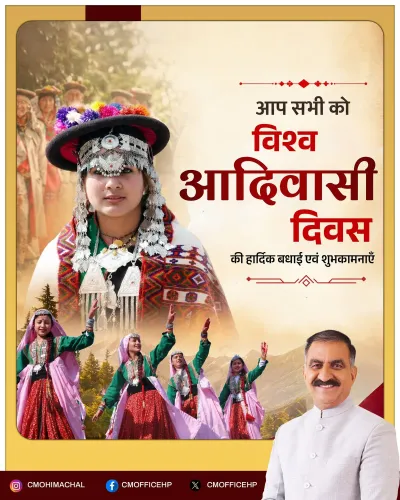
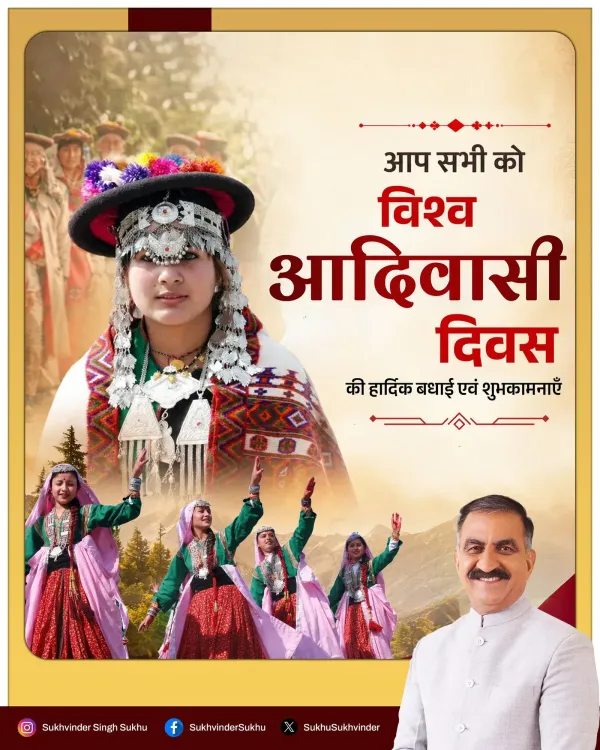
On World Indigenous Peoples Day, 9 August, Himachal Pradesh Chief Minister Sukhvinder Singh Sukhu saluted the state's tribal communities, calling their culture a 'shared heritage' and signing off with the traditional greeting 'Jai Johar'.
Key Takeaways
CM Sukhvinder Singh Sukhu posted a greeting on 9 August for World Indigenous Peoples Day , addressing Himachal Pradesh's tribal communities.
He described their culture and traditions as a 'shared heritage' and cited their bond with nature as an inspiration for all.
He signed off with Jai Johar , a traditional salutation used widely among tribal communities across India.
The United Nations proclaimed 9 August as the International Day of the World's Indigenous Peoples in 1994 .
Himachal Pradesh has notified tribal areas in Kinnaur , Lahaul and Spiti , and parts of Chamba , home to communities with distinct Himalayan cultural practices.
Every year on 9 August, the world pauses to honour the cultures, rights, and resilience of indigenous peoples — and Himachal Pradesh Chief Minister Sukhvinder Singh Sukhu used the occasion to send a warm message to the state's tribal communities, saluting their living traditions and their bond with the natural world.
Posting in Hindi on World Indigenous Peoples Day, CM Sukhu described the rich culture and traditions of Himachal Pradesh ke aadivasi bhai-behnon (the tribal brothers and sisters of Himachal Pradesh) as a 'shared heritage belonging to all of us.' He highlighted their deep connection with nature, their instinctive outlook on life, and their commitment to preserving ancestral customs as a source of inspiration. He signed off with the traditional greeting 'Jai Johar' — a salutation widely used among tribal communities across India as an expression of respect and solidarity.
'Jai Johar': What the greeting carries
Jai Johar is more than a pleasantry. Used across tribal belts from Jharkhand to Himachal Pradesh, it is a cultural marker — an acknowledgement of shared indigenous identity. When a Chief Minister closes an official message with it, the signal is deliberate: recognition, not just courtesy.Why 9 August matters for Himachal's tribal belt
The United Nations proclaimed 9 August as the International Day of the World's Indigenous Peoples in 1994, anchoring it to the first meeting of the UN Working Group on Indigenous Populations in 1982. Himachal Pradesh is home to several notified tribal areas — including the high-altitude districts of Kinnaur, Lahaul and Spiti, and parts of Chamba — where communities maintain distinct languages, rituals, and ecological practices shaped by the Himalayan landscape. Their traditions of sustainable coexistence with mountain ecosystems have drawn attention well beyond state borders. Indian political leaders across parties routinely issue greetings on this UN-designated day, but messages from a sitting Chief Minister carry administrative weight — they signal the state government's orientation toward tribal welfare at a moment when Scheduled Tribe communities are watching policy priorities closely.Point of View
Where Scheduled Tribe voters hold decisive sway in Himachal's hill constituencies. The use of 'Jai Johar' — a greeting with roots in Jharkhand's tribal movement — signals a deliberate cultural outreach that travels beyond the state's own tribal dialects. At a national level, the day has become a soft-power moment for state governments to stake a claim on tribal welfare narratives, often as a counterpoint to central government schemes. Whether such messaging translates into concrete policy action in Himachal's tribal districts is the question communities and observers will continue to press.
NationPress
23 Sept 2026
Frequently Asked Questions
When is World Indigenous Peoples Day celebrated?
World Indigenous Peoples Day is observed every year on 9 August , following a 1994 proclamation by the United Nations General Assembly .
What did CM Sukhu say on World Indigenous Peoples Day?
CM Sukhvinder Singh Sukhu called the culture and traditions of Himachal Pradesh's tribal communities a 'shared heritage,' praised their bond with nature, and greeted them with the traditional salutation Jai Johar .
What does 'Jai Johar' mean?
Jai Johar is a traditional greeting used among tribal communities across India, expressing respect, solidarity, and pride in indigenous identity.
Which tribal areas are there in Himachal Pradesh?
Himachal Pradesh has notified tribal areas primarily in Kinnaur , Lahaul and Spiti , and parts of Chamba , where communities maintain distinct cultures and ecological practices tied to the Himalayan environment.
Why do Indian leaders post messages on World Indigenous Peoples Day?
Indian leaders across parties use 9 August to publicly acknowledge Scheduled Tribe communities and signal government commitment to tribal welfare, a constituency with significant electoral and cultural importance.