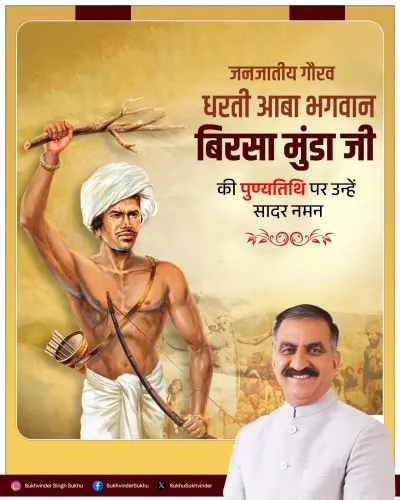
CM Sukhu Pays Tribute to Birsa Munda's Legacy of Dignity

Synopsis
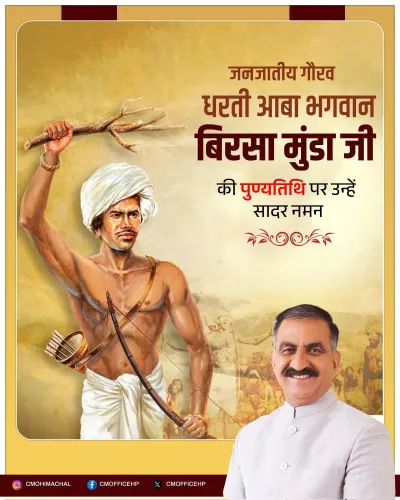
Chief Minister Sukhvinder Singh Sukhu of Himachal Pradesh has paid tribute to tribal icon Birsa Munda, invoking his ideals of self-respect and social justice and closing with the Adivasi salutation 'Jai Johar' — a gesture carrying both cultural and political resonance for tribal communities across India.
Key Takeaways
The Chief Minister's Office of Himachal Pradesh posted the tribute on 9 June 2026 , attributed directly to CM Thakur Sukhvinder Singh Sukhu .
The message invokes Birsa Munda's legacy as an inspiration for self-respect and social justice.
The post closes with 'Jai Johar' , a traditional Adivasi greeting symbolising solidarity with tribal communities.
Birsa Munda was a 19th-century tribal leader from Chotanagpur who resisted colonial exploitation and is revered as Dharti Aaba .
Such tributes align with a broader pattern of Indian political leaders engaging with tribal icons to signal commitment to equity and marginalised communities.
Observers will watch for related welfare scheme announcements targeting Himachal Pradesh's Scheduled Tribe areas in the 2026-27 budget cycle.
The Chief Minister's Office of Himachal Pradesh, on behalf of Chief Minister Thakur Sukhvinder Singh Sukhu, posted a tribute on Tuesday, 9 June 2026, invoking the enduring ideals of self-respect and social justice associated with tribal icon Birsa Munda.
Context
The post, written in Hindi, carries the salutation 'Jai Johar' — a traditional Adivasi greeting that has come to symbolise solidarity with tribal communities across India. The message, attributed directly to Chief Minister Sukhu, reads: 'His thoughts and ideals continue to inspire everyone to move forward on the path of self-respect and social justice.' The use of 'Jai Johar' is a deliberate cultural marker, signalling alignment with Adivasi identity and aspiration.
Policy Backdrop
Paying public tribute to Birsa Munda — the 19th-century tribal leader from the Chotanagpur region who led a fierce resistance against colonial exploitation and landlord oppression — has become a recurring practice among state governments across India, particularly those with significant Scheduled Tribe populations. Such observances gained institutional momentum in the early 2000s, with leaders from multiple parties invoking Munda's legacy to signal commitment to tribal rights and equity. Himachal Pradesh has a constitutionally recognised Scheduled Tribe population, and the current Congress-led government under Sukhu has emphasised welfare and social sector priorities since taking office in December 2022.
Stakeholders and Impact
The tribute is directed at tribal communities, Adivasi rights advocates, and social justice constituencies in Himachal Pradesh and beyond. For these groups, official acknowledgement of Birsa Munda's philosophy carries symbolic weight, reinforcing the state's stated commitment to the rights and dignity of marginalised communities. The greeting 'Jai Johar' resonates particularly strongly with communities across Jharkhand, Chhattisgarh, Odisha, and the hill states, where Munda is revered as Dharti Aaba — 'Father of the Earth.' Political messaging of this kind also speaks to a broader national audience watching how regional governments engage with tribal identity.
What's Next
State-level commemorative tributes of this nature often precede or accompany announcements related to welfare schemes targeting Scheduled Tribe communities. Observers will watch whether the Himachal Pradesh government follows this tribute with concrete policy steps — such as scheme expansions or budget allocations for tribal welfare areas — as part of its 2026-27 fiscal cycle. The invocation of self-respect and social justice themes may also signal the tone of the government's messaging ahead of future electoral cycles in the state.
Point of View
Punctuated by the Adivasi salutation 'Jai Johar,' is a carefully calibrated act of cultural solidarity that extends well beyond ceremonial courtesy. For a Congress-led government in a non-tribal-majority hill state, invoking Munda's philosophy of self-rule and social justice positions the administration within a national narrative of Adivasi assertion that has gained political salience across multiple states. The gesture also reflects a competitive dynamic: the BJP at the Centre has made tribal outreach — including the elevation of President Droupadi Murmu — a central plank, and regional Congress governments are signalling they hold equal claim to this legacy. Whether symbolic messaging translates into measurable policy for Himachal Pradesh's Scheduled Tribe communities will be the real test of the government's stated commitment.
NationPress
23 Sept 2026
Frequently Asked Questions
Who is Birsa Munda and why is he significant in Indian politics?
Birsa Munda was a 19th-century tribal leader from the Chotanagpur region who led a movement against colonial exploitation and landlord oppression, and is revered as 'Dharti Aaba' — Father of the Earth — by Adivasi communities. His legacy of self-respect and resistance has made him a central symbol of tribal rights in India, and political leaders across parties regularly invoke his memory to signal solidarity with Scheduled Tribe communities.
What does 'Jai Johar' mean?
'Jai Johar' is a traditional Adivasi greeting and salutation used widely among tribal communities, particularly in Jharkhand, Chhattisgarh, Odisha, and parts of the hill states. It carries connotations of mutual respect, solidarity, and pride in Adivasi identity, and has increasingly entered mainstream political discourse as a marker of alignment with tribal communities.
Why did CM Sukhu of Himachal Pradesh issue this tribute?
Chief Minister Sukhvinder Singh Sukhu issued the tribute to honour Birsa Munda's enduring ideals of self-respect and social justice. State governments across India, including those with Scheduled Tribe populations, regularly pay tribute to Munda on commemorative occasions to highlight their commitment to tribal rights and equity.
What is Sukhvinder Singh Sukhu's background?
Sukhvinder Singh Sukhu is a Congress leader who has served as Chief Minister of Himachal Pradesh since December 2022. His government has placed emphasis on welfare and social sector programmes since taking office.
Will Himachal Pradesh announce new tribal welfare schemes following this tribute?
No specific scheme announcement has been made alongside this tribute. However, observers note that such commemorative messaging often precedes or accompanies welfare announcements, and attention will be on whether the Himachal Pradesh government follows up with concrete policy steps for Scheduled Tribe communities in its 2026-27 budget cycle.