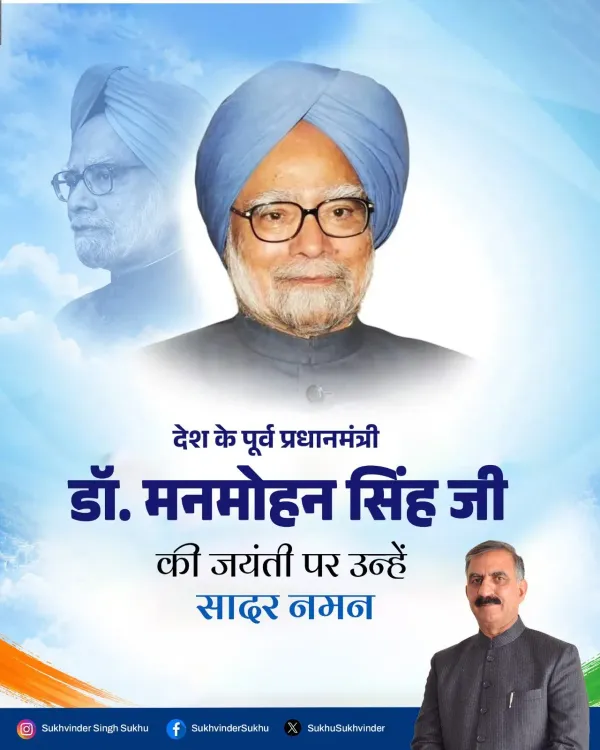
CM Sukhu pays tribute to Dr. Manmohan Singh on birth anniversary
Synopsis
On Dr. Manmohan Singh's birth anniversary, Himachal Pradesh CM Sukhvinder Singh Sukhu saluted the former PM's economic vision, crediting him with transforming India's economy in 1991 and championing inclusive growth for marginalised communities during his decade as Prime Minister.
Key Takeaways
CM Sukhvinder Singh Sukhu posted a tribute on September 26, 2026 — Dr.
Manmohan Singh's birth anniversary.
Singh's 'farsightedness and economic understanding' for giving India's economy 'new momentum.' Dr.
Manmohan Singh served as Finance Minister in 1991 , dismantling the Licence Raj and opening India's economy.
As Prime Minister from 2004 to 2014 , he oversaw the enactment of MGNREGA in 2005 , the world's largest public employment scheme.
Sukhu specifically highlighted Dr.
Singh's commitment to the poor, Dalits, and marginalised communities as central to his economic philosophy.
The tribute reflects the Congress party's consistent narrative linking economic liberalisation to inclusive welfare — renewed every September 26.
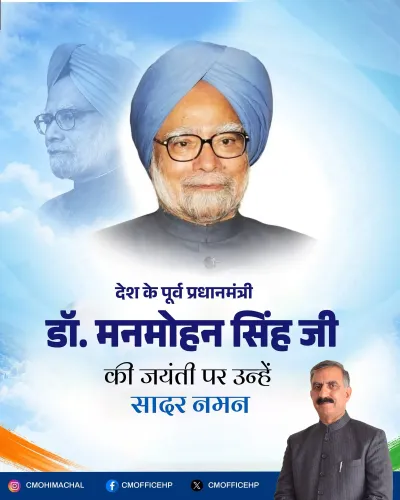
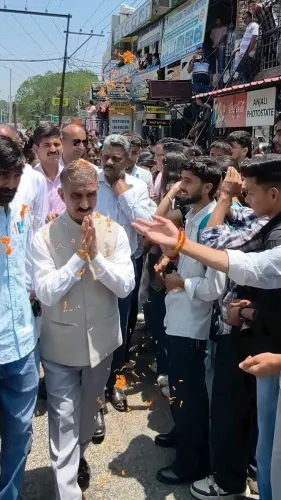
On the birth anniversary of one of India's most consequential economic architects, Himachal Pradesh Chief Minister Sukhvinder Singh Sukhu offered a heartfelt tribute to former Prime Minister Dr. Manmohan Singh on Saturday, September 26, 2026, saluting his vision, economic acumen, and lifelong commitment to India's most vulnerable citizens.
Posting in Hindi on X, CM Sukhu wrote: 'देश के पूर्व प्रधानमंत्री डॉ. मनमोहन सिंह जी की जयंती पर उन्हें शत-शत नमन एवं वंदन' — 'I offer a hundred salutes and reverence to former Prime Minister Dr. Manmohan Singh on his birth anniversary.' He credited Dr. Singh with giving 'new momentum to India's economy through farsightedness and economic understanding, linking development to broad public interest.'
The architect of 1991 — and what he built after
The tribute lands with particular weight given the scale of Dr. Singh's legacy. As Finance Minister in 1991, he presented a landmark budget that dismantled the Licence Raj, threw open India's economy to foreign investment, and set the country on a path of sustained growth. It was arguably the single most transformative economic intervention in post-independence India.
But Sukhu's tribute reaches beyond 1991. The Chief Minister specifically highlighted Dr. Singh's focus on the poor, Dalits, and marginalised communities — a reference to the welfare architecture built during the UPA government (2004–2014), which Dr. Singh led as Prime Minister. Most notably, the Mahatma Gandhi National Rural Employment Guarantee Act (MGNREGA), enacted in 2005, guaranteed 100 days of wage employment annually to rural households — a programme that remains the world's largest public employment scheme.
A Congress narrative, renewed every September 26
Within the Indian National Congress, Dr. Singh's birth anniversary on September 26 has become a recurring moment of ideological reaffirmation. Party leaders consistently invoke the 1991 reforms alongside UPA-era welfare measures to argue that economic growth and social equity are not competing goals but complementary ones. Sukhu's post fits squarely in that tradition.
'Increasing opportunities in the lives of the poor, Dalits, the deprived, and the weak was an important part of his economic vision,' Sukhu wrote. 'His dedication to the nation will remain a source of inspiration for generations to come.'
For a state like Himachal Pradesh — where a significant share of the population depends on rural employment and government welfare delivery — the invocation of Dr. Singh's inclusive development model carries local resonance beyond mere political ritual. Dr. Singh's legacy, on the anniversary of his birth, remains as alive in party discourse as it is in policy textbooks.
Point of View
The party projects itself as the only force capable of holding economic reform and social equity together. For CM Sukhu, echoing that framing in Himachal Pradesh reinforces a pro-poor identity ahead of any future electoral cycle. The consistency of this ritual signals that Dr. Singh's legacy has become a living policy argument, not just a fond memory.
NationPress
26 Sept 2026
Frequently Asked Questions
When is Dr. Manmohan Singh's birthday?
Dr. Manmohan Singh was born on September 26 . CM Sukhvinder Singh Sukhu and other Congress leaders mark this date annually with public tributes.
What did Manmohan Singh do as Finance Minister in 1991?
As Finance Minister in 1991 , Dr. Manmohan Singh presented a budget that dismantled the Licence Raj, opened India's economy to foreign investment, and launched the era of economic liberalisation.
What is MGNREGA and who introduced it?
MGNREGA (Mahatma Gandhi National Rural Employment Guarantee Act) was enacted in 2005 under Prime Minister Dr. Manmohan Singh's UPA government. It guarantees 100 days of wage employment annually to rural households and is the world's largest public employment scheme.
Why did CM Sukhu pay tribute to Manmohan Singh?
Himachal Pradesh CM Sukhvinder Singh Sukhu paid tribute on September 26, 2026 — Dr. Manmohan Singh's birth anniversary — honouring his economic vision and commitment to the poor, Dalits, and marginalised communities.
How long was Manmohan Singh the Prime Minister of India?
Dr. Manmohan Singh served as Prime Minister of India for ten years, from 2004 to 2014 , leading the United Progressive Alliance (UPA) government through two terms.