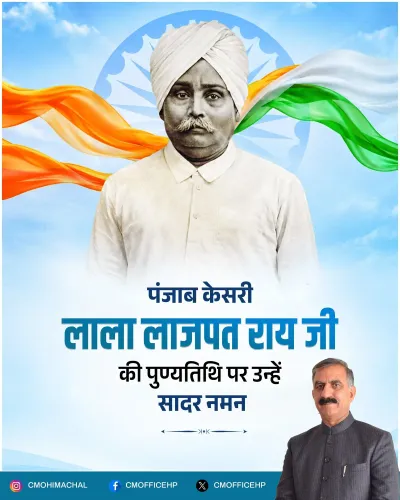
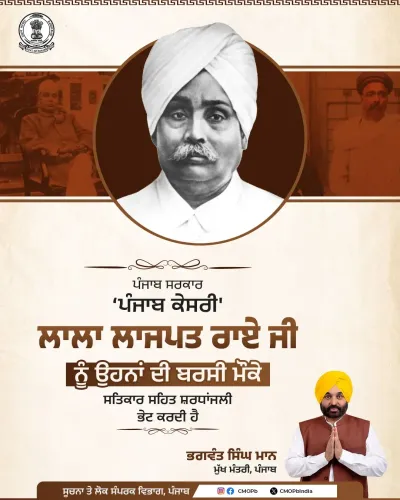
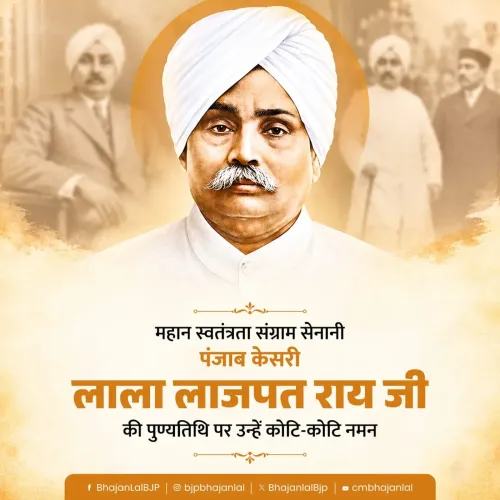
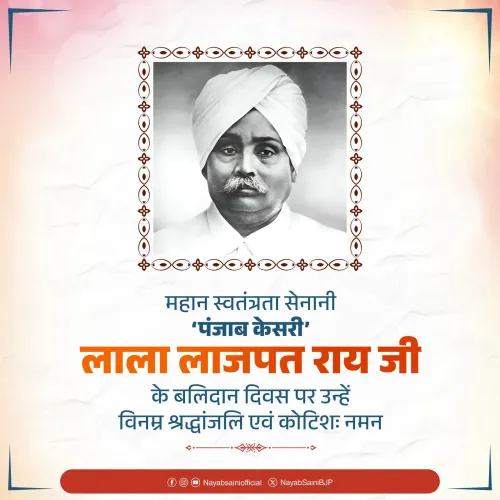
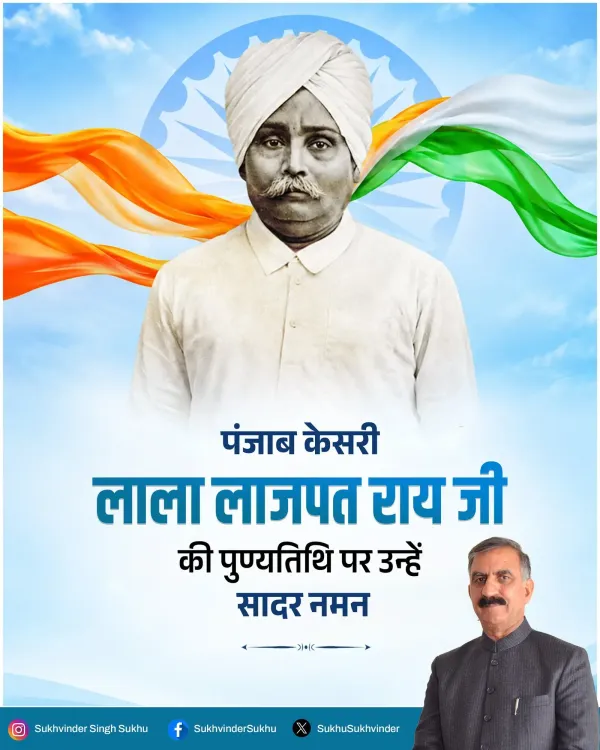
CM Sukhu pays tribute to Punjab Kesari Lala Lajpat Rai on death anniversary
Synopsis
Himachal Pradesh Chief Minister Sukhvinder Singh Sukhu honoured Lala Lajpat Rai, the 'Punjab Kesari', on his death anniversary of November 17, recalling the nationalist icon's fearless leadership against British rule and his ultimate sacrifice during the 1928 Simon Commission protests.
Key Takeaways
CM Sukhvinder Singh Sukhu paid tribute to Lala Lajpat Rai on his death anniversary, 17 November .
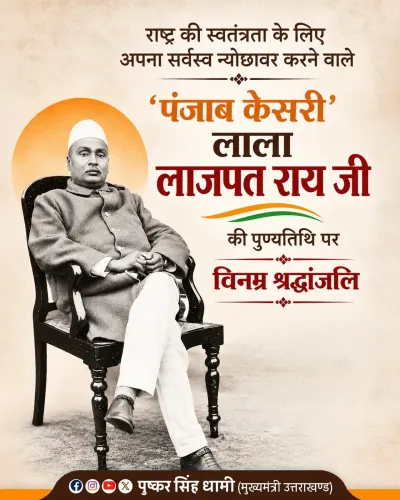
Lala Lajpat Rai, known as 'Punjab Kesari' , died on 17 November 1928 from injuries sustained in a police lathi charge in Lahore during protests against the Simon Commission .
Rai was part of the celebrated Lal-Bal-Pal nationalist triumvirate that radicalised the Indian independence movement in the early twentieth century.
His death directly inspired revolutionary Bhagat Singh and accelerated the mass anti-colonial movement.
CM Sukhu called Rai's sacrifice an 'eternal source of inspiration' for India's youth and future generations.
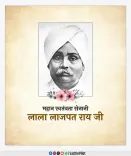
A century after a British lathi felled one of India's fiercest freedom fighters, the memory of Lala Lajpat Rai endures in every corner of the subcontinent's political consciousness. Himachal Pradesh Chief Minister Sukhvinder Singh Sukhu marked the death anniversary of 'Punjab Kesari' on Tuesday, November 17, paying homage to the nationalist icon whose sacrifice helped ignite the final, irreversible push against colonial rule.
CM Sukhu wrote in Hindi: 'लाला लाजपत राय जी के निर्भीक नेतृत्व और ओजस्वी विचारों ने अंग्रेजी हुकूमत के अत्याचारों के विरुद्ध आज़ादी की लड़ाई को नई ऊर्जा दी।' — 'The fearless leadership and stirring ideas of Lala Lajpat Rai gave fresh energy to the freedom struggle against the oppression of British rule, and kindled the spirit of patriotism in the youth.'
The blow that shook a nation
Born on 28 January 1865 in Punjab, Lala Lajpat Rai rose to become the thundering third of the celebrated Lal-Bal-Pal triumvirate — alongside Bal Gangadhar Tilak and Bipin Chandra Pal — whose aggressive nationalism reshaped the independence movement in the early twentieth century. His title, 'Punjab Kesari' (the Lion of Punjab), was no courtesy; it was earned on picket lines, in jails, and on public stages across a subcontinent straining against empire.
On 30 October 1928 in Lahore, Rai led a protest march against the all-British Simon Commission, which had been constituted to review India's governance without a single Indian member. The colonial police responded with a brutal lathi charge. Rai was struck repeatedly. He died from his injuries on 17 November 1928 — the same date commemorated today — after reportedly declaring that 'every blow struck at me is a nail in the coffin of the British Empire.' History records he was not wrong.
A sacrifice that accelerated history
His death radicalised a generation. The young revolutionary Bhagat Singh, who had witnessed the Lahore lathi charge, resolved to avenge Rai by assassinating British police officer J.P. Saunders — an act that reverberated through the independence movement and the colonial administration alike. The chain of events set in motion on the streets of Lahore in 1928 became one of the defining sequences of India's road to 1947.
CM Sukhu's tribute reflects the cross-party recognition that leaders like Rai belong not to any faction but to the nation's shared founding story. November 17 routinely draws commemorative messages from political leaders across the spectrum, a rare moment of consensual memory in an otherwise combative public discourse.
Point of View
Leaders across parties reinforce the Congress-era freedom-struggle lineage as a source of governing legitimacy. For CM Sukhu of the Indian National Congress, the tribute also signals continuity with the party's historical identity at a time when that narrative is actively contested. The cross-party nature of such commemorations, however, underscores that Rai's legacy has long transcended partisan ownership. What is worth watching is how the freedom-struggle memory is mobilised in HP's political space, where both Congress and BJP frequently claim the mantle of nationalist heritage.
NationPress
17 Nov 2026
Frequently Asked Questions
Why is Lala Lajpat Rai remembered on November 17?
November 17 is the death anniversary of Lala Lajpat Rai, who died on this date in 1928 from injuries sustained during a police lathi charge in Lahore while leading protests against the Simon Commission.
What does 'Punjab Kesari' mean and why was Lala Lajpat Rai given this title?
'Punjab Kesari' means 'Lion of Punjab' in Hindi. The title was given to Lala Lajpat Rai in recognition of his fierce, fearless leadership of the nationalist movement in undivided Punjab against British colonial rule.
What was the Simon Commission and why was it controversial?
The Simon Commission was a 1927 British commission formed to review India's governance structure. It was controversial because it had no Indian members, prompting nationwide protests led by figures like Lala Lajpat Rai.
Who was Sukhvinder Singh Sukhu paying tribute to and why does it matter?
Himachal Pradesh Chief Minister Sukhvinder Singh Sukhu paid tribute to Lala Lajpat Rai on his death anniversary, as part of a broader national tradition of honouring freedom fighters on their significant dates.
How did Lala Lajpat Rai's death influence Bhagat Singh?
Bhagat Singh witnessed the Lahore lathi charge that fatally injured Lala Lajpat Rai and was deeply moved by his death, which directly inspired Singh's decision to avenge him — an act that became a landmark moment in the independence movement.