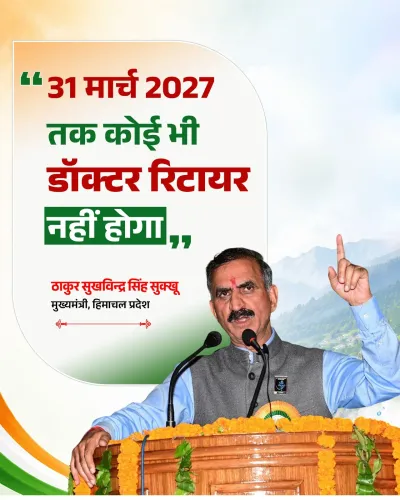
CM Sukhu targets 70% health staffing in HP by March 2027

Synopsis
CM Sukhvinder Singh Sukhu has set a deadline of 31 March 2027 to double Himachal Pradesh's public health staffing from 35% to 70%, using fast-tracked State Selection Commission recruitments and North India's first Allied Health Services College in Hamirpur.
Key Takeaways
Staffing target: Himachal Pradesh aims to raise health sector employee availability from 35% to 70% by 31 March 2027 .
Recruitment drive: The Himachal Pradesh State Selection Commission is conducting accelerated recruitment to fill vacant health department posts.
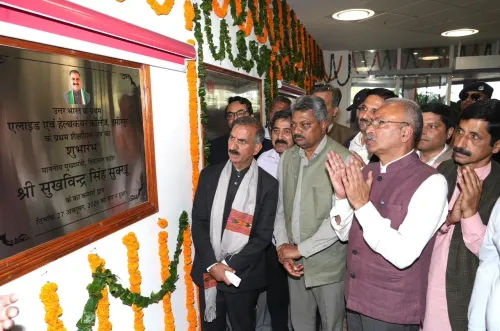
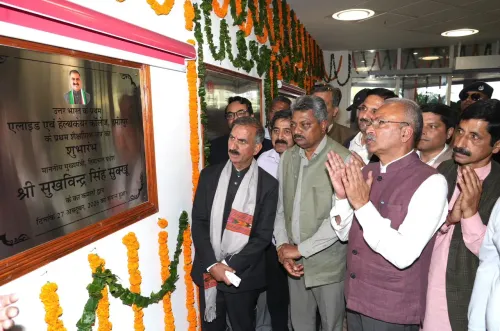
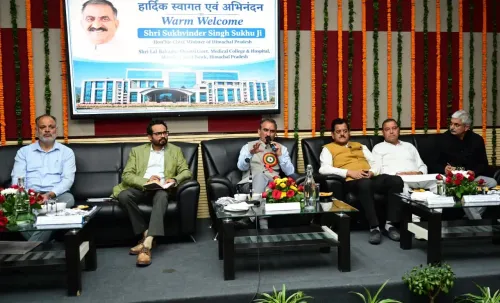
New institution: North India's first Allied Health Services College has been inaugurated in Hamirpur district.
Local pipeline: The college is designed to provide education, training, and employment to Himachal Pradesh's youth within the state itself.
New courses: Additional health sector courses are being launched alongside the college to expand training capacity.
A state where mountain geography has long made healthcare delivery an uphill battle is now racing against a hard deadline. Himachal Pradesh Chief Minister Sukhvinder Singh Sukhu announced on Friday, 30 October 2026 that the state aims to double its public health sector staffing — from 35% to 70% — by 31 March 2027, anchoring the push with rapid recruitments and a landmark new institution in Hamirpur.
The 35-to-70 mission: what the numbers mean
In a post on X, CM Sukhu laid out the target plainly: 'हमारा लक्ष्य 31 मार्च 2027 तक स्वास्थ्य सेवाओं में कर्मचारियों की उपलब्धता 35% से बढ़ाकर 70% करना है' ('Our goal is to increase the availability of employees in health services from 35% to 70% by 31 March 2027'). That is not a marginal nudge — it is a demand to fill roughly half the state's health workforce gap in roughly 17 months.
The Himachal Pradesh State Selection Commission is the engine behind this sprint, with vacancies being filled through fast-tracked recruitment drives across the state's health department. For a hilly state where remote postings have historically made it hard to attract and retain medical personnel, filling posts on paper is only the first obstacle — keeping staff in place is the harder challenge that follows.
Hamirpur gets North India's first Allied Health Services College
The most concrete announcement in the post is the inauguration of an Allied Health Services College in Hamirpur — described as the first of its kind in North India. The institution is designed to train Himachal Pradesh's youth in allied health disciplines locally, so they are neither forced to leave the state for education nor, crucially, likely to settle elsewhere after graduating.
The logic is deliberate. States that import trained health workers from outside often lose them to better-paying urban postings. By building a pipeline at home — training, certification, and placement all within the state — Hamirpur's new college attempts to solve the retention problem at its root. New courses in the health sector are also being launched alongside the college, the Chief Minister noted.
A wider pattern in Indian health governance
Himachal Pradesh's push fits a broader trend across Indian states that have struggled to meet National Health Mission norms on health worker density — a framework that has guided state-level healthcare staffing since 2005. Hilly and tribal states face a compounded challenge: geographic isolation depresses postings, depressed postings worsen outcomes, and worsened outcomes drive more residents to seek care in cities, hollowing out local infrastructure further.
Breaking that cycle requires exactly the kind of simultaneous investment — recruitment velocity plus local training capacity — that CM Sukhu's announcement describes. Whether the State Selection Commission can sustain the pace, and whether the Hamirpur college becomes fully operational quickly enough to matter, are the two questions that will define whether the March 2027 target holds.
Himachal Pradesh's healthcare workforce is about to face its most ambitious stress-test in recent memory. The deadline is set. The institutions are named. Now comes the hardest part — delivery.
Point of View
Which deepens shortages, which drives patients away. Setting a numeric, time-bound target (35% to 70% by March 2027) and pairing it with a dedicated institution in Hamirpur signals a shift from intent to accountability. The real political test arrives if recruitment pipelines stall or the new college's intake proves too slow to move the needle before the deadline. For a Congress government seeking visible governance wins in a competitive state, the health workforce numbers will be watched closely.
NationPress
30 Oct 2026
Frequently Asked Questions
What is Himachal Pradesh's health staffing target for 2027?
Chief Minister Sukhu has announced a target to increase health sector employee availability from 35% to 70% by 31 March 2027, through fast-tracked recruitments and new training institutions.
Where is the new Allied Health Services College in Himachal Pradesh?
The Allied Health Services College has been inaugurated in Hamirpur district of Himachal Pradesh and is described as the first such institution in North India.
Which body is conducting health recruitment in Himachal Pradesh?
The Himachal Pradesh State Selection Commission is tasked with filling vacant positions in the state's health department as part of the staffing push announced by CM Sukhu.
Why does Himachal Pradesh face a healthcare staffing shortage?
Geographic challenges in the hilly state make remote postings unattractive, historically leading to a large proportion of health sector vacancies remaining unfilled.
What new courses are being launched in Himachal Pradesh's health sector?
CM Sukhu stated that new courses are being started in the health sector alongside the launch of the Allied Health Services College in Hamirpur, though specific course names were not detailed in the announcement.