MP CM Yadav: Farmers Get ₹12,000/Year via Kisan Samman
Synopsis
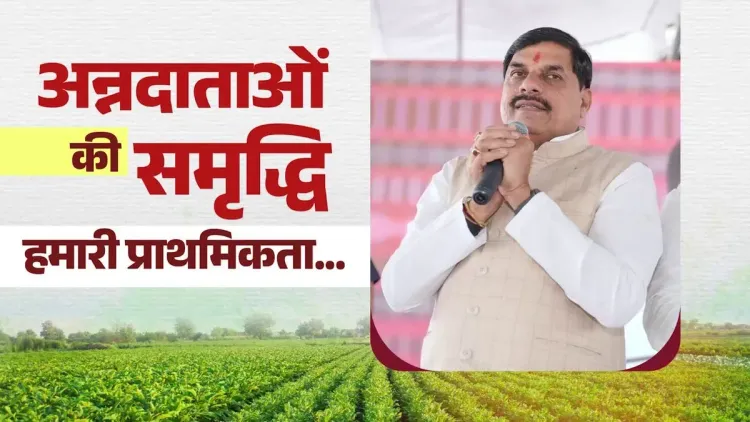
Chief Minister Dr. Mohan Yadav confirmed on 30 October 2026 that Madhya Pradesh farmers receive a combined ₹12,000 annually under the Kisan Samman Nidhi — matching the Centre's ₹6,000 PM-KISAN outlay with an equal state contribution — calling farm welfare the government's top priority.
Key Takeaways
The Chief Minister's Office of Madhya Pradesh confirmed on 30 October 2026 that farmer welfare is the government's 'highest priority'.
Farmers in Madhya Pradesh receive a combined ₹12,000 per year under the Kisan Samman Nidhi .
The central government contributes ₹6,000 annually under the PM-KISAN scheme, launched in 2019 .
The state government adds a matching ₹6,000 annual top-up , doubling the direct income support.
Payments are direct benefit transfers, reaching farmers without intermediaries.
Mohan Yadav , in office since December 2023 , has made agricultural support central to his administration's messaging.
Twelve thousand rupees a year, delivered directly into a farmer's account — no middleman, no queue. Chief Minister Dr. Mohan Yadav reaffirmed on Friday, 30 October 2026, that the Madhya Pradesh government's top priority remains the financial empowerment of its farming community, citing the combined Kisan Samman Nidhi payout as proof of that commitment.
Speaking through the Chief Minister's Office of Madhya Pradesh on X, Dr. Yadav stated: 'किसानों का सम्मान और उनका आर्थिक सशक्तिकरण हमारी सरकार की सर्वोच्च प्राथमिकता है' — 'Respecting farmers and their economic empowerment is the highest priority of our government.' The mechanism is straightforward: the central government contributes ₹6,000 annually under the PM-KISAN scheme, and the state government matches it with an additional ₹6,000, putting a combined ₹12,000 per year into eligible farmer accounts.
PM-KISAN and the state top-up: how the ₹12,000 stacks up
The PM-KISAN scheme, launched by the Central Government in 2019, delivers ₹6,000 in three equal instalments of ₹2,000 directly to landholding farmer families across India. What Madhya Pradesh has done is layer its own matching transfer on top — effectively doubling the direct income support a farmer in the state receives compared to a counterpart in a state with no top-up. The combined ₹12,000 arrives as direct benefit transfers, bypassing intermediaries entirely.
Madhya Pradesh is a state where agriculture is not just an economic activity but a political bedrock. Dr. Mohan Yadav, who took charge as Chief Minister in December 2023, has positioned farm welfare at the centre of the government's public messaging. The state's decision to match the central outlay rupee-for-rupee signals a deliberate political and fiscal commitment — one that several other Indian states have also pursued in various forms to address agrarian distress and bolster rural incomes.
What ₹1,000 a month means for a small farmer
Put simply, the combined payout works out to roughly ₹1,000 per month. For a marginal or small farmer managing a few acres, that is a predictable cash cushion that can cover seeds, a portion of fertiliser costs, or simply a month's household expenses during a lean season. Direct cash transfers — as opposed to subsidised inputs — give farmers the flexibility to deploy the money where it is most needed on their specific holding. That flexibility is the core design logic of the PM-KISAN architecture, and the state top-up amplifies it.
The scheme's funding trajectory and beneficiary coverage will be the numbers to watch in the state's upcoming budget cycle. Widening disbursement efficiency and ensuring no eligible farmer is excluded remain the practical challenges behind the political headline.
Point of View
Publicly reiterating the ₹12,000 figure reinforces the BJP's rural support architecture ahead of any electoral cycle. The broader pattern — states across India layering top-ups on PM-KISAN — suggests that the central scheme has become a floor, not a ceiling, for farm income support politics. The real test, however, is always disbursement efficiency and beneficiary coverage, not just the headline number.
NationPress
30 Oct 2026
Frequently Asked Questions
How much money do farmers in Madhya Pradesh get under Kisan Samman Nidhi?
Farmers in Madhya Pradesh receive a total of ₹12,000 per year — ₹6,000 from the Central Government under PM-KISAN and ₹6,000 as a state government top-up.
What is PM-KISAN and when did it start?
PM-KISAN is a central government direct income support scheme launched in 2019 that provides ₹6,000 annually in three instalments to eligible landholding farmer families across India.
Does Madhya Pradesh give extra money to farmers beyond PM-KISAN?
Yes. Madhya Pradesh adds its own ₹6,000 annual contribution on top of the central PM-KISAN amount, bringing the total annual support to ₹12,000 per farmer.
Who is the Chief Minister of Madhya Pradesh?
Dr. Mohan Yadav is the Chief Minister of Madhya Pradesh, having assumed office in December 2023 .
How is the Kisan Samman Nidhi amount paid to farmers?
The amount is paid as a direct benefit transfer directly into farmers' bank accounts, bypassing intermediaries.