CM Sukhu Unveils Rs 10 Lakh Health Cover for 10 Lakh HP Families
Synopsis
Himachal Pradesh CM Sukhvinder Singh Sukhu has announced a scheme to provide up to Rs 10 lakh in health insurance coverage at low premiums to 10 lakh families, benchmarking care quality to AIIMS standards — doubling the central PM-JAY ceiling in a significant state-level welfare push.
Key Takeaways
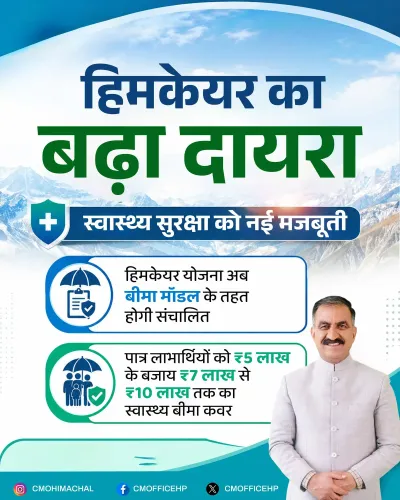
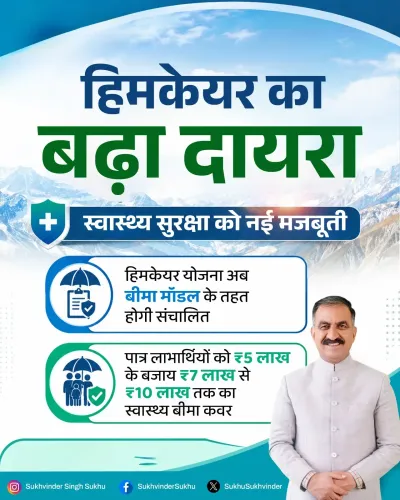
10 lakh families in Himachal Pradesh are to receive health insurance coverage of up to Rs 10 lakh per family under the proposed scheme.
The scheme targets low premiums to ensure affordability for economically vulnerable households.
CM Sukhu has set AIIMS-standard care quality as the benchmark for all beneficiaries under the plan.
The proposed coverage ceiling is double that of the central Ayushman Bharat PM-JAY scheme, which covers up to Rs 5 lakh per family.
The initiative follows a broader pattern of Indian states supplementing PM-JAY with higher-ceiling state programmes to reduce out-of-pocket medical expenditure.
Key implementation details — hospital empanelment, premium subsidy structure, and budget allocation — are awaited in the next legislative session.
When illness strikes, the bill should not break the family. That is the governing conviction behind a major health insurance initiative announced by Himachal Pradesh Chief Minister Sukhvinder Singh Sukhu on Tuesday, 11 August 2026 — a scheme that would extend coverage of up to Rs 10 lakh per family at low premiums to 10 lakh families across the state.
Posting in Hindi on X, CM Sukhu framed the initiative as a direct promise: 'हर परिवार को बेहतर इलाज मिले और बीमारी के समय पैसों की चिंता न हो' ('Every family should get better treatment and not worry about money during illness'). He added that the government's goal is to ensure every person receives timely, quality care benchmarked to AIIMS standards — so that no family is pushed into financial distress by a medical emergency.
Double the ceiling: how this stacks up against PM-JAY
The benchmark for comparison is the central government's Ayushman Bharat Pradhan Mantri Jan Arogya Yojana (PM-JAY), launched in 2018, which provides up to Rs 5 lakh in annual health coverage to economically vulnerable households. The proposed Himachal scheme would set the ceiling at Rs 10 lakh — twice that figure — while targeting low premiums to keep the plan accessible.
Several Indian states have already moved to supplement PM-JAY with higher-ceiling state programmes, citing gaps in hospital empanelment and persistently high out-of-pocket expenditure. Himachal Pradesh's initiative follows that pattern but, if notified as described, would position the state among the more ambitious state-level expansions of health protection in the country.
AIIMS as the quality yardstick
CM Sukhu explicitly invoked the All India Institute of Medical Sciences network as the standard of care every beneficiary should expect. The AIIMS benchmark is significant: it signals an intent to move beyond mere financial coverage toward guaranteed quality, a distinction that has often been the weak link in insurance-linked health schemes where empanelled hospitals vary widely in care standards.
For Himachal Pradesh — a hill state of roughly 7 million people where the Congress government under Sukhu has prioritised welfare delivery since taking office in December 2022 — the scheme represents one of its most consequential social-sector commitments. The details that will determine its real impact — which hospitals are empanelled, what the premium subsidy mechanism looks like, and how the state budget accommodates the outlay — are expected to emerge in the next legislative session.
A state that refuses to let a hospital bill define a family's fate is making a statement about what governance is for. Himachal Pradesh has now put that statement in writing — the delivery is what the next session must prove.
Point of View
Which has staked its identity on welfare delivery since December 2022. By doubling the PM-JAY ceiling and invoking AIIMS-level quality standards, the scheme is designed to draw a sharp contrast with the central government's existing architecture — a familiar Congress playbook of state-level supplementation as implicit critique. The AIIMS quality benchmark is notably ambitious and will be the hardest element to operationalise, given the uneven quality of empanelled hospitals that has plagued similar schemes elsewhere. Whether the scheme becomes a genuine health-protection milestone or a well-intentioned announcement awaiting implementation will depend entirely on the budget allocation and hospital network decisions that follow.
NationPress
11 Aug 2026
Frequently Asked Questions
What is the Himachal Pradesh health insurance scheme announced by CM Sukhu?
CM Sukhvinder Singh Sukhu has announced a scheme to provide health insurance coverage of up to Rs 10 lakh to 10 lakh families in Himachal Pradesh at low premiums, with care quality benchmarked to AIIMS standards.
How is Himachal Pradesh's new health scheme different from Ayushman Bharat PM-JAY?
The proposed Himachal Pradesh scheme offers up to Rs 10 lakh in coverage per family — double the Rs 5 lakh ceiling under the central Ayushman Bharat PM-JAY scheme launched in 2018. It also explicitly targets low premiums and AIIMS-standard care quality.
How many families will benefit from the Himachal Pradesh health insurance scheme?
The scheme is intended to cover 10 lakh (one million) families across Himachal Pradesh.
When will the Himachal Pradesh health insurance scheme be implemented?
The scheme has been announced by CM Sukhu but key implementation details — including hospital empanelment, premium subsidy mechanisms, and budget allocation — are expected to be finalised in the next legislative session.
Why is AIIMS mentioned in the Himachal Pradesh health insurance announcement?
CM Sukhu cited AIIMS as the quality standard that every beneficiary should receive, signalling an intent to ensure not just financial coverage but also high-quality, timely medical care under the proposed scheme.