CM Sukhu Launches Indira Gandhi Sukh-Suraksha Yojana for Girls
Synopsis
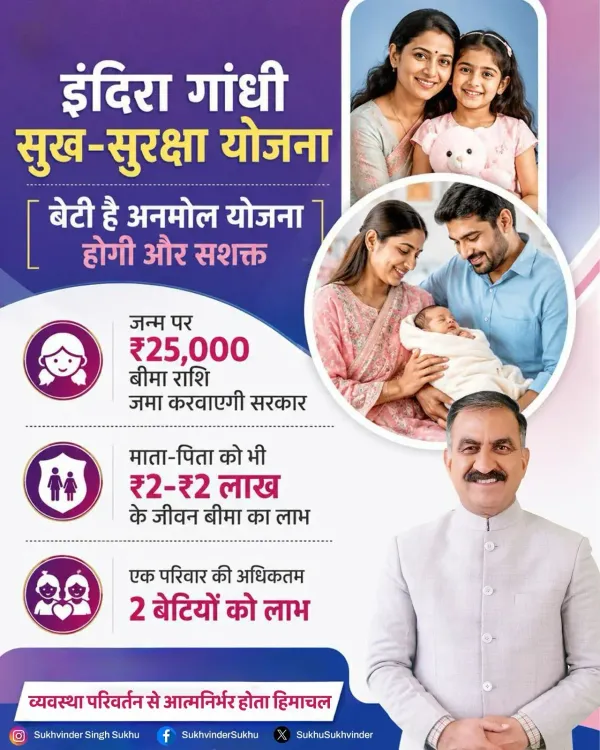
Himachal Pradesh Chief Minister Sukhvinder Singh Sukhu has announced the Indira Gandhi Sukh-Suraksha Yojana, which deposits Rs 25,000 with an insurer at a girl's birth and provides Rs 2 lakh life cover to each parent, benefiting up to two daughters per family. The scheme extends the existing Beti Hai Anmol framework.
Key Takeaways
Rs 25,000 will be deposited with an insurance company at the birth of a girl child under the new Indira Gandhi Sukh-Suraksha Yojana .
Each parent of the girl child will receive a Rs 2 lakh life insurance cover under the scheme.
The benefit is limited to a maximum of two daughters per family.
The scheme is designed to strengthen the existing Beti Hai Anmol programme, launched in 2010 .
Operational details including the insurance partner and registration process are yet to be officially notified.
The announcement was made by Chief Minister Sukhvinder Singh Sukhu on 30 May 2026 .
Himachal Pradesh Chief Minister Sukhvinder Singh Sukhu on Saturday, 30 May 2026 announced the Indira Gandhi Sukh-Suraksha Yojana, a new state scheme that will deposit Rs 25,000 with an insurance company at the birth of a girl child and provide parents with a life insurance cover of Rs 2 lakh each, with benefits capped at a maximum of two daughters per family.
Context
Posting in Hindi on X (formerly Twitter), CM Sukhu framed the announcement in terms of social necessity, writing: 'बेटियों के जन्म को प्रोत्साहित करना और उनके भविष्य को आर्थिक सुरक्षा देना आज की आवश्यकता है' ['Encouraging the birth of daughters and giving their future financial security is today's need']. He described the new scheme as a direct strengthening of the existing Beti Hai Anmol programme, saying it will make that initiative 'more effective and empowered.'
Under the scheme, the Rs 25,000 deposit at birth is designed to grow into a larger corpus by the time the girl reaches adulthood, while the Rs 2 lakh life insurance cover for each parent provides a safety net for the family unit. Operational details, including the insurance partner and beneficiary registration process, are yet to be notified officially.
Policy Backdrop
Himachal Pradesh launched the Beti Hai Anmol scheme in 2010 to offer financial incentives and scholarships for girl children from below-poverty-line families. The new Indira Gandhi Sukh-Suraksha Yojana builds on that foundation by adding an insurance-linked endowment component and extending parental life cover, reflecting a broader shift in state policy from scholarship-only models to combined insurance-and-savings frameworks.
At the national level, the Beti Bachao Beti Padhao programme, initiated in 2015, pushed states including Himachal Pradesh to intensify efforts on child sex ratios. Multiple Indian states have since introduced conditional cash transfer and insurance-linked schemes to incentivise the birth and survival of girls. Such measures operate alongside enforcement of the PCPNDT Act and periodic monitoring by the Registrar General of India.
Stakeholders and Impact
The primary beneficiaries are girl children born in Himachal Pradesh and their families, with the two-daughter cap ensuring the scheme targets households where girls may otherwise face financial discrimination. The parental life insurance component is particularly significant for BPL and lower-income families, where the death of a breadwinner can push a girl child out of education.
By routing the benefit through an insurance company rather than a direct bank transfer, the government signals an intent to create a long-term savings instrument rather than a one-time cash handout, though the specific product structure and maturity terms remain to be disclosed in official guidelines.
What's Next
The state government is expected to release operational guidelines covering the insurance tie-up, beneficiary registration process, and eligibility criteria. Observers will watch the Himachal Pradesh state budget for a dedicated allocation to the scheme, which will determine the scale of rollout. The announcement also sets a political benchmark ahead of local body elections, with the Congress government keen to highlight its welfare credentials for women and girls.
Point of View
Moving from scholarship-linked transfers to an insurance-and-endowment model that addresses both birth incentivisation and family financial resilience in a single instrument. By naming the scheme after Indira Gandhi and explicitly linking it to the older Beti Hai Anmol brand, the Congress government is constructing a layered political and policy narrative ahead of electoral cycles. The parental life cover component is a notable addition that differentiates this scheme from comparable state programmes, though its real impact will depend on the insurance product's maturity terms and the government's ability to ensure last-mile registration in rural and tribal pockets. The announcement fits a broader national pattern of states competing on welfare optics for women, making budget allocation and implementation fidelity the true test of the scheme's ambition.
NationPress
25 Sept 2026
Frequently Asked Questions
What is the Indira Gandhi Sukh-Suraksha Yojana?
The Indira Gandhi Sukh-Suraksha Yojana is a Himachal Pradesh government scheme announced by Chief Minister Sukhvinder Singh Sukhu that deposits Rs 25,000 with an insurance company at the birth of a girl child and provides Rs 2 lakh life insurance cover to each parent, with benefits available for up to two daughters per family.
Who is eligible for the Indira Gandhi Sukh-Suraksha Yojana?
Families with girl children born in Himachal Pradesh are eligible, with the scheme covering a maximum of two daughters per family. Detailed eligibility criteria and registration guidelines are yet to be officially notified by the state government.
What is the Beti Hai Anmol scheme in Himachal Pradesh?
Beti Hai Anmol is a Himachal Pradesh scheme launched in 2010 that offers financial incentives and scholarships for girl children, primarily from below-poverty-line families. The new Indira Gandhi Sukh-Suraksha Yojana is intended to make this programme more effective by adding an insurance-linked endowment component.
How much money does the HP government give at the birth of a girl child?
Under the newly announced Indira Gandhi Sukh-Suraksha Yojana, the Himachal Pradesh government will deposit Rs 25,000 with an insurance company at the birth of a girl child, in addition to providing Rs 2 lakh life insurance cover to each of her parents.
What is CM Sukhu doing for girl child welfare in Himachal Pradesh?
Chief Minister Sukhvinder Singh Sukhu has announced the Indira Gandhi Sukh-Suraksha Yojana, combining a Rs 25,000 insurance deposit at birth with parental life cover of Rs 2 lakh each, building on the existing Beti Hai Anmol scheme to strengthen financial security for girl children and their families in Himachal Pradesh.