CM Sai backs Chhattisgarh Startup Policy 2025-30 for youth
Synopsis
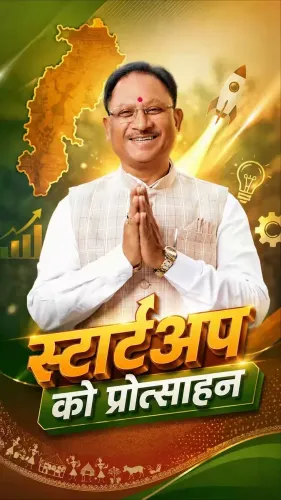
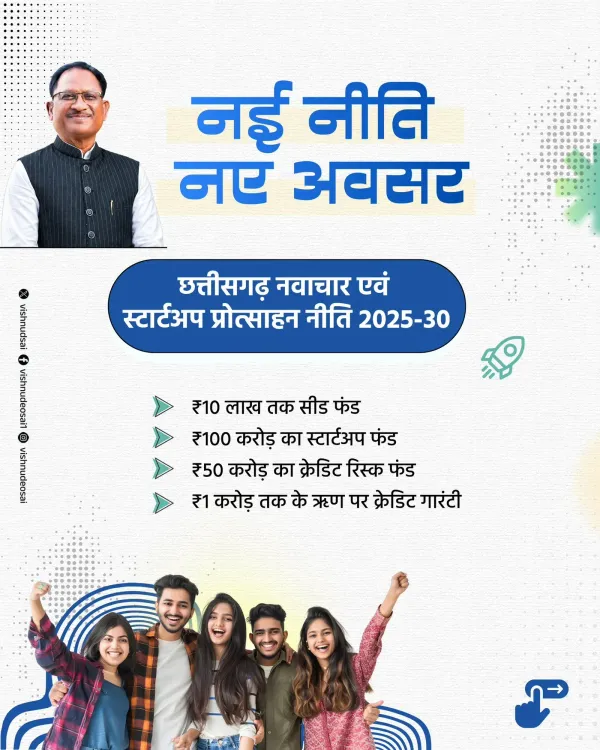
Chhattisgarh CM Vishnu Deo Sai on 9 November 2026 spotlighted the state's 'Innovation and Startup Promotion Policy 2025-30', pledging incentives and an enabling ecosystem to turn youth ideas into enterprises and generate new employment across the state.
Key Takeaways
Chhattisgarh Chief Minister Vishnu Deo Sai promoted the state's new startup and innovation policy on 9 November 2026 .
The Chhattisgarh Innovation and Startup Promotion Policy 2025-30 spans five years and targets youth-led entrepreneurship and job creation.
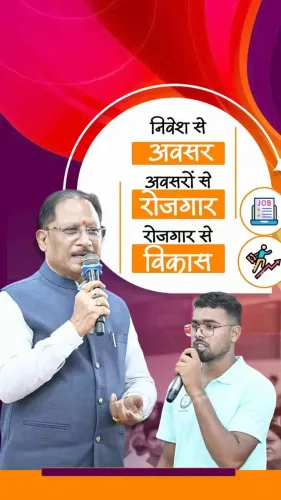
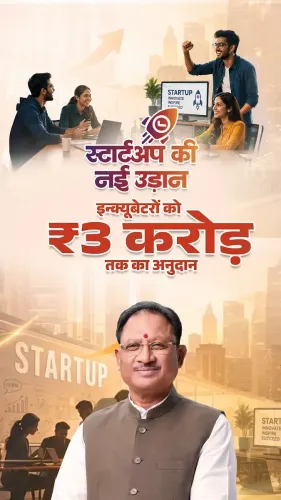
The policy aims to provide incentives and an enabling ecosystem to convert new ideas into startups and startups into employment generators.
It aligns with India's national Startup India initiative launched in 2016 and the Atmanirbhar Bharat framework.
CM Sai framed the policy as central to building a self-reliant and developed Chhattisgarh by anchoring youth talent within the state.
A new policy framework is rewriting the rules for young entrepreneurs in Chhattisgarh — and Chhattisgarh Chief Minister Vishnu Deo Sai wants every aspiring founder in the state to know the runway is open. On Monday, 9 November 2026, CM Sai took to X to champion the state government's 'Chhattisgarh Innovation and Startup Promotion Policy 2025-30', calling it the vehicle that will convert youth ideas into enterprises and enterprises into jobs.
Posting in Hindi, CM Sai wrote: 'युवाओं के हुनर, नवाचार और उद्यमशीलता को मिल रहा नया आसमान' — 'Youth talent, innovation and entrepreneurship are getting a new sky.' He framed the policy as a commitment by his BJP-led 'Sushasan Sarkar' (good-governance government) to build a Aatmanirbhar evam Viksit Chhattisgarh — a self-reliant and developed Chhattisgarh — by turning young people's dreams into opportunities.
What the 2025-30 Policy Sets Out to Do
The Chhattisgarh Innovation and Startup Promotion Policy 2025-30 is designed to provide incentives and an enabling ecosystem for youth to launch startups, scale new ideas, and generate fresh employment in the state. The policy sits squarely within the state government's broader development agenda, targeting young founders as the engine of economic transformation in one of central India's fastest-evolving states.
Chhattisgarh's move mirrors a pattern seen across Indian states in recent years: frame or revamp startup policies to align with the national Startup India initiative — launched in 2016 — and the Atmanirbhar Bharat framework. States have increasingly offered fiscal incentives, incubation support and regulatory facilitation to bring grassroots ideas to market. Chhattisgarh's five-year window through 2030 signals a sustained, structured push rather than a one-off gesture.
Youth Entrepreneurship as a State Priority
The emphasis on youth is deliberate and pointed. Chhattisgarh, with significant tribal and rural populations, has historically seen its educated youth migrate to larger metros for opportunity. A homegrown startup ecosystem, backed by state incentives, is a direct attempt to reverse that drift and anchor talent within the state.
CM Sai's post underlined that the policy is not just about new businesses — it is about new employment avenues. For a state government measured heavily on jobs and development metrics, positioning startups as job-creators rather than just innovation showcases is a sharp political and economic calculation. The specific incentive structures, budget allocations and incubation centre rollouts under the policy are yet to be fully detailed in publicly available implementation reports.
Chhattisgarh's Place in India's Startup Map
India's startup ecosystem has grown into one of the world's largest, but the gains have been concentrated in a handful of metros. State-level policies like this one are increasingly seen as the corrective — pushing the frontier into Tier-2 and Tier-3 cities and states that have talent but lack structured support. If Chhattisgarh's 2025-30 framework delivers on its incentive and incubation promises, it could position the state as a meaningful contributor to India's next wave of entrepreneurship.
The proof, as always, will be in the numbers: startups registered, funds disbursed, and jobs created by the time the policy reaches its 2030 horizon.
Point of View
Chhattisgarh's push to build a homegrown startup ecosystem addresses a structural challenge: retaining educated youth who would otherwise migrate to metros. How rigorously the incentive and incubation architecture is implemented will determine whether this becomes a genuine economic inflection point or remains an aspirational framework.
NationPress
9 Nov 2026
Frequently Asked Questions
What is the Chhattisgarh Innovation and Startup Promotion Policy 2025-30?
It is a five-year state government policy designed to provide incentives, incubation support and an enabling ecosystem to help young people launch startups, scale new ideas and create employment in Chhattisgarh.
Who announced the Chhattisgarh Startup Policy 2025-30?
Chhattisgarh Chief Minister Vishnu Deo Sai promoted the policy on 9 November 2026 , posting about it on X and describing it as a tool to build a self-reliant and developed Chhattisgarh.
How does the Chhattisgarh startup policy relate to Startup India?
The state policy complements the national Startup India initiative launched in 2016 , extending its framework to Chhattisgarh with state-specific incentives and an emphasis on youth-led ventures and local employment generation.
What is the goal of Chhattisgarh's startup policy for youth?
The policy aims to convert young people's ideas into enterprises, help them launch startups, and generate new employment opportunities, with the broader objective of making Chhattisgarh self-reliant and economically developed by 2030 .
Which states in India have similar startup policies?
Multiple Indian states have framed or revised startup and innovation policies in recent years to complement the national Atmanirbhar Bharat and job-creation agenda, offering fiscal incentives, incubation support and regulatory facilitation. Chhattisgarh's 2025-30 policy follows this broad state-level trend.