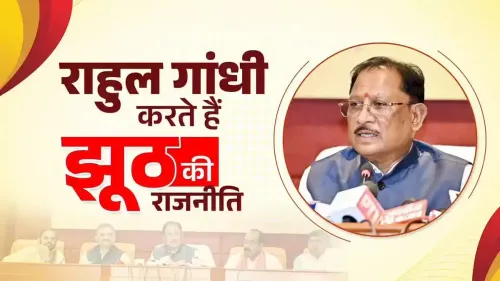
CM Vishnu Deo Sai: Congress betrayed India, voters rejected it
Synopsis
Chhattisgarh CM Vishnu Deo Sai accused the Indian National Congress of decades of deceit, saying the gap between its words and deeds has led Indian voters to reject the party — sharpening the BJP's core anti-Congress electoral narrative.
Key Takeaways
Vishnu Deo Sai , Chief Minister of Chhattisgarh and BJP leader, posted a pointed attack on Congress on 4 November 2026 .
He accused Congress of always deceiving the Indian public during its long years in power, citing a 'sky-and-earth difference' between its words and actions.
Sai declared that Indian voters have today rejected the Congress party.
The BJP has deployed similar anti-Congress messaging consistently since the 2014 Lok Sabha elections , when NDA ended UPA's decade in government.
Sai became Chhattisgarh Chief Minister after the BJP's victory in the 2023 state assembly elections , defeating the Congress government.
Decades of power, and what did the country get in return? Chhattisgarh Chief Minister Vishnu Deo Sai fired a sharp broadside at the Indian National Congress on Wednesday, 4 November 2026, accusing the party of systematically deceiving the Indian public across its long years in government — and arguing that voters have now delivered their unmistakable verdict.
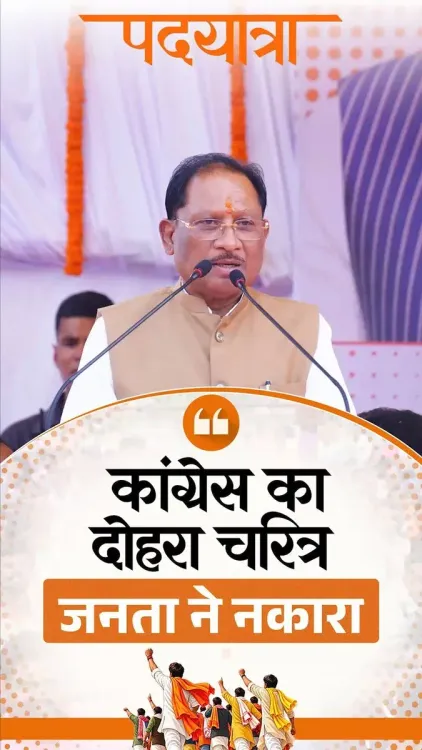
Posting on X, CM Sai wrote: 'लंबे समय तक देश पर राज करने वाली कांग्रेस पार्टी ने हमेशा देश की जनता के साथ छल किया है।' ('The Congress party, which ruled the country for a long time, has always deceived the people of this nation.') He went further, saying there has always been a 'sky-and-earth difference' — jamin-aasman ka antar — between what Congress promises and what it delivers. His conclusion was blunt: 'That is why today the people of India have rejected the Congress party.'
A rhetorical tradition the BJP has sharpened since 2014
The attack follows a well-worn but potent BJP playbook. Since the 2014 Lok Sabha elections — when the BJP-led NDA ended the Congress-led UPA's decade-long hold on New Delhi — BJP leaders have consistently framed Congress's history as a story of broken promises, dynastic entrenchment, and governance failure. The messaging works precisely because it inverts Congress's founding claim: that the party built modern India.
Sai himself is a product of that 2014-onwards political realignment. He took charge as Chief Minister of Chhattisgarh after the BJP swept back to power in the state's 2023 assembly elections, ending the Congress government led by Bhupesh Baghel. His elevation to the top post — the first tribal chief minister from the state — was itself framed by the party as a contrast to what it called Congress's neglect of marginalised communities.
Why 'betrayal' remains BJP's sharpest edge against Congress
The word 'chal' — deceit or betrayal — is deliberate and loaded. It signals not mere policy disagreement but moral failure, a framing that has proved durable across BJP campaigns in state after state. The argument is structural: a party that ruled for so long and still left poverty, illiteracy, and corruption behind it has no standing to promise better.
Congress, for its part, has consistently pushed back by pointing to welfare schemes and institution-building from the Nehruvian era through the UPA years. But the counter-narrative has struggled to cut through in an electoral environment where voters increasingly weigh promises against immediate, visible delivery — a standard the BJP has worked hard to own.
With state election cycles continuing across the country, expect this language of betrayal versus delivery to intensify at every hustings. CM Sai's post is less a news event than a temperature reading — and the needle is running hot.
Point of View
Not transformative. This framing has proved electorally durable since 2014 because it converts abstract governance debates into a moral story about trust and betrayal. The language of 'chal' (deceit) is calibrated to resonate with voters who experienced the gap between UPA-era welfare promises and on-the-ground delivery. As election cycles pile up, the BJP's challenge is to keep the narrative fresh while simultaneously defending its own expanding record in office.
NationPress
4 Nov 2026
Frequently Asked Questions
What did Chhattisgarh CM Vishnu Deo Sai say about Congress?
CM Vishnu Deo Sai said Congress deceived the Indian public throughout its long years in government, that there has always been a vast gap between its promises and its actions, and that Indian voters have therefore rejected the party.
Why does BJP frequently attack Congress over its record in power?
Since the 2014 Lok Sabha elections, BJP leaders have consistently used Congress's long tenure in government as a contrast point, arguing that decades of rule produced broken promises and dynastic politics rather than genuine development.
When did Vishnu Deo Sai become Chief Minister of Chhattisgarh?
Vishnu Deo Sai became Chief Minister of Chhattisgarh after the BJP won the state assembly elections in 2023, defeating the incumbent Congress government led by Bhupesh Baghel.
How long did Congress rule India at the national level?
The Indian National Congress governed India for multiple decades after independence before the BJP-led NDA ended the Congress-led UPA's national government in the 2014 Lok Sabha elections.
What is the BJP's main line of attack against Congress in elections?
The BJP's core line is that Congress made repeated promises to voters that it never fulfilled, contrasting what it calls Congress's 'katha-karan' (saying) versus 'karna' (doing), framing the party as fundamentally untrustworthy.